KING
CAKES AND KING
CAKE PARTIES:
AN OVERVIEW
 King
Cake Parties are a New Orleans and south Louisiana tradition that was heavily borrowed from
pre-medieval European customs. Specifically, in the pre-Christian religions of
what is now present-day France and Western Europe, it was customary to choose a man to be the "sacred king" of the
tribe for a year. That man would be treated like a king for the year, then he
would be sacrificed, and his blood returned to the soil to ensure that the
upcoming harvest would be an abundant one. The method of choosing who would have the honor of
being the sacred king was the King's Cake. A coin or bean would be placed in the
cake before baking, and whoever got the slice that had the coin or bean was the chosen
one. When Christianity extended its influence into France and Western
Europe, it began overshadowing the
religions that came before it. Many of the local customs were not
abolished outright, but instead were incorporated into a Christian tradition and given a
new spin. Catholic priests were not predisposed to human sacrifice, so the King's
Cake was converted into a celebration of the Magi, the three Kings who came to
visit the Christ Child.
King
Cake Parties are a New Orleans and south Louisiana tradition that was heavily borrowed from
pre-medieval European customs. Specifically, in the pre-Christian religions of
what is now present-day France and Western Europe, it was customary to choose a man to be the "sacred king" of the
tribe for a year. That man would be treated like a king for the year, then he
would be sacrificed, and his blood returned to the soil to ensure that the
upcoming harvest would be an abundant one. The method of choosing who would have the honor of
being the sacred king was the King's Cake. A coin or bean would be placed in the
cake before baking, and whoever got the slice that had the coin or bean was the chosen
one. When Christianity extended its influence into France and Western
Europe, it began overshadowing the
religions that came before it. Many of the local customs were not
abolished outright, but instead were incorporated into a Christian tradition and given a
new spin. Catholic priests were not predisposed to human sacrifice, so the King's
Cake was converted into a celebration of the Magi, the three Kings who came to
visit the Christ Child.
King
Cake Parties have been increasing in popularity since the 1960 and up through
today. King
Cake Parties begin on January 6, and are held up until Mardi Gras Day. January
6 is the 12th day of Christmas, which also marks the beginning
of Epiphany. This day is also known as King’s Day. It is supposedly the day
the Biblical Magi, more commonly known as the Three Wise Men, visited the baby
Jesus to offer him their gifts of gold, frankincense, and myrrh. The names
of the Three Wise Men were Balthasar, Gaspar (also known as Caspar), and Melchior.
The word Epiphany means many things to different
people. As a feeling, it is a realization or comprehension of the essence
or meaning of something or someone. Or an inspired understanding arising
from connecting with profound insight, awareness, or enlightened truth. As
a meditation, Epiphany is a practice of evoking and engaging with mindful
contemplation. A breakthrough or transcendent awareness. Or a
profound realization that seems to engage one's whole being in resonant
connection with aspects of truth and insight. As was already stated and
will be explained in greater detail later on, Epiphany, in Louisiana, marks the
beginning of Mardi Gras season, which is also known as King Cake season, and
celebrates the Three Wise Men. In French, the word Mardi means "Tuesday";
Gras means "Fat". Hence, the words "Fat Tuesday" in English.
In a nutshell, Mardi Gras is held the day before the start of the 40-day a
celebration of the Christian liturgical season of Lent, Ash Wednesday.
Mardi Gras is also know as Shrove Tuesday or Pancake Day, because in some parts
of the world, it is customary to each pancakes on that day. That is
because during Lent, since fasting is involved, only the plainest of foodstuffs
may be eaten. Therefore, rich ingredients such as eggs, milk and sugar
have to be disposed of immediately. One efficient way of using up these
goods was to make pancakes and doughnuts. In France, the pancakes are
called crepes.
Some other examples of what Epiphany means in other
places around the world are that:
-
January 6 is the day in most European cultures when
the Christmas greenery is taken down. The other cultures will keep it
up until February 2, the day known as the Meeting of the Lord.
-
In The Netherlands, this day is called Driekoningendag,
which is Dutch for Three Kings Day.
-
In Ireland, this day is called Little Christmas
(Nollaig Bheag in Gaelic), or more specifically,
Women's Christmas (Nollaig na mBan). That is because men take on all the
household chores and give their wives a day of rest. Children
will often buy presents for their mothers and grandmothers, similar to
Mother's Day. Most women will either host parties or celebrate the day
with their friends, sisters, mothers, aunts, daughters, etc. The
clientele in the pubs and restaurants will be completely or almost
completely comprised of women. This celebration is very popular in the
city of Cork.
-
In France, people eat the gateau des Rois in Provence.
Or the galette des Rois in Belgium and France's northern half. These food
items are similar to a King Cake and has a trinket or bean inside. Whoever
gets the trinket or bean is King or Queen for the Year.
-
In
England, the Anglican Church regards Epiphany as a Principal Fast. It
begins with the Evening Prayer on Epiphany Eve and ends with an Evening
Prayer on the Feast of the Presentation, which is usually on February 2.
-
In
Spain, Mexico, Cuba, Puerto Rico, and other Latin American countries,
Epiphany Day is called El Dia de los Reyes (the Day of the Kings) or Dia de
los Tres Reyes Magos (The Day of the Three Royal Magi). Some people in
Chile call this day Pascua de los Negros (Holy Day of the Blackmen).
-
In
the Ethiopian Orthodox Church, Epiphany is celebrated on January 19 (or
January 20 if it is a leap year). It is marked by a feast called
Timkat, which features the Blessings of the Waters and solemn possessions,
with the sacred Tabot.
-
In
the Syriac Christmas, the Epiphany feast is called Denho, meaning up-going.
This name is associated with the notion a rising light in Luke 1:78.
-
Also in Spain, Mexico and Puerto Rico, and in Argentina and Uruguay,
children and many adults anxiously await for toys and other gifts brought to
them by the three Kings. They do this by polishing their shoes and
leaving them ready for the Kings' presents before they go to bed on Epiphany
Eve. The shoes are left by the family Nativity scene, by
everyone's, or underneath the Christmas tree. Sometimes the shoes are
filled with hay for the camels, so that the Kings will be generous with
their gifts. A letter to the Three Kings, which can be toy
requests, may also be left by the shoes. Some households even
leave sweet wine, nibbles, fruit, and milk for the Kings and their camels.
Children in Puerto Rico will even fill a box with grass or hay and place it
underneath their bed, for the same aforementioned reasons. When the
shoes are left underneath the Christmas tree, it is analogous to children
leaving mince pies or cookies and milk out for Father Christmas in Western
Europe.
-
According to Spanish tradition, when the Three Wise Men brought their gifts
to baby Jesus, Melchior arrived on a horse to bring gold and to represent
Europe; Gaspar arrived on a camel to bring frankincense and to represent
Arabia; and Melchior arrived on an elephant to bring myrrh and to represent
Africa.
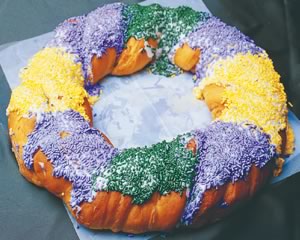
A King Cake, as illustrated in the photo above, is an oval-shaped cinnamon sweetened yeast bread. It is
usually filled with a filling, such as, but not limited to, lemon, apple,
strawberry, pecan, raspberry, blueberry, chocolate, or cream cheese. Since
Epiphany symbolizes many different things as was just explained, the cake is
shaped in the form of an oval to
symbolize the unity of faiths. The cake is decorated in three different
colors –
Purple,
Green,
and
Gold,
which are the colors of Mardi Gras.
Purple represents justice,
Green represents faith,
and Gold represents power.
Purple also represents the passion of
Christ,
Green also represents hope,
and Gold also symbolizes the rewards of leading a Christian life.
However, some bakers will add a little bit of
Red
to the King Cake,
which symbolizes the life of Jesus
Christ.
In New
Orleans, the King Cake tradition came with the first French settlers and has
stayed ever since. Like the rest of Mardi Gras during those early days, the
King
Cake was a part of the family's celebration, and really didn't take on a public
role until after the Civil War. In 1870, a group of men known as the Twelfth Night Revelers held their
ball, with a large King Cake as the main attraction. Instead of choosing a
sacred king to be sacrificed, the Twelfth Night Revelers used the bean in the
cake to choose the queen of the ball. This tradition has carried on to this day,
although the Twelfth Night Revelers now use a wooden replica of a large king
cake. The ladies in attendance take turns pulling open the little drawers in the cake's lower layer,
some of which contain silver and gold beans. A lady who gets a silver bean mean
that she is on the court;
the lucky lady who gets the lone gold
bean is the Queen. With the Twelfth Night Revelers making a big deal over the
King Cake in the society circles, other people in the city started having their
own King Cake
Parties. And these parties would eventually spread to other parts of
Louisiana and beyond. These parties particularly among children, became very popular and have
also continued to today. The focus of today's king cake party for kids has
shifted more to the school classroom than the home, however. Up through the
1950's, neighborhoods, especially those in larger cities, would have parties. One family would start the ball rolling
after Twelfth Night, and they'd continue on weekends through Carnival. Whoever
got the baby (the coin or bean had changed to a ceramic or porcelain baby about
an inch long by then) in the King Cake, was given the honor to host the next party. You can still
hear stories from folks who were kids during the Great Depression of what their
mommas would do to them if they came home with the baby from a King Cake Party,
since so many families were short on money then.
At a King Cake Party, the host will instruct everyone
to gather round the King Cakes, in
groups (one big cake is usually present, but in this example, as will be
explained later, there are three small ones.) Then, the host instructs everyone to take a knife, take turns cutting
a small piece of the cake, and putting it on their paper plate. That's all
the guests do for the moment; they are not to eat it yet. That's because one of the pieces has a surprise in it. When
the host gives the nod, everyone will break open their
piece to see who has the surprise. The host mentions that when the three
people find the surprise, they are to hold it up. What these people
are holding is another symbol of
the King Cake. It is a figurine that represents baby Jesus. This
little "searching" activity for the guests to participate in to find the baby, is based on the notion of the Three Wise Men
following the star of Bethlehem to find baby Jesus.
Now, all three people who found the baby Jesus in their piece of cake
will come up
and stand beside the host. Here is what it means for all three people.
They are the Kings and/or Queens for the day. The host or last year's
Kings/Queens will then crown these three people (a crown from a party goods
store is ideal.) These three people will
also have one year of good luck. They are then blessed by,
the host, a priest or member of the clergy, or even a volunteer. Now, there are two things that this
year's Kings and/or Queens will have
to do. First, they get the honor of hosting next year’s King Cake Party
and supplying the King Cake. The second
thing is they have to do is portray one of the Three Wise Men – again, Balthasar, Gaspar,
and Melchior. One easy, fun, and educational way that this can be done is
to have each of the three people pick any one of the
Three Wise Men, and
read a passage about them and the gifts that they brought - gold, frankincense,
and myrrh. Sample passages that can be used can be
found by clicking on the names of the Three Wise Men listed below:
Balthasar
Gaspar
Melchior
When this little ceremony is done, the King Cake Party gets into
full swing. Besides the King Cake, there is plenty of food and drink to go
around. Simple snacks, munchies, or plates of cheeses and vegetable
platters are just fine. Or if the hosts wants to
get real snazzy, some ideal things to serve are some mouth-watering Louisiana
and Cajun dishes. And everyone also enjoys some swinging and dancing
Louisiana, Cajun, and Mardi Gras music.
Actually, there is considerable debate as to how many wise men
really did
visit baby Jesus. It has been said that there could have been as many as
20. Whether it was 3, 20, or something in between, it is also not known
who brought what in the way of gifts. But is it
commonly believed that there were three wise men, Balthasar, Gaspar, and Melchior,
synonymous with the Father, Son, and the Holy Ghost, and that the gifts that
were brought were gold,
frankincense, and myrrh.
More information can be found by clicking on any of
the following links below:
Trivia
Frequently Asked
Questions (FAQ's)
Source of information: Wikipedia, the free
encyclopedia.
BACK TO MAIN MENU