|
A Master Educator demonstrates the following INTASC
standards:
|
 Principle
#1: Principle
#1:The teacher understands the central concepts, tools of
inquiry, and structures of the discipline(s) he or she teaches
and can create learning experiences that make these aspects of
subject matter meaningful for students.
Artifact:
Lesson
Plan
This lesson was on using formulas, primarily distance = rate x
time. Students worked together to pass a small toy across
the room. From the distance traveled and the amount of
time taken, students were then able to calculate the rate at
which the toy moved. The activity made the subject less
abstract and more meaningful to students. |
|
Principle #2: The teacher understands how children learn and
develop and can provide learning opportunities that support
their intellectual, social and personal development.
Artifact: Educational
Psychology Case Studies
Three different case studies are analyzed from the
behaviorist and cognitive development perspective. These
two psychological philosophies are highly influential in
educational theory and practice. |
 Principle
#3: Principle
#3:The teacher understands how students differ in their
approaches to learning and creates opportunities that are
adapted to diverse learners.
Artifact: Position Paper -
Mathematics Gender Gap
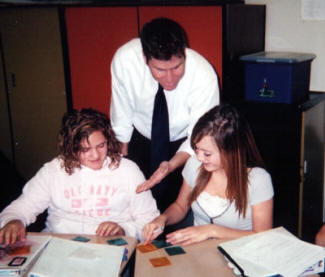
This paper analyzes the gender gap that often exists between
boys and girls in mathematics, exploring its causes and what can
be done to eliminate it. |
 Principle
#4: Principle
#4:The teacher understands and uses a variety of
instructional strategies to encourage students' development of
critical thinking, problem solving, and performance skills.
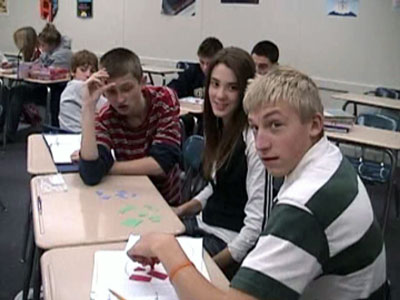
Artifact: Activity - Venn
Diagrams In this activity incorporates group work, use of
manipulatives and inquiry as an introduction to basic set
theory. |
|
Principle #5: The teacher uses an understanding of individual
and group motivation and behavior to create a learning
environment that encourages positive social interaction, active
engagement in learning, and self-motivation.
Artifact:
Supplementary
Overhead Slides These overhead slides were used to guide
class examples of calculating rate. I utilized local
references, visual aids and humor to capture students'
attention. Students were motivated by the local references
and were inspired to develop their own questions about the
lesson. |
 Principle #6: Principle #6:The teacher uses knowledge of effective verbal,
nonverbal, and media communication techniques to foster active
inquiry, collaboration, and supportive interaction in the
classroom.
Artifact:
Lesson Plan,
Supplementary Handouts,
Sample Presentation,
Sample
Spreadsheet
In this lesson, students utilize the Internet, a spreadsheet
and presentation software in an offbeat exercise on proportions,
ratios and extreme eating. |
|
Principle #7: The teacher plans instruction based upon
knowledge of subject matter, students, the community, and
curriculum goals.
Artifact:
Position Paper - Calculators in the Mathematics Classroom
This paper analyzes the debate over the use of calculators in
math classes. The premise is that any policy on the use of
calculators must be based upon the objectives for the lesson and
the goals for the curriculum. |
|
Principle #8: The teacher understands and uses formal and
informal assessment strategies to evaluate and ensure the
continuous intellectual, social and physical development of the
learner.
Artifact:
Reading Tables and Charts Test
This summative assessment utilizes cross-curricular subject
matter and material of direct personal relevance to students and
calls upon higher-order thinking skills in a multiple choice
format. |
|
Principle #9: The teacher is a reflective practitioner who
continually evaluates the effects of his or her choices and
actions on others (students, parents, and other professionals in
the learning community) and who actively seeks out opportunities
to grow professionally.
Artifact: Teaching Video Clip,
Self-Critique
I used this video to evaluate my teaching style and
performance. I was able to heed my own suggestions with
great success in my subsequent student teaching. |
|
Principle #10: The teacher fosters relationships with school
colleagues, parents, and agencies in the larger community to
support students' learning and well being.
Artifact:
Group Presentation - The Equity of Inclusion
As the leader of a group presentation on special education
inclusion, I developed the idea of interviewing local experts,
determined the format the presentation would take, organized my
team's responses, created a PowerPoint and moderated the class
discussion. |