|
Illustrated life of an atlantic puffin |
Puffin Information |
Puffin Homes
|

|
|
Illustrated life of an atlantic puffin |
Puffin Information |
Puffin Homes
|
|
|
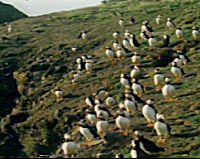 |
In the spring, puffins come ashore in groups of hundreds to court and breed during the summer. They form colonies on islands like the Outer Hebrides in the North of Scotland. This island in the Outer Hebrides is covered in puffins who have just flown in after spending the winter floating on the ocean and diving for fish. Puffins mate for life, splitting up during the winter and meeting each spring, returning to the same burrows.
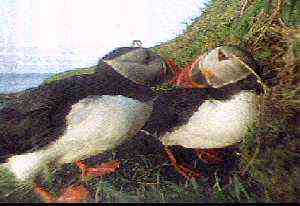
The puffins began courting at sea and now that the snow on the islands has melted, revealing old burrows, they choose their burrows and their mates. Courtship involves much tapping of beaks, as this pair are doing, and culminates with the male violently flapping his wings as he mates with the female. They mate a few times to make sure an egg is fertilised, and it is laid soon afterwards. The puffins have lined the burrow with dry dead grass to make it comfortable.
| 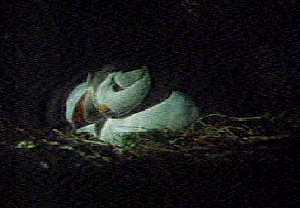
Puffins communicate with moans and growls and these carry through the earth so that puffins can "chat" from burrow to burrow. It is not unusual for burrows to recieve visitors, but these are not always welcome and altercations are not uncommon. Puffins share child raising responsibilities equally between both sexes. They take turns incubating the egg and fishing to feed the new puffling.
| 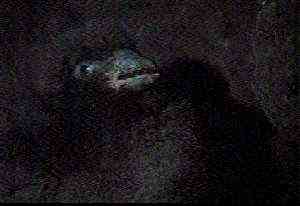
The baby puffin is called a puffling and it is born covered in black down and with a small black beak. It is very demanding and as it grows it needs larger and larger feeds of fish. If there is not a good supply of fish it will die.
| |