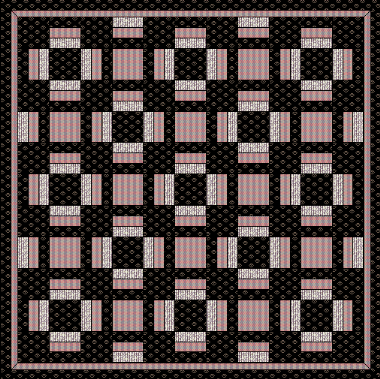
On Flamingo Pond

Fabric  you will need:


82 striped set blocks for this quilt

17 light plain blocks

66 of the dark plain blocks

The width of your borders is extra fabric... 

quilt finishes without borders:
49 1/2 inches  X  67 1/2 inches


You need to piece:

10 1/4 strip sets of your light, medium and dark fabrics.

For the frenzy quilt on left:

Cut your strips 2 inches selvage to selvage.

Sew them together using a very accurate 1/4" seam allowance.

Use the "glob of tape" method or a seam guide to guide the fabric through the sewing machine.  You want all the strips to measure the same width! You can have your "personal seam allowance" on this quilt, but just so all the strip sets are the same width.

Press the seam allowances in one direction for the strip sets.  To the dark will be good.  There is no matching of the strips so it won't matter which way they go but just nice that they all go in one direction.
 

First things first.
Getting an accurate 1/4" seam allowance. 

You must have  an accurate seam allowance! How to test? Cut three strips of fabric 2" wide.  Sew the three strips with what you think is your 1/4" mark on your sewing machine. 

Press the seams of the strips in one direction.

Now measure them.  They should measure 5" across with the center piece measuring 1 1/2".  If the set is smaller or larger, move your 1/4" mark and try again until it is right!

Remember that pressing in one direction  also takes up some fabric.

I put masking tape on my machine to guide me.

Web pages on sewing seams accurately
and pressing seams properly:

Pages should come up in a separate window when you click on them so you won't have to wait for this page to reload. 

How to mark your sewing machine for an accurate seam allowance all the time.

How to press your strip sets properly.

Fabric for the quilt above: Medium fabric: 3/4 yard of medium fabric for the strips and light plain blocks

I would get a little more for safety and shrinkage, crooked cuts, etc. ...
(if you want to use this fabric in the border you will need more yardage for the borders) 

If you want to use this fabric in the border, get 6 times the width of your border size for pieced borders.

Light fabric:  1 1/3 yard total for the light for the strips and light plain blocks

I would get a little more for safety and shrinkage, crooked cuts, etc. ...

If you want to use two fabrics of the same "tone" for the lights, ** example ** one beige for the squares and another same tone beige for the strips, get or take from your stash: 

3/4 yard for the strips

You need 15 of the light blocks.
You get 8 cuts across strip = 2 strips plus one block

15 inches (exactly) for the light blocks...
I would get a little more for safety and shrinkage, crooked cuts, etc. ...

(if you want to use this fabric in the border you will need more yardage for the borders)

If you want to use this fabric in the border, get 6 times the width of your border size for pieced borders.

Don't cut your plain squares until you sew and measure your strip sets!

Dark fabric: 2 1/4 yard total of the dark for the strips and dark plain blocks

I would get a little more for safety and shrinkage, crooked cuts, etc. ...

Once again if you want to use two fabrics with the same "tone" for the dark blocks and different fabric for the dark strips:

1 1/2 yards dark for the plain blocks 
   3/4 yard of the dark for the strips

(if you want to use this fabric in the border you will need more yardage for the borders)

If you want to use this fabric in the border, get 6 times the width of your border size for pieced borders.
 

Don't cut your plain squares until you sew and measure your strip sets!


This is a strip set with fabrics cut selvage to selvage and pieced together... the five cuts at 5 inches will take up 40  inches of the strip. The same will apply for the plain blocks but there of course will be no striped fabric.
1) You will make 10 1/4 (or eleven if you don't want to cut a 1/4 strip set)  strip sets of three fabrics, light, medium and dark.

...
Cut the strip apart in squares the same width as the strip set.

2) You will cut squares of the light and dark. 

Don't cut your plain squares until you sew and measure your strip sets!

The size of the squares will be the same size as the width of your strip sets.

This will assure that your strip sets and you plain blocks are the same size if you used a larger or smaller seam allowance and your strips are a tad wider or more narrow than the mathematical measurement.

This is a simple calculation that allows you to have "your personal size" of strip. Sew your strips together for your strip sets, then measure them in several different places.  Take the average (hopefully they are all the same!) and cut your plain squares the width of the strip sets.
.............

3) .....

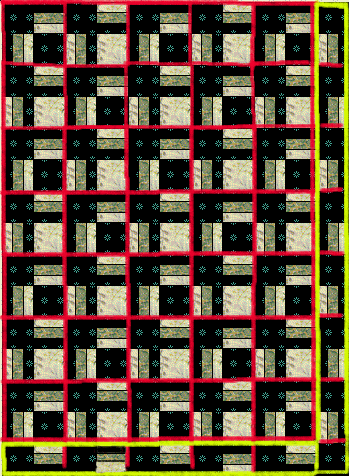
This is what is meant by  a "half row".  It is just one square and one strip set.

.4) (this is the half block row that is on the right side and on the bottom row)

(see quilt diagram above)


5) First row will be in this order:

...........

6) Note that the half block  rows on even and odd rows have  the dark side of the strip set to the outside on the first and odd rows, then to the inside on the even rows.. 

Half block will have dark stripe on right side of half block.

7) Second row will be the opposite blocks under each other:

...........

8) Half block will have dark stripe on left side of half block.
9) The blocks in the even number rows will alternate from the odd number rows.
60 striped set blocks for this quilt

12 light plain blocks

49 of the dark plain blocks

The width of your borders is extra fabric... 

quilt finishes without borders:
49 1/2 inches  X  49 1/2 inches


You need to piece:

8 strip sets of your light, medium and dark fabrics.

Fabric for the quilt above: Medium fabric: 3/4 yard of medium fabric for the strips and light plain blocks

I would get a little more for safety and shrinkage, crooked cuts, etc. ...
(if you want to use this fabric in the border you will need more yardage for the borders) 

If you want to use this fabric in the border, get 6 times the width of your border size for pieced borders.

Light fabric:  1 yard total for the light for the strips and light plain blocks

I would get a little more for safety and shrinkage, crooked cuts, etc. ...

If you want to use two fabrics of the same "tone" for the lights, ** example ** one beige for the squares and another same tone beige for the strips, get or take from your stash: 

3/4 yard for the strips
You need 12 of the light blocks.
You get 8 cuts across strip = 1 1/2 strips 

10 inches (exactly) for the light blocks...
I would get a little more for safety and shrinkage, crooked cuts, etc. ...

(if you want to use this fabric in the border you will need more yardage for the borders)

If you want to use this fabric in the border, get 6 times the width of your border size for pieced borders.

Don't cut your plain squares until you sew and measure your strip sets!

Dark fabric: 2  yards total of the dark for the strips and dark plain blocks

I would get a little more for safety and shrinkage, crooked cuts, etc. ...

Once again if you want to use two fabrics with the same "tone" for the dark blocks and different fabric for the dark strips:

1 1/4 yards dark for the plain blocks 
   3/4 yard of the dark for the strips

(if you want to use this fabric in the border you will need more yardage for the borders)

If you want to use this fabric in the border, get 6 times the width of your border size for pieced borders.
 

Don't cut your plain squares until you sew and measure your strip sets!

 1) If you cut your strip width for the strip sets these widths below: 2) You  get the finished block size below: 3) A square quilt will need this many rows: 4) A rectangle quilt will need this many rows:
1 1/2" strips  finished block size:
3 inches
Quilt square:

5 x 5 blocks 
+ 1 half row:

33" x 33"

Quilt rectangle:

5 X 7 blocks 
+ 1 half row

33" X 45"

2 inch strips finished block size:
4 1/2"
5 x 5 blocks 
+ 1 half row:

49 1/2" X 49 1/2"

5 X 7 blocks 
+ 1 half row

49 1/2" X 67 1/2"

2 1/2" strips finished block size:
6 inches
5 x 5 blocks 
+ 1 half row:

66" X 66"

5 X 7 blocks 
+ 1 half row

66" X 99"

3 inch strips finished block size:
7 1/2
5 x 5 blocks 
+ 1 half row:

82 1/2" X 82 1/2"

5 X 7 blocks 
+ 1 half row

85 1/2" X 112 1/2"

3 1/2" strips finished block size:
9 inch block
5 x 5 blocks 
+ 1 half row:

99" X 99"

5 X 7 blocks 
+ 1 half row

Too big!
99" X 135"

Introduction
page 1
Page 2 Page 3 Page 4
here
Page 5 Page 6

How to figure the fabric amounts you need for a specific other size quilt:
 
 
How many blocks do you need?  Use the chart on page 3 as a guideline for quilt sizes. 

Take the number of blocks needed =
Sample = 82 blocks
How many block cuts can you get across the fabric strip?  For example, if you cut your fabric selvage to selvage your width may be around 42"-44" depending on the fabric manufacture. 

So if your blocks are 5 inches square, 
you can get (5 times 8 is 40) 8 blocks from a strip.

Divided by the number of blocks you need by the number of cuts you can get across the strip = Sample =  the number of cuts you can get across the strip is 8 and you need 82 blocks.

So you divide 82 by 8 = 10.5 strips.

You need to cut 10.5 strips of each strips set fabric.

I would get a little more for safety and shrinkage, crooked cuts, etc. ...

How much fabric do you need?

Multiply the number of strips you need (round up) but the width of the strips you need =


You need 10.5 strips (round up to 11)
Multiply that times the width of your strips in the quilt = you strip width is 2 inches:

11 times 2= 22

You need 22 inches of fabric for those strips.

I would get a little more for safety and shrinkage, crooked cuts, etc. ...

Now repeat for the other strips and the blocks =
How many plain blocks do you need? 
How many can you get from the width of the fabric?
Multiply times the width of the blocks  to the amount of fabric you need =
Introduction
page 1
Page 2 Page 3 Page 4
  here
Page 5 Page 6

Hosted by www.Geocities.ws

1