Additional Resources





|
Family as Client
When newborns are diagnosed with a congenital heart defect many parents are overwhelmed. They arrived at the hospital to give birth to a healthy baby and they are instead thrust into a world of hospitalizations, critical care, and separation from their new infant. This is a time of high stress and shock for these families. As the primary care givers, nurses have the opportunity to ensure that parents are able to cope with this diagnosis and the future while forming a lasting and meaningful attachment with their child.
The Interpretive/ Experiential Paradigm is defined as phenomenological, based in experience and interpretations, and believes that �shifting perspectives to see the world as patients see it is something that is central to providing competent nursing care to meet patients needs� (LoBiondo-Wood & Haber, 2002, p.132). This perspective takes into account the phenomenological experiences of families who have newborns with congenital heart defects. Within this paradigm nurses care not only for the infant and the illness, but also the family. The family�s experiences are seen as just as important as the newborn�s technical care.
Through this perspective nurses are able to address the problems that parents face, in accepting and understanding their newborn's illness. By recognizing and discussing these problems, in families, nurses are able to enable the formation of more secure parent-child attachments and more stable family adaptation and coping, while meeting the complex care needs of the infant.
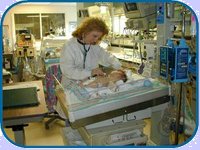
Strategies for Caring for Families who have a Child with a CHD
- Enable parents to discuss their feelings and worries
- Reassure parents that their feelings are normal and expected
- Explain the machine and alarms, in the NICU, to parents
- Welcome parents to the NICU and ensure feel accepted
- Encourage parents to touch and hold their infant as soon as possible
- Point out the positive aspects of the infant and ensure that the parents can "see" the beauty of their child
- Help parents to participate in their newborn's care
- Include the family in decision making and daily activities
- Recognize parents as a valuable resource in caring for the infant
- Do not judge family members if they are unable to visit or to care for the baby
- Put parents in contact with support groups and resources both in the hospital and the community

|
[Background]
[Stressors]
[Coping]
[Attachment]
[Family as Client]
[Main]
References
LoBiondo-Wood, G. & Haber, J. (2002). Nursing research: Methods, critical appraisal and utilization. Toronto: Mosby.
McGrath, J.M. (2001). Building relationships with families in the NICU: Exploring the guarded alliance. Journal of Perinatal and Neonatal Nursing, 15(3), 74-83.
Ward, K. (2001). Perceived needs of parents of critically ill infants in a neonatal intensive care unit. Pediatric Nursing, 27(3), 281-285.
Wong, D.L., Hockenberry, M.J., Wilson, D., Winklestein, M.L.& Kline, N.E. (2003). Wong�s nursing care of infants and children. (7th ed.). Toronto: Mosby.
This site was built by Haylie A. Isaac, Kwantlen University College, Student Nurse, April 2003
|