Additional Resources






|
Attachment
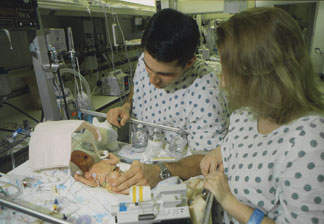 Attachment is the formation of a bond between parent and child. It is this bond that ensures the mutual relationship between parent and infant. A secure relationship promotes healthy parenting and healthy infant development and these early interactions also affect the nature and quality of later attachments (Friedman, 1998). In normal circumstances maternal-child attachment, which generally begins from conception, is solidified in the time immediately after a woman gives birth. Both mother and child have a period of sensitivity, to bonding, in which they read the signals of each other and act on them. With a critically ill infant these cues may not be present from the newborn, interrupting the natural manner in which attachment occurs. Nystrom and Axelsson (2002) identified that separation, fear of the infant�s death, and an inability to care for the child all affect this attachment process with a critically ill newborn.
Secure Attachment
- Parents are involved with their child
- Requires support for the family by the nurses caring for the infant
- Support alleviates some of the parental fears about touching and caring for their child
- Early interaction is also essential to facilitate attachment
- Parents be reunited with their infant as soon as possible, especially if the separation was immediately after birth
- Attachment occurrs much faster when the mother�s feelings towards the infant are positive
- Nurses play an important role in ensuring that parents are able to see the uniqueness and beauty of their child
- Healthy and functional coping enable the family to involve themselves in their child�s care and to interact with the infant
Secure attachment is the result of hard work by the parents to adjust to the situation and facilitation by the nurses and staff caring for the child.

Delayed Attachment
- The appearance and behavior of the newborn and separation are the major contributing factors
- The appearance of the infant may not fit the expectations of the parents, principally the blue hypoxic newborns, and critically ill newborns do not act in the manner most parents anticipate
- This may cause anxiety and reluctance for parents to touch and interact with their child
- Unless parents hold, touch, and look at their child they are unable to form a lasting bond with their child
- The NICU interrupts the natural instincts of mothers because they are not the primary caregivers of their newborns
- Increased stress and can further delay attachment
- Families may avoid bonding with their child as a coping strategy
- Reluctance is a result of their fear of the infant�s death and being unable to deal with the grief of losing a child who they have bonded with
- Parental perceptions of the infant, the illness, and coping strategies determine the extent to which they become involved with their child.
When effective coping and adaptation are not present families are at a greater risk for delayed attachment.


|
[Background]
[Stressors]
[Coping]
[Attachment]
[Family as Client]
[Main]
References
Bialoskurski, M., Cox, C.L., & Hayes, J.A. (1999). The nature of attachment in a
neonatal intensive care unit. Journal of Perinatal and Neonatal Nursing, 13(1), 66-77.
Friedman, M.M. (1998). Family nursing: Research, theory, and practice. (4th ed.). Connecticut: Appleton & Lange.
Nystrom, K. & Axelsson, K. (2002). Mothers� experience of being separated from their newborns. Journal of Obstetrical, Gynecological, and Neonatal Nursing, 31(3), 275-282.
This site was built by Haylie A. Isaac, Kwantlen University College, Student Nurse, April 2003
|