Additional Resources






|
How do Families Cope?
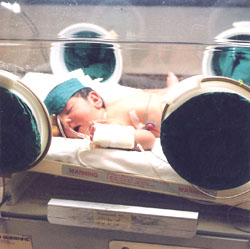 Coping involves using a set of strategies to manage stress within a situation. Parents of children with a CHD have much greater stress than parents of children with other chronic conditions because of the threat to life and uncertain outcomes (Svavarsdottir & McCubbin, 1996).Effective adaptation rarely occurs in families with a newborn who has a CHD, 70% of families reported maladjustment and disturbed mother-child relationships (Svavarsdottir & McCubbin, 1996). Adaptation is essential in order for families to cope with the increased demands of caring for a child with a CHD. Adaptation is the key to acceptance of both the diagnosis and the child and facilitates the attachment process. Coping enables families to interact in a healthy manner with their infant.
Bonadaptation
- Is achieved through the combination of a variety of coping strategies and behaviors in order to accept and adapt to changes that have occurred
- Positive communication, social support, faith, positive outlook, and focusing on the infant are all strategies that have been identified to foster healthy adaptation
- Family problem solving, emotional coping, and the use of medical services are effective behaviors for families to have in order to cope with major life stresses
- Families who seek out information from health professionals in order to understand the rationale for treatment and the long-term implications of the CHD are able to understand and cope with the infant much more successfully than families who do not acquire these facts
When families use these strategies and behaviors they are enabling themselves to adapt to the changes in their lives. Families are able to cope with the stressful experience that they are facing, and therefore they are able to adapt to these changes. This adaptation fosters parents� ability to care for their child, interact in the altered environment, and form a bond.
Maladaptation
- Occurs when families are unable to cope with the stressors that they are facing and adapt to the changes in their life
- Families may have ineffective coping strategies and behaviors that inhibit the adaptation process.
- Dysfunctional family adaptive and coping strategies tend to temporarily reduce stress; however, they fail to deal with the underlying stressors so the stress returns
- Denial is a common ineffective coping strategy used by families that removes the stress of the actual problem and conversely inhibits the family from coming to terms with the actual problem
- Denial also leads to escape-avoidant behaviors where families actively try to avoid situations in which they have to face the truth of the situation
- Can include not caring for their child and interacting with the medical team
- Escape-avoidant coping led to poor maternal functioning.
- Further perpetuates feelings of guilt and self-blame
- Furthering the distance between parent and child may also be utilized
When families are not able to effectively cope they are increasing the stress of the situation and thus they are not able to successfully adapt. This maladaptation can have significant implications for the functioning of the family as it can increase family addictions and violence. This in turn increases the attachment problems.


|
[Background]
[Stressors]
[Coping]
[Attachment]
[Family as Client]
[Main]
References
Hughes, M., McCollum, J., Sheftel, D., & Sanchez, G. (1994). How parents cope with the experience of neonatal intensive care. Children�s Health Care, 23(1), 1-14.
Svavarsdottir, E.K. & McCubbin, M. (1996). Parenthood transition for parents of an infant diagnosed with a congenital heart condition. Journal of Pediatric Nursing: Nursing Care of Children and Families, 11(4), 207-215.
Tak, Y.R. & McCubbin, M. (2002). Family stress, perceived social support and coping following the diagnosis of a child�s congenital heart disease. Journal of Advanced Nursing, 39(2), 190-198.
This site was built by Haylie A. Isaac, Kwantlen University College, Student Nurse, April 2003
|