PRELUDE:
Lights Out
INTERMISSION:
Shorty's Lament
The Moles Are Coming
Would We Be Alive?
RECESSIONAL:
The New Hymn
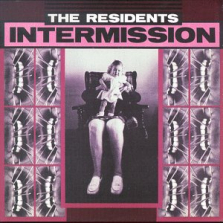
INTERMISSION
EP
| PRELUDE:
INTERMISSION:
RECESSIONAL:
|
|
For the Mole Show live production, the Residents played the music of Mark of the Mole and The Tunes of Two Cities on stage. However, they also used prerecorded music (written specifically for The Mole Show) to play as the opening and closing themes, and during the intermission. In 1982, as the disastrous tour began, the Residents released that music as an EP. This was Intermission, almost immediately a fan favorite.
RATING: 9
Intermission supposedly distills the Residents' post-Duck Stab sound the same way that Fingerprince distills pre-Duck Stab. That's an unfair assessment. You couldn't distill such an eclectic sound in 25 minutes and 5 songs; between Eskimo and Commercial Album I wouldn't have a clue where to even start trying. But Intermission certainly captures a great deal of their ideas: I can hear bits of Duck Stab, Commercial, Mark of the Mole, and even Diskomo. More importantly, the five pieces are of a piece, and are GREAT!
I was, in fact, about to name "Shorty's Lament" and "The New Hymn" as my favorites, until "Moles Are Coming" came over my speakers. I decided I had to add that, too; then came "Would We Be Alive?" Of course that was another favorite, how could I exclude it? That left only the spectacular and scary "Lights Out," which I love, and—so I surrendered.
The truth is, these songs are probably as close to perfect as the Residents got, at least in terms of arrangement and production. Of course, "perfect" can be a nasty word to experimental musicians, but I don't think they'd mind in Intermission's case. After all, it was never intended to be anything but a very minor project, a few incidental passages to supplement the much more ambitious Mole trilogy. And Intermission was exactly that, and by sheer coincidence also was a tiny specimen of immaculate, brilliant music, and a Cliff's-Notes version of the story of the Moles. Take that into account with its brevity and mostly-instrumental-ness, and what do you get? You get everything that The Tunes of Two Cities should have been. Not to mention a pocket work of art.
BACK TO TOP / BACK TO MAIN PAGE