The Walrus Hunt
Birth
Arctic Hysteria
The Angry Angakok
A Spirit Steals a Child
The Festival of Death
ESKIMO
Album
| The Walrus Hunt |
|
No Residents album is as storied as Eskimo. Allegedly three years in the making, its media campaign began in January 1978—ten months before its scheduled release—with ads in almost every major music publication in North America and Europe. Then in September, the marketing blitz stopped dead in its tracks. New versions of the ads appeared with disclaimers that announced indefinite delays in Eskimo's release.
Tension, it seems, between the Residents and their management, the Cryptic Corporation, had reached critical mass. Either because they were simply fed up, or because the isolation in which they recorded Eskimo was affecting their collective judgement, the Residents stole the Eskimo master tape from Ralph Records and went to England, leaving the tape in the care of Chris Cutler (from the band Henry Cow).
In Ocober, the problems were resolved, the Residents returned to San Francisco, and the Cryptic Corporation (who had pulled and released Not Available to meet the band's contractual obligation) held a press event during which the Eskimo master was returned to Cryptic president John Kennedy.
When Eskimo was finally released in October 1979, it received universally glowing notices and cemented the Residents' stature in the avant-garde and new wave communities.
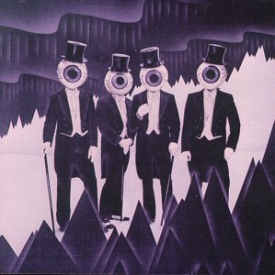
The cover art marks the first appearance of the band's soon-to-be-trademark eyeball costumes. Reportedly inspired by (fictional?) N. Senada, Eskimo consists of six tracks, each one the sound of a story taking place. The stories are printed on the back of the album's sleeve, and the listener is instructed to read each story while listening to the corresponding track on headphones. The overarching intention is to expose the listener to traditional Eskimo music and culture—all of which the Residents completely fabricated for the Eskimo album.
RATING: 10
Okay. Your ingredients are: Arctic soundscapes. Lovely, but rudimentary melodies. Tribal-sounding chants. Fake anthroplogy. Fake musicology. Fake folklore. Electronic instruments. Instruments you invented and built yourself. Stabs, both harsh and subtle, at American consumerism; globalism; cultural apathy; pop culture; mass media; self-important msuci buffs; critics; academia; and, naturally, yourself. Oh, yes: you've also got genuinely moving, involving, and human stories. How do you make all these ingredients work together?
My guess is, you'd be so overwhelmed that you couldn't even start such a task. But if you were the Residents, you'd somehow make all these things inseparable.
Eskimo is a work of art that is truly more—exponentially more—than the sum of its parts. Look again at the list at the beginning of this review for just a hint of the number of levels at work on the album. It's the Residents' most accomplished music, most sublime statement, most stinging satire, and most absurd joke all rolled into one. If you believe that cliché about how you can tell a great masterpiece by your ability to find something new with every examination...well, I hear a dozen new things every time I listen to Eskimo.
I'm trying very hard to keep these comments as general as possible: Eskimo is something you have to experience for yourself. I don't want to spoil it for anyone. Just know that most of it sounds like an arcane radio play instead of music (although it IS music), but also know that every detail is important, and that whatever you make of the thing from cover art to Resident-designed Ceremonial instruments is a valid interpretation—and the Residents probably thought of it, too.
Also bear this in mind:
Coca-Cola adds life.