|
Purpose
To zoom in or out in the perspective view by changing the camera field of view.
Overview
Zoom operates like changing the lens on a camera. A value smaller than the default is like using a telephoto lens, whereas a value larger than the default provides a wide angle lens effect.
>
How to Use
-
1
-
Click in the Perspective window to make it active.
-
2
-
In the Tool Palette, select Zoom from the Cameras menu or click its icon.
-
3
-
Click a mouse button.
- To create a smaller field of view, click and drag the left mouse button to zoom in.
- To create a larger field of view, click and drag the right mouse button to zoom out.
- To increase or decrease the angle of view interactively, click the middle mouse button. Dragging up or to the right increases it, and dragging down or to the left decreases it.
>
|
Note:
|
When working with a large model, the speed at which the
screen is redrawn during a Zoom
operation can be increased
by decreasing the Motion Precision in the Preferences >
Performance options window.
|
You can type the angle of view from the keyboard when the system prompts:
Enter angle of view (ABS):
The values are between 0.2 and 179. Type the angle (preceded by the letter r
if you want a relative angle) and press Enter.
Select
Cameras > Zoom- to display the Zoom Options box. to display the Zoom Options box.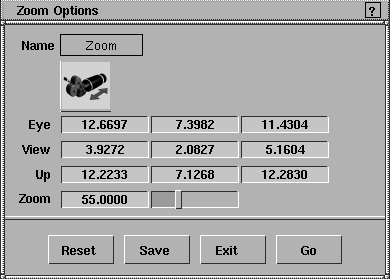
Eye/vView/Up
-
- These sliders let you define a view by positioning the camera. The view is determined by the eye position, view point position and up vector end point. These nine fields contain floating-point values. They represent, from left to right, the X, Y, and Z coordinates for each of the three camera parameters. To see the camera as you modify it, use DisplayTgls > Object Toggles > Camera.
Zoom
-
- The Zoom slider also takes a floating-point value which defines the angle of the camera's field of view.Values must be positive in the range of 0.2 to 179.
>
|
Note:
|
For windows other than the Perspective window
(orthographic), two of the three Eye and View values must
be the same, and two of the three Eye and Up values must be
the same. If they are all different, or are all the same, the
results are unpredictable. This is because viewing
operations on orthographic windows are performed on the
window rather than the camera of the window.
|
|


