|
Domain |
Explanation |
|
Loving & doving? |
- Any worldly phenomenon can be either deterministic or random or pseudo-empirical
- Deterministic phenomenon can be precisely, completely, unambiguously & accurately understood, predicted & modeled
- On the other hand, random phenomenon is either too complex to be understood & modeled or has not been observed & analyzed, thus stochastic or statistical methods have evolved to fill the void of understanding
- Pseudo-empirical phenomenon is neither completely understood nor completely unknown / random, thus some understanding can be extracted from existing knowledge
- Loving & Doving are naturally-occurring processes or phenomena that are constantly being staged around us
- As such, loving & doving are worldly phenomena that can be modeled
- If they are deterministic events, then one would be able to tell exactly what the outcomes would be & be prepared for what lie ahead
- If they are random events, then one would not be able to tell or feel anything at all & be completely unprepared
- However, if they are pseudo-empirical events, then one would be able to base some understanding & some approaches towards some outcomes, yet not being totally prepared for the future - a tip-toeing syndrome: promotes caution, care & concern in a decentralised, mutual way
|
|
What pattern? |
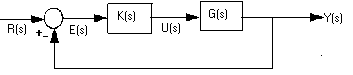
- Using the unity feedback configuration, the output y of a process G(s) under the input of a controller K(s) is subtracted from a reference r to produce the tracking error e for K(s)
- G(s): the process is the loving-doving phenomenon that is a variable of the emotive frequency s
- K(s): the controller that influences the loving-doving process over the emotive frequency s such that yà r and eà 0
- Y: the output or actual consequence of the loving-doving phenomenon from applying control K(s) on process G(s)
- R: the desired outcome of the relationship whether for loving or doving
- E: the error between the actual outcome y & the desired outcome r
- Using pseudo-empirical theory, the loving-doving process G(s) has components: 1) nominal: completely understood portion; 2) uncertainty: incompletely known or unknown portion
- Controlling: in order that yà r & eà 0, K(s) has to be tuned, adapted and reached homeostasis with the loving-doving process G(s)
- Criteria of success: eà 0 or literally the K(s) need not do anything as the process G(s) has reached its desired optimal level
- The pattern: by changing K(s) in terms of internal, self-self & environmental push-pull w.r.t. to emotive frequencies, there would come level(s) where the loving-doving process G(s) would reach desirability
- Implication: the closed-loop process with controller H(s) has to be: 1) stable: so that the coupling does not steer towards mutual annihilation; 2) performance: so that while maintaining zero e, other factors are also satisfied for optimal coupling valence (eg. finances, health, family, lifestyle, hopes, people)
|
|
Findings |
- That all the above concepts are really variables that differ with individuals, circumstances & environment
- Stochastically, the loving-doving process is a hill or a Gaussian process where
- Loving is the start, rise & climax of the relationship
- Doving is the decline, drop & decay of the relationship
- Let's look at the each of the above six phases:
- Start: emotive changes, as favourable perceptions are attracted towards a party - feeling: a slight itch
- Rise: emotive inertia broken, bio-chemical enhanced, propagation of favourable perceptions & actions begin rolling - feeling: fun, let's try, why-not syndrome
- Climax: emotive resonance as external stimulus frequencies equates internal emotive dynamic frequencies - feeling: love, u-r-for-me syndrome
- Decline: emotive shifting away from resonance as unfavourable perceptions are piled against the other party; the low contrast starkly with the previous resonance - feeling: tired, want-to-look-away syndrome
- Drop: resonance inertia broken, as bio-chemicals spreads & unfavourable perceptions propagate throughout - feeling: bitter sore, get-away-from-me syndrome
- Decay: emotive node reached, coupling ended, depending on the degree of resonance reached previously, temporary or permanent emotional deformations are leftover - feeling: depressive, why-this-mess syndrome
|
|
Advice |
- Look before U leap
- It is fun, but do U want to be a clown all your life?
- If climax is what U are aiming, death is what U are looking
- Regular saving is preferred over lumped-sum dumping
- Where there is extreme kick, there is extreme butt
|