The Sun and especially the Moon are the prime creators of our tides. The
Moon has the most effect as it is the nearest body to the Earth. When the Sun
and the Moon are in line or at opposites then the tides are the highest and
these are called "spring tides"; this is when there is a New Moon or Full Moon.
There is a lapse of one and a half days after full/new moon when Spring tides
materialise. They occur every two weeks with the lowest tides called neaps
intervening.
Tides have two effects,
Tidal movement Laterally
Tidal movement Vertically
Lateral tidal movement or tidal streams (as it is called) usually move
along the coast in first one direction building up to a maximum speed at
around half tide and then in the opposite direction. With speeds varying
from say 1knot to in extreme cases of 7knots depending on the topography of
the coast. A knot is 1 sea mile per hour which is about 1.1 land miles. With
relatively slow moving sailing boats it is advantageous to use the tidal
'lift' to significantly increase the boat speed and so shorten the journey
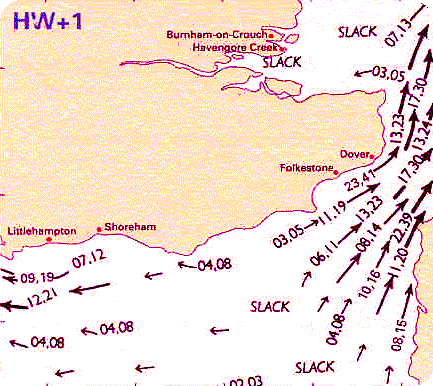
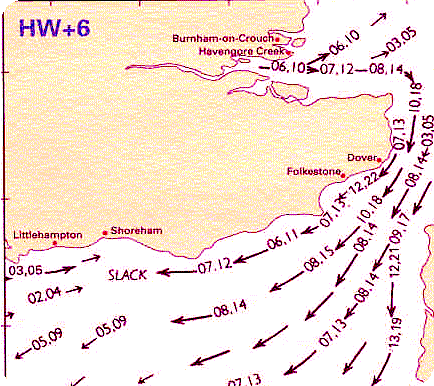
time. Below are two chartlets of tidal streams and the rate /direction at
two specific times relative to high water Dover plus 1 hour and high water
Dover plus 6 hours.
The numbers for example, 04,08 are interpreted as 0.4 knots at mean
neaps and 0.8 at mean springs (mean equals average)
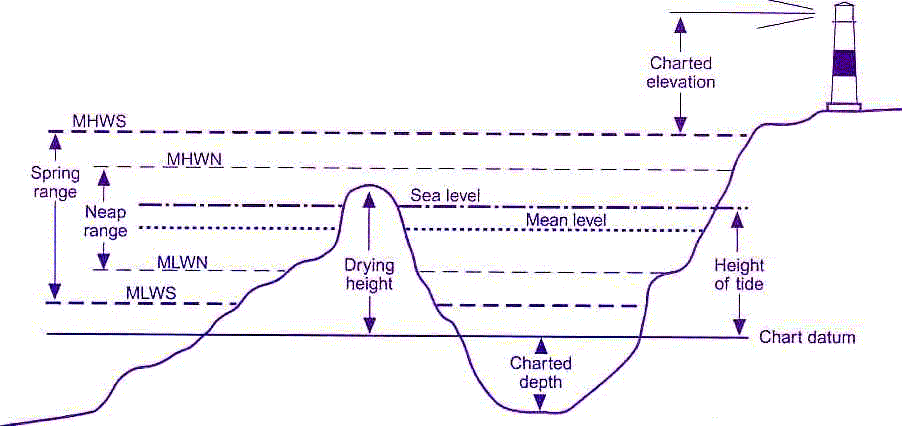
Tides have approximately a twice daily cycle ie, two high waters
and two low waters each day. In fact tide times, in keeping with lunar time,
progress daily by on average half an hour. See below extract from Macmillan Reeds Nautical
Almanac that shows clearly the differing tidal levels along with some
names/explanations.
MHWS = Mean High Water Springs
�MLWS = Mean Low Water Springs MHWN = Mean High Water Neaps ��MLWN = Mean Low Water Neaps
 MHWS = Mean High Water Springs
�
MHWS = Mean High Water Springs
� MHWN = Mean High Water Neaps ��