


In this section the graph edge-colouring and minimum cost
problems will be considered.
An algorithm which colours the graph with no more than  colours
is first given. The problem of minimising the sum of the largest weight
of each colour is then considered and an algorithm will be suggested
that attempts to solve the problem.
colours
is first given. The problem of minimising the sum of the largest weight
of each colour is then considered and an algorithm will be suggested
that attempts to solve the problem.
Let  be a graph, where
  is the set of vertices and
  the
set of edges. The degree of a vertex is the number of edges
that are linked to the vertex. The degree of a graph, denoted by
the
set of edges. The degree of a vertex is the number of edges
that are linked to the vertex. The degree of a graph, denoted by  , is the maximum
degree of all vertices of the graph.
Two edges are said to be adjacent if they share the same vertex.
, is the maximum
degree of all vertices of the graph.
Two edges are said to be adjacent if they share the same vertex.
The edge-colouring problem can be defined as follows:
edge-colouring problem assign each edge of the graph  with
a colour, such that no adjacent edges have the same colour.
with
a colour, such that no adjacent edges have the same colour.
The chromatic number of a graph,  ,
is the least number of colours needed
to edge-colour the graph.
It is easy to see that at least colours are needed to colour the graph, so
,
is the least number of colours needed
to edge-colour the graph.
It is easy to see that at least colours are needed to colour the graph, so
 . In fact an interesting theorem in graph
theory, proved by Vizing [15], shows that
. In fact an interesting theorem in graph
theory, proved by Vizing [15], shows that
Theorem If is a graph, then
 .
.
Therefore it is always possible to colour the edges of a graph
with no more than colours. However to decide whether
it is possible to colour the graph with only colours is
an NP-complete problem [7]. So a practical bound is colours.
The proof of the Theorem 1 (see, e.g. [4]) is based on
adjusting the colouring of the graph. Let  be the set of
colours. Assume that part of the graph
is coloured with colours from . Consider adding an uncoloured
edge to the coloured part of the graph.
If there is a common unused colour from the colour set at both ends of the
edge, then colour the edge with that colour. Otherwise adjust
the colouring of the coloured part of the graph to allow
the new edge to be coloured with no conflict.
be the set of
colours. Assume that part of the graph
is coloured with colours from . Consider adding an uncoloured
edge to the coloured part of the graph.
If there is a common unused colour from the colour set at both ends of the
edge, then colour the edge with that colour. Otherwise adjust
the colouring of the coloured part of the graph to allow
the new edge to be coloured with no conflict.
The following algorithm, which colours a graph
with no more than colours, is based on
the proof of the theorem. Here
a path is denoted to be a list of vertices of the form
 , where for
  ,
the pair
,
the pair
 constitutes an edge in
and vertices are not repeated, apart
from the case
constitutes an edge in
and vertices are not repeated, apart
from the case  .
.
Algorithm COLOUR
be the set of colours. Let  be the part
of the graph whose edges were coloured using colours in with no conflict.
be the part
of the graph whose edges were coloured using colours in with no conflict.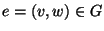 that is not in , where
  and
and  are two ends of the edge
  . If no such edge
exists then all the edges have been coloured with colours in , so terminate.
. If no such edge
exists then all the edges have been coloured with colours in , so terminate. unused at both ends and , then
colour the edge
unused at both ends and , then
colour the edge  with the colour
  , add the edge and both ends
to , go to step 2. Otherwise let
, add the edge and both ends
to , go to step 2. Otherwise let  be an unused colour at
and
be an unused colour at
and  be an unused colour at ., find the largest path in coloured with
colours
be an unused colour at ., find the largest path in coloured with
colours  and
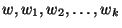
and  alternately. Let the path be
 .
. then exchange the colours and in the path,
colour the edge with , add the edge and its ends to , go to step 2.
then exchange the colours and in the path,
colour the edge with , add the edge and its ends to , go to step 2. unused both at and
  then change the colour of the edge
  from to . Colour the
edge with , add and its ends to , go to step 2. be an unused colour at . Uncolour
the edge and delete it and its ends from .
Colour the edge
with colour and add it and its ends to .
Rename as , as , the edge
as and repeat the procedure from step 4.
from to . Colour the
edge with , add and its ends to , go to step 2. be an unused colour at . Uncolour
the edge and delete it and its ends from .
Colour the edge
with colour and add it and its ends to .
Rename as , as , the edge
as and repeat the procedure from step 4.
In practice there is usually more than one colouring scheme
that edge-colours the graph with no more
than colours. Let  be the set of all such colouring schemes.
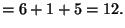
The cost of each colouring scheme, is defined as the sum of the largest weight
of the edges that have the same colour. For example, in Figure 3 (a),
edges (1,6), (2,5) and (3,4) have colour , with a largest weight of
be the set of all such colouring schemes.
The cost of each colouring scheme, is defined as the sum of the largest weight
of the edges that have the same colour. For example, in Figure 3 (a),
edges (1,6), (2,5) and (3,4) have colour , with a largest weight of
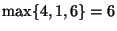 ; edges (1,2) and (6,5) have colour , with the largest
weight of
; edges (1,2) and (6,5) have colour , with the largest
weight of 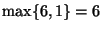 ; edges (2,3) and (5,4) have colour , with the largest weight of
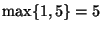 , thus
the cost of the colouring scheme given by Figure 3 (a) is
, thus
the cost of the colouring scheme given by Figure 3 (a) is 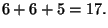 The minimum cost problem can be stated as following
minimum cost problem Among all colouring scheme  ,
find one that has the minimum cost.
,
find one that has the minimum cost.
Although the algorithm COLOUR can give a colouring scheme
with no more than colours, the colouring scheme
may not be the one with minimum cost.
To illustrate this, Table 3
presents a communication task table given by
partitioning a mesh of 788 elements into 16 subdomains,
using a spectral bisection algorithm. Thus the graph described by the
table has 16 vertices. The maximum degree is  Applying algorithm COLOUR
on the graph of Table 3
results in the scheduling scheme given by Table 4. In this case 5 colours are
used. If one views the table as a communication schedule, then
in the 5-th stage,
processor 10 exchanges messages with processor 13, which needs 10
units of time. Processors
11 and 12 exchange messages which need 2 units of time,
the rest of the processors are idle. A better balancing of the communication
load at each stage will reduce the overall communication costs.
Applying algorithm COLOUR
on the graph of Table 3
results in the scheduling scheme given by Table 4. In this case 5 colours are
used. If one views the table as a communication schedule, then
in the 5-th stage,
processor 10 exchanges messages with processor 13, which needs 10
units of time. Processors
11 and 12 exchange messages which need 2 units of time,
the rest of the processors are idle. A better balancing of the communication
load at each stage will reduce the overall communication costs.
| Processor |
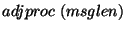 |
||||
| 1 | 9 (2) | 12 (2) | - | - | - |
| 2 | 3 (3) | 10 (1) | 11 (3) | 13 (6) | - |
| 3 | 2 (3) | 10 (4) | 11 (8) | 12 (1) | - |
| 4 | 7 (3) | 14 (5) | 15 (6) | - | - |
| 5 | 9 (2) | 10 (4) | - | - | - |
| 6 | 11 (4) | 12 (5) | 16 (4) | - | - |
| 7 | 4 (3) | 10 (2) | 13 (4) | 14 (6) | - |
| 8 | 15 (6) | 16 (6) | - | - | - |
| 9 | 1 (2) | 5 (2) | - | - | - |
| 10 | 2 (1) | 3 (4) | 5 (4) | 7 (2) | 13 (10) |
| 11 | 2 (3) | 3 (8) | 6 (4) | 12 (2) | - |
| 12 | 1 (2) | 3 (1) | 6 (5) | 11 (2) | 16 (6) |
| 13 | 2 (6) | 7 (4) | 10 (10) | 14 (3) | - |
| 14 | 4 (5) | 7 (6) | 13 (3) | - | - |
| 15 | 4 (6) | 8 (6) | - | - | - |
| 16 | 6 (4) | 8 (6) | 12 (6) | - | - |
| Processor |
|
||||
| 1 | 9 ( 2) | 12 ( 2) | - | - | - |
| 2 | 3 ( 3) | 10 ( 1) | 11 ( 3) | 13 ( 6) | - |
| 3 | 2 ( 3) | 11 ( 8) | 10 ( 4) | 12 ( 1) | - |
| 4 | 7 ( 3) | 14 ( 5) | 15 ( 6) | - | - |
| 5 | 10 ( 4) | 9 ( 2) | - | - | - |
| 6 | 11 ( 4) | 16 ( 4) | 12 ( 5) | - | - |
| 7 | 4 ( 3) | 13 ( 4) | 14 ( 6) | 10 ( 2) | - |
| 8 | 15 ( 6) | - | 16 ( 6) | - | - |
| 9 | 1 ( 2) | 5 ( 2) | - | - | - |
| 10 | 5 ( 4) | 2 ( 1) | 3 ( 4) | 7 ( 2) | 13 ( 10) |
| 11 | 6 ( 4) | 3 ( 8) | 2 ( 3) | - | 12 ( 2) |
| 12 | 16 ( 6) | 1 ( 2) | 6 ( 5) | 3 ( 1) | 11 ( 2) |
| 13 | 14 ( 3) | 7 ( 4) | - | 2 ( 6) | 10 ( 10) |
| 14 | 13 ( 3) | 4 ( 5) | 7 ( 6) | - | - |
| 15 | 8 ( 6) | - | 4 ( 6) | - | - |
| 16 | 12 ( 6) | 6 ( 4) | 8 ( 6) | - | - |
max.  |
6 | 8 | 6 | 6 | 10 |
| comm. cost | 36 | ||||
The following algorithm is proposed in an attempt to solve the minimum cost problem. The idea is to colour as many as possible the edges with large weights using one colour, then repeat the procedure recursively for the remaining edges.
The algorithm, named REDUCE,
starts with a graph edge-colouring with no more than colours.
Roughly speaking,
a) first the edge  with the largest weight is found and locked,
its colour is ;
b) Then the unlocked edge
with the largest weight is found and locked,
its colour is ;
b) Then the unlocked edge  with the largest weight is found,
its colour is . An attempt is then made to colour the two edges
and with the same colour;
c) If
with the largest weight is found,
its colour is . An attempt is then made to colour the two edges
and with the same colour;
c) If  , then the two edges with largest weights
have indeed the same colour, so lock .
Otherwise the following
steps are carried out to change the
colour of into ;
d) If at both ends of the edge , colour
is unused, then the colour of can simply be changed to .
Otherwise the logic used in the algorithm COLOUR can be adapted;
e) The largest path containing the edge and
coloured alternately with and is found.
If it contains locked edges, then lock ;
otherwise the two colours
on the path are exchanged making having the same colour
as , and lock . This process is repeated from b) until all edges are
locked.
The edges with colour are then removed and the process repeated
on the remaining graph. In this way edges with similar weights are
coloured with the same colour. The detailed algorithm is as follows, where
, then the two edges with largest weights
have indeed the same colour, so lock .
Otherwise the following
steps are carried out to change the
colour of into ;
d) If at both ends of the edge , colour
is unused, then the colour of can simply be changed to .
Otherwise the logic used in the algorithm COLOUR can be adapted;
e) The largest path containing the edge and
coloured alternately with and is found.
If it contains locked edges, then lock ;
otherwise the two colours
on the path are exchanged making having the same colour
as , and lock . This process is repeated from b) until all edges are
locked.
The edges with colour are then removed and the process repeated
on the remaining graph. In this way edges with similar weights are
coloured with the same colour. The detailed algorithm is as follows, where
 the colour of edge ,
 the set of edges of a graph ,
 the set of locked edges,
 the set of unlocked edges.
, and first colours it with
the algorithm COLOUR.
the set of unlocked edges.
, and first colours it with
the algorithm COLOUR.
Algorithm REDUCE
 ,
,  .
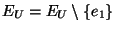
. then terminate. Otherwise
let be the edge in
then terminate. Otherwise
let be the edge in  with the largest weight, let
  ,
,
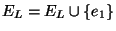 ,
,
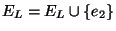
 . go to step 7. Otherwise let
be the edge in with the largest weight, let
. go to step 7. Otherwise let
be the edge in with the largest weight, let  .
. then
then
 ,
,
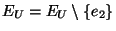 , go to step 4. and is coloured with
and alternately. If the path contains locked edges, then let
,
, go to step 4.
Otherwise
exchange the colours and on the path, let
,
, go to step 4. from the graph. Rename
the remaining graph as , go to step 2.
, go to step 4. and is coloured with
and alternately. If the path contains locked edges, then let
,
, go to step 4.
Otherwise
exchange the colours and on the path, let
,
, go to step 4. from the graph. Rename
the remaining graph as , go to step 2.
This algorithm is a descent algorithm, in the sense that given a colouring scheme of a graph, applying REDUCE will always produce a colouring scheme with a cost not more than that of the original scheme. This is proved in the following theorem.
Theorem
The algorithm REDUCE applied to an edge-coloured graph results in
a colouring scheme with the cost
not more than that of the original colouring scheme.
Proof
In the algorithm, the only place where the colouring scheme
might be modified is at step 6, when
a path with non-locked edges, coloured with
and alternately, is found and the two colours
are exchanged. On this path, and in fact among
all unlocked edges, is the edge with the largest weight.
When the colour and are exchanged, the cost for colour
remains equal to the weight of , because
this is the edge with the largest weight among all the
edges in the current graph. The
cost for colour will not increase because those edges that changed
their colours from to have weights smaller
than that of the edge , as is the edge in
with the largest weight. Therefore overall, the cost of the
new colour scheme will not be more than that of the original colouring scheme
In the actual implementation of the algorithm, if the cost is reduced, then the algorithm is restarted on the new coloured graph. This process is repeated until no further reduction is possible.

 ;
(b)
;
(b)  ,
,  , path
 Exchange colours and on the path. Lock and ;
(c) No more improvement possible. Remove colour
Exchange colours and on the path. Lock and ;
(c) No more improvement possible. Remove colour  (d)
(d)  ,
,  , change colour of
to . Lock and
, change colour of
to . Lock and  (e) No more reduction possible, final scheme with communication cost
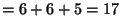
An example is given by the graph in Figure 3 (a). The process of applying REDUCE to the graph is shown in Figure 4. As a further example, applying the algorithm to the scheduling scheme of Table 4 gives the scheduling scheme of Table 5, the cost is reduced from 36 to 26 - a significant saving.
| Processor |
|
||||
| 1 | 12 ( 2) | - | - | - | 9 ( 2) |
| 2 | 3 ( 3) | 11 ( 3) | 10 ( 1) | 13 ( 6) | - |
| 3 | 2 ( 3) | 12 ( 1) | - | 10 ( 4) | 11 ( 8) |
| 4 | - | - | 7 ( 3) | 14 ( 5) | 15 ( 6) |
| 5 | 10 ( 4) | - | - | 9 ( 2) | - |
| 6 | 16 ( 4) | - | - | 11 ( 4) | 12 ( 5) |
| 7 | 13 ( 4) | 10 ( 2) | 4 ( 3) | - | 14 ( 6) |
| 8 | - | - | - | 15 ( 6) | 16 ( 6) |
| 9 | - | - | - | 5 ( 2) | 1 ( 2) |
| 10 | 5 ( 4) | 7 ( 2) | 2 ( 1) | 3 ( 4) | 13 ( 10) |
| 11 | - | 2 ( 3) | 12 ( 2) | 6 ( 4) | 3 ( 8) |
| 12 | 1 ( 2) | 3 ( 1) | 11 ( 2) | 16 ( 6) | 6 ( 5) |
| 13 | 7 ( 4) | 14 ( 3) | - | 2 ( 6) | 10 ( 10) |
| 14 | - | 13 ( 3) | - | 4 ( 5) | 7 ( 6) |
| 15 | - | - | - | 8 ( 6) | 4 ( 6) |
| 16 | 6 ( 4) | - | - | 12 ( 6) | 8 ( 6) |
| max. |
4 | 3 | 3 | 6 | 10 |
| comm. cost | 26 | ||||
When the algorithm REDUCE terminates, it is not necessary that a global minimum has been found. For that reason we will also test an algorithm which takes the best result for ten runs of the algorithm REDUCE, each run starts with randomly permuted edge and vertex indices. This algorithm is denoted as REDUCE10.
The three algorithms are applied to the communication task graphs resulting from partitioning five meshes of various sizes (given in the column ``mesh'' of the table) using a spectral bisection algorithm. The number of colours and the cost of the colouring scheme generated by the three algorithms are given in Table 6.
 |
mesh | COLOUR | REDUCE | REDUCE10 |
| 16 | 771 | 6/44 | 6/34 | 6/30 |
| 16 | 788 | 5/36 | 5/26 | 5/25 |
| 16 | 3564 | 6/74 | 6/59 | 5/56 |
| 16 | 5520 | 5/385 | 4/216 | 4/216 |
| 32 | 353710 | 17/4678 | 17/2042 | 17/2028 |
| 64 | 353710 | 28/4140 | 28/1853 | 28/1823 |
| 128 | 353710 | 36/3433 | 36/1214 | 36/1196 |
| 256 | 353710 | 37/2715 | 37/930 | 37/902 |
From Table 6 it is clear that both the algorithms REDUCE and REDUCE10 improve significantly the cost of the colouring scheme given by the algorithm COLOUR.