William Herschel 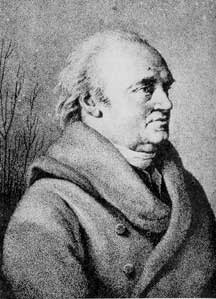
(1738 - 1822 AD) English astronomer who, after constructing the largest reflecting telescope of his era, discovered Uranus, Oberon, and Titania in 1781. He was a patient, careful observer, who visually scanned the entire northern sky. His catalog of extended objects was compiled into the New General Catalog of Nebulae and Clusters of Stars by Dreyer. He constructed a map of the galaxy based of the observed distribution of stars. Herschel discovered infrared radiation by noticing that the region beyond the red end of the spectrum would cause a thermometer to indicated an elevated temperature. This amounted to a conversion from light into heat. In 1820, he showed that right- and left-handed quartz caused rotation of the plane of polarization of light in opposite directions. |