Christian Doppler 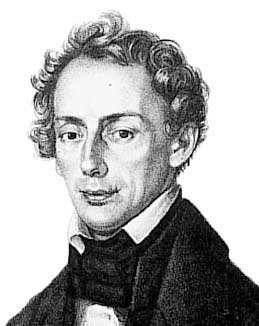
(1803 - 1853 AD) Christian Doppler was an Austrian mathematician who lived between 1803-1853. He is known for the principle he first proposed in Concerning the coloured light of double stars in 1842. This principle is what is now known as the Doppler Effect. He theorized that sound waves from a moving source would be compressed or expanded, or that the frequency would change. This theory wasn't tested until 1845. In 1845, Doppler set up an experiment using two groups of trumpeters, all who had perfect pitch. One group set up at a train station while the other set up on a train car that was to be pull past the station. Both groups were to play the same note and Doppler's theory stated that the notes would be dissonant (that the frequencies would be different). This turned out to be true; the notes were audibly different, even though both groups of musicians were playing the same note. Later, a scientist named Fizeau generalized Doppler's work by applying his theory not only to sound but also to light. **The preceding information is provided by the University Corporation for Atmospheric Research's Windows to the Universe.** |