James Clerk Maxwell 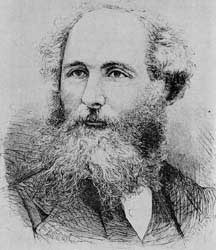
(1831 - 1879 AD) Scottish mathematician and physicist who published physical and mathematical theories of the electromagnetic field. When he first became interested in electricity, he wrote Kelvin asking how best to proceed. Kelvin recommended that Maxwell read the published works in the order Faraday, Kelvin, Amp�re, and then the German physicists. Maxwell wanted to present electricity in its most simple form. He started out by writing a paper entitled "On Faraday's Lines of Force" (1856), in which he translated Faraday's theories into mathematical form, presenting the lines of force as imaginary tubes containing an incompressible fluid. He then published "On Physical Lines of Force" (1861) in which he treated the lines of force as real entities, based on the movement of iron filings in a magnetic field and using the analogy of an idle wheel. He also presented a derivation that light consists of transverse undulations of the same medium which is the cause of electric and magnetic phenomena. Finally, he published a purely mathematical theory in "On a Dynamical Theory of the Electromagnetic Field" (1865). Maxwell's formulation of electricity and magnetism was published in A Treatise on Electricity and Magnetism (1873), which included the formulas today known as the Maxwell equations. Maxwell also showed that these equation implicitly required the existence of electromagnetic waves traveling at the speed of light. He also proposed a physical theory of ether. He abandoned attempts to formulate a specific mechanical model, instead using the formalism of Lagrangian mechanics. With Clausius, he developed the kinetic theory of gases. In "Illustrations of the Dynamical Theory of Gases" (1860), he showed the velocity distribution of molecules was "Maxwellian." His studies of kinetic theory led him to propose the Maxwell's demon paradox in a 1867 letter to Tait. Maxwell's demon (termed a "finite being" by Maxwell) is a tiny hypothetical creature that can see individual molecules. He can make heat flow from a cold body to a hot one by opening a door whenever a molecule with above average kinetic energy approaches from the cold body, or below average kinetic energy approaches from the hot body, then quickly closing it. This process appears to violate the second law of thermodynamics, but was used by Maxwell to show that the second law of thermodynamics is a statistical law describing the properties of a large number of particles. Maxwell also observed in private correspondence that the time reversal of all events was consistent with the laws of dynamics, but inconsistent with the Second Law of Thermodynamics. Maxwell published his views on the limitations of the Second Law in Theory of Heat (1871). Maxwell made numerous other contributions to the advancement of science. He argued that the rings of Saturn were small individual particles, performed experiments which showed the viscosity varied directly with temperature, derived the equipartition theorem, and tried to describe spectral lines using a vibrational model. **The preceding information is provided by the Eric Weisstein's World of Scientific Biogra.** |