

















| |
||||
| |
|
|
||
| |
||||
| |
|
|
||
| |
||||
| |
|
|||
| |
||||
| |
||||
| |
||||
| |
||||
| |
||||
| |
||||
| |
||||
| |
||||
| |
||||
| |
|
|
|
|

A HISTORY OF CONTROVERSY
Christian art is nearly as old as Christianity itself, and controversy over Christian art, even over whether there should be such a thing as Christian art, isn't much younger.
The earliest surviving Christian image (discovered so far!) is ************ and the earliest image of the Eucharistic feast is *******
Offensive to Jewish Christians, artistic representations of Christ and his saints flourished amongst the gentile Greek and Roman Christians who were already familiar with the use of representative art as an aid to worship and prayer.
Much later, The Byzantine Empire and the Greek Orthodox form of Christianity that flourished throughout the empire in the Middle East as well as Greece, was challenged theologically by the rise of Islam.
This Greek and Middle Eastern Christian culture had developed a sophisticated form of iconic representation of Christ, of the Apostles, the saints and martyrs, the Blessed Virgin and even the Holy Trinity. Islam, on the other hand, taught that trying to compete with God's creative work by copying it was blasphemous (think Frankenstein) and therefore that images of things God created – and especially images of God Himself – should not be made or used.
Islam, instead, explored the beauty of calligraphy and organic and geometric patterns as a way of artistically expressing the mystical experience of the Divine.
So the controversy within Christianity began, and much fighting, It is sad to say that much that is unjust and unchristian was done in His name by both sides of the Iconoclast Controversy. Inspired by islamic iconoclasm, this controversy was not the result of muslim agitators but was rather internal to Christianity. Christian thinkers found themselves re-evaluating their approach to God and it is in this climate that the theology of icons and its analogy to the Incarnation was most fully and rigourously developed.
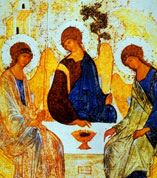 |
EARLY ICONS This image of the Blessed Trinity shows the full audacity of the art. To many (Christian and non-Christian alike), to think that God in his full Glory and unrestrained Being as the unknowable and hidden ground of all Reality could be adequately depicted in the form of His creatures was at best ignorant and indiscreet and at worst a blasphemous slur against God. But, answers the iconic tradition, God's Love is such that He came ‘down' to this created world as a man and in doing so lifts us ‘up' to His own divinity. All Icons, they say, proclaim by their very nature the Mystery of the Incarnation that is the centre of all Christian faith. Rublev's Hospitality of Abraham interprets the Old Testament story as a prefiguration of the Christian experience of God in Trinity. |
Much was written for and against the veneration of icons. For a short while, under Emperor Leo the Isaurian, icons were officially banned throughout the Empire, but not for long.
Later of course, the controversy would re-emerge in western Europe as a part of the Protestant Revolution. Martin Luther, John Calvin, their peers and successors all frowned upon the use of images in worship and many artworks inside churches were painted over and stained glass windows, depicting episodes from the Bible or the lives of the saints, were smashed as idolatry and replaced with clear glass and new churches were largely unadorned.
The windows in the Anglican church at Elphinstone, built following this tradition, are clear glass and, emphasize the iconoclast's point – those windows open onto the beautiful bush setting in which the church building is situated and prove that, for all their glory, the art of Christchurch's windows cannot hope to compete with the artistry of God Himself in the glorious and humble work of Creation.
MUHAMMAD AND THE CHRIST CHILD There are many historical details that are known of the life of the Prophet Muhammad and the rise of Islam. For many Muslims, next to the Koran in sanctity are the accounts of the life of the Prophet, for he lived the perfect human life and serves as an example for all Muslims. These collections, called hadith, were carefully and meticulously collected and written down that they might never be lost. Their compilers followed the stories to an eyewitness account, or as many as can be found, by a reliable and trustworthy source known for honesty and integrity. The proper study of hadith involves not just the interpretation of the accounts but also weighing up the value of the accounts and the integrity of the witnesses. This is one such account. When Islam was accepted by the city of Mecca (without a drop of blood being spilt) The Muslims gained access to the Kab'ah, a cube shaped, black draped shrine that marks the spot where Adam and Eve, and then Abraham and Ishmael, built shrines to God. Their most Holy site, its sacred inner chamber had been profaned with the pagan idols of a multitude of gods. Like Christ overturning the tables of the moneychangers in the Temple , Muhammad had the idols destroyed. Much earlier, when a Roman Emperor attempted to have idols of himself set up in the Jewish Temple in Jerusalem , it had caused a violent and widespread Jewish revolt. But there was, amongst the eclectic mix of idols, a Christian statue of the Madonna and Christ Child. The Prophet covered their eyes with his hands, shielding them from the destruction, and declared that this image of the Prophet and Christ of Islam and His Virgin Mother, an image sacred to fellow ‘People of the Book' was to be unharmed. |
The Byzantine Empire, or the Eastern Roman Empire survived the collapse of Rome and the Western Empire to the ‘barbarians' of the north and which, centuries later retained the seat of an ancient and Christian culture and empire at Constantinople, now Istanbul, and which remained a highly advanced civilization and the single largest Christian Empire until the middle ages and the advance of both Muslims and Western Christians into their territories.
The capital of Byzantium —oriental and Greek influences. Helped return the learning of the ancient world to the Europe.
Due to the rise of Islam and local Christian iconoclasm, it was eastern Christianity that was most pressed to explain coherently and in line with the faith the fundamental validity, purpose, theology, practise, and veneration of icons.
From very early on opinions about sacred images were tied very closely to theology. Here are a few:
The nature of the Trinity—the highest Christian expression of God—
The Incarnation and the questions about whether Jesus was man or God (He is both) and in what way he is both—
The relation between God and the world He created—
The nature of the sacrament —
In short, sacred art and the most fundamental aspects of Christian theology are tied together. These are Mysteries proper, the bedrock of the faith that cannot be reasoned out but only experienced directly. In essence, the many kinds of deep Christian life all spring from the most scientific of bases.
Such debates go back to the days of Christ himself. His answers often gave rise to even more difficult questions. But it all leads the questioner to a greater understanding of him or her self and of God; the questions guides the pilgrims along a sacred way that, for all the guidance and support available, they must finally walk the path and arrive at the sacred destination, the centre of the world and themselves, the Throne of the Compassionate, alone.
It takes time to understand Christ—and through Him the Blessed Trinity—because one cannot know Him through books or other kinds of instruction. One can only know Him through direct experience, Person to person. There are no eyewitnesses, only participants and non-participants.
“He who is not with us is against us.”