


















| |
||||
| |
|
|
||
| |
||||
| |
|
|
||
| |
||||
| |
|
|||
| |
||||
| |
||||
| |
||||
| |
||||
| |
||||
| |
||||
| |
||||
| |
||||
| |
||||
| |
|
|
|
|

THE ART OF THE ICON
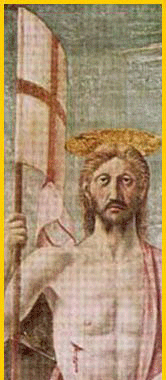
While western forms of Christian art became very lifelike and human, especially in the Roman period (***)and during and since the Renaissance, during the long middle ages (***) and always in the Eastern Church, images of the holy people of the faith have been crafted with an unearthly appearance. They are recognizably human but also different. On the wall of the chapel is seated a small reproduction of an icon of Pope John XXIII, who led the Catholic Church through the Second Vatican Council, which sought to adjust the course of the “ship of souls” towards the life of the people of this modern age. It is a lovely icon, and recognizably western, for his face is rendered accurately – it represents his human appearance. Not so for the icons behind the altar.
The Eastern iconic tradition has chosen, in its art, to represent the glorious and spiritual body that was glimpsed by some of the disciples when Christ was transfigured on Mount Tabor .
And after six days Jesus taketh Peter, James, and John his brother, and bringeth them up into an high mountain apart, And was transfigured before them: and his face did shine as the sun, and his raiment was white as the light. And, behold, there appeared unto them Moses and Elias talking with him . … a bright cloud overshadowed them: and behold a voice out of the cloud, which said, This is my beloved Son, in whom I am well pleased; hear ye him. And when the disciples heard it, they fell on their face, and were sore afraid. And Jesus came and touched them, and said, Arise, and be not afraid. And when they had lifted up their eyes, they saw no man, save Jesus only. And as they came down from the mountain, Jesus charged them, saying,
“ Tell the vision to no man, until the Son of man be risen again from the dead. ”
The Gospel according to St. Matthew, 17:1-3, 5-9
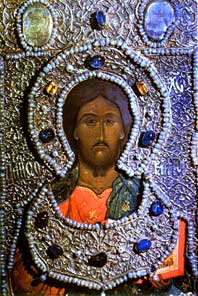 |
SHIELDING THE SACRED This icon of the Saviour is lavishly decorated with a cover of silver and precious and semi-precious stones. This is indeed a cover, for the icon itself is painted underneath with the same care and devotion as the visible areas. In part it serves the same purpose as the veil of the Jewish Temple, which kept hidden and unprofaned the sanctuary, the Holy of Holies where God's Presence, His Shekinah , dwelt on Earth until the destruction of the Temple by Imperial Roman forces in ****. This symbolic veiling also occurs in the Islamic tradition: the Muslim hijab shielded the Kaliphah , the spiritual and temporal leader of all Muslims and a direct descendent of the Prophet Muhammad from the gaze of others. Ideally, the hijab or head covering that a Muslim woman may chose to wear also protects the Holy and Hidden from the indiscreet gaze. The Ka 'bah, the sacred cubic ***shrine**** sacred to all Muslims is covered in black cloth. The Ka 'bah also contains a small inner room which is kept empty and sealed and where God's Presence dwells amongst us. In all these traditions descended from the Biblical Patriarch Abraham, that which is covered and hidden because it is most Holy is on the most special Holy-days, opened and entered into. For the Christian, this opening up of the most Holy Creator to His creatures in the fullness of divine Life is made available once and for all in the ‘perfect and sufficient sacrifice' of Christ on the Cross, in sympathy of whom and as a tangible message of the ‘good news': ... the veil of the temple was rent in twain from the top to the bottom; and the earth did quake, and the rocks rent; And the graves were opened; and many bodies of the saints which slept arose, And came out of the graves after his resurrection, and went into the holy city, and appeared unto many. Now when the centurion, and they that were with him, watching Jesus, saw the earthquake, and those things that were done, they feared greatly, saying, Truly this was the Son of God. The Gospel according to Matthew, 27:51-54. Despite this , a liturgical cycle of occlusion and revelation reminds the worshipper—of whichever faith—that the gift that is offered by God is absolutely astounding and must not be taken for granted. So we all undergo, in our own human lives as well as in the liturgical year, periods of separation and grief and periods of union and joy. In and through both the gift of Grace is offered. One who has chosen to accept this gift, this Grace, undertakes the sacrament of baptism. |
At this moment, the Incarnate Christ revealed His true nature to the disciples, a nature which is His by right of His divinity and which is given as a gift to those who accept it by right of adoption. The ancient tradition of the Church Fathers, which is the common theological inheritance of all Christian traditions, makes it clear: What Christ is by nature, we become by Grace.”
So, the icons of the Eastern tradition show the true transfigured and glorified nature, given by God's grace, in the images of the blessed saints. These are, after all, not merely pictures of saints but, and this is the key to all such iconography (including non-Christian arts), windows to Heaven. They are painted as more than we understand by ‘human' (THE TWINKING OF AN EYE PASSAGE) because they is what they, in their heavenly presence (and for some, in their lives), are. They remind us by their presence – even only through this window – that we are invited to join Them.
PRAXIS AND THEORIA
Artistic conversations are interesting and help reveal the intriguing history of the art of the icon but they are hardly the main issue! An Icon, and icon, is sacred art; its history is secondary because what it seeks to reveal is eternal. The truths of sacred art are true for all people at all times. The iconographer asks not that they be acclaimed; they are mot the icon, acclaim instead the truth that can be glimpsed through the window!
What we want to explore is not the bare details of the icon but rather its heart. It is made for that purpose, that is its place, its use. To consider its age or origin is comfortable but the icon asks us to stand on the edge of an abyss and, at the edge of our created natures confronted with the uncreated, to gaze into that Uncreated and Infinite nature and to allow ourselves, the Holy Spirit that is our true selves by rite of baptism, to gaze upon Itself, reflected, so to speak, as in a mirror. This is what the icon asks of its viewer; for this reason (but not this alone) it is venerated. To ‘use' the icon as a sacred instrument to risk having one's heart pierced by love, to risk being swept away—of being enraptured— and of being challenged to the quick of life. It is a place to learn the fear of God and the Love of God. It is a beautiful art form, exquisitely beautiful, but to view an icon properly takes courage.
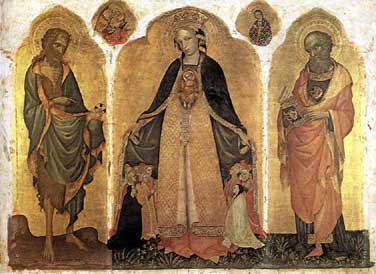 |
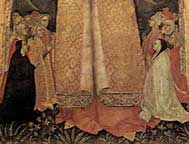
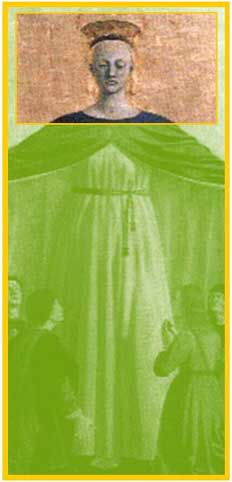
The Western Style This beautiful triptych image shows the Virgin Mary flanked by Sts. ****** (PETER AND PAUL??). It is lovingly painted and is decorated with gold leaf; the haloes are further embossed. This image type is known by the Latin name 'Madonna della misericordia', The Mother of Mercy. It shows the Holy Virgin, crowned as Queen of Heaven, in her role as comforter to the faithful in their sorrows and as Intercessor for us with Her Divine Son (see detail below). In its own way it reflects many of the same qualities of the Virgin Mother as does the orthodox icon of Madonna and Child in our Chapel. The standards for depicting these Holy people are followed. It is recognizably western in style: the Madonna and saints (and the Christ Child enthroned in Her Compassionate Heart) are carefully rendered as human beings—ideal humans in many ways (Her high forehead follows the fashion of genteel beauty of the time)— but nevertheless human people as we are people. Compare this with the image to the right: it is also western art but here the artist has chosen to reveal the Madonna with an impassive austerity, a royal untouchability that is human but certainly more ‘other' than our first example. |
 |
MY BEST FRIEND JESUS
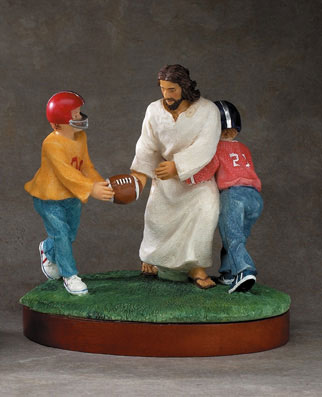 This cake-decoration (or perhaps mantlepiece ornament) is made with an artistic sensibility that is the opposite of the orthodox iconic tradition. Jesus here is as normal as the boys with whom he plays gridiron; He is an older brother or friend, or perhaps a loving father: the best brother, friend, father that could be hoped for.
From the Orthodox perspective, however, because—being human ourselves—it is easier for us to understand the human nature of Christ than it is to understand His divine nature it is important to make helping lovers of Christ come to understand that divine nature a priority in our sacred art. Otherwise, we and they are in danger of over-sentimentalizing our relationship with the Saviour, of turning it into a pop-song love affair when it is really a relationship far grander than that. In the divine-human Person of Jesus Christ, God is our most intimate and trustworthy companion, friend, confidant, guide and guard, even lover (in the highest possible sense of the word): but He is also God Supreme— only Son of the Father, begotten not made, true God from True God, of one being with the Father—and our relationship with Him must respect and seek to understand that, as we would seek any person we would call our best friend.
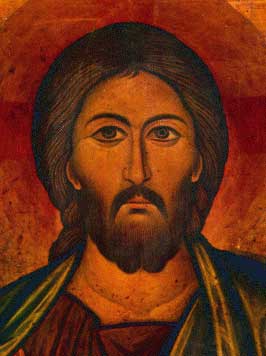 |
THE FACE OF GOD This detail of an icon of our Lord as Pantocrator (Ruler of All, as He will show Himself victorious at the Second Coming) shows the more Eastern Christian preference for a face of God and the saints that both reveals them and also preserves their divine mystery. |
The Fear of God
Despite popular caricature, the fear of God is not the fear of a bully with a big stick. Philip Sherrard explains the ‘fear of God' beautifully and succinctly. He writes that it:
“ ...is not abject terror but the voice of conscience and the dread of contaminating something which is pure. ...without which all relationships of genuine love are impossible; and they constitute something very different from compulsory obedience.”
The fear of God and the love of God cannot be separated—they are two interdependent human responses to the awe-ful Presence of the Holy, the Truly Other.