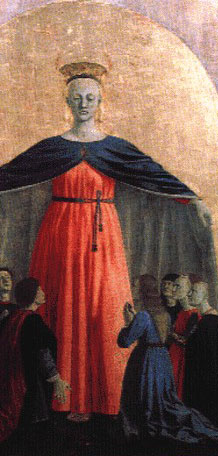
“I believe in Christianity like I believe that the sun has risen:
not only because I see it, but because by it I see everything else.”
- C.S. Lewis
 |
||||
 |
 |
 |
||
 |
||||
 |
 |
 |
||
 |
||||
 |
 |
|||
 |
||||
 |
||||
 |
||||
 |
||||
 |
||||
 |
||||
 |
||||
 |
||||
 |
||||
 |
|
|
|
|
THREADS OF CHRISTIAN THOUGHT
Christian theology—perhaps all theology—begins with a direct experience.
In the case of Christianity it is a direct personal experience of God in the Person of Jesus Christ. This experience and the relationship it implies is a puzzle as much as an answer. The Gospels show us a man who answered questions with more questions and with riddles or jokes. His disciples rarely knew what to make of Him, yet the reality of their experience (and of the Christian experience in general) in undeniable.
For the centurion who pierced His side it came at that intense climax of His mortal life as he stood there, his spear and hands drenched, while the earth shuddered and the heavens themselves gaped open around him.
For most Christians however it is a much less cosmic affair, often takes much longer, but is no less real or significant.
In other words, theology is—or at least should be—inherently mystical. If it's not, then the theologian has no idea what they are talking about.
For Vladimir Lossky (one of the foremost Russian theologians of the 20th century), this also went the other way: If mysticism is not theological then no one else knows what you are talking about! And maybe no one at all.
The common language of theology provides not just linguistic tools but also conceptual ones. It's purpose (and the purpose of doctrine) is to provide fruitful models of thought and dialogue on a subject, God, that is essentially beyond both thought and speech.
One may be guided by a guru or confessor or staretz but one but is also guided by Tradition as a teacher of wisdom, advisor of life and guard against self-delusion.
It is to the Christian Tradition as teacher, guide and guard that this is website is dedicated. We do not question her faithfulness to her people or her endurance and patience. She remains, undiminished, regardless of our deficiencies and obstinancies.
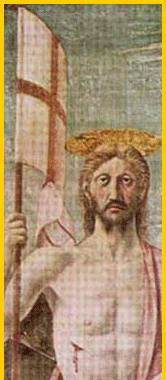
Thanks to the Paraclete, the experience of the Risen One, made by the apostolic community in the origins of the Church, will always be able to be lived by successive generations, in the measure that it is transmitted and actualized in faith, in worship and in the communion of the People of God, pilgrim in time.
Pope Benedict XVI
Features
Frithjof Schuon on Christianity A Muslim luminary writes on the Christian Tradition. |
|
| WIndows Unto Heaven - A journey into the tradition of Icons |
What does Christian Mean?
Christianity is a variegated tradition; a tree with many branches. The variety is bewildering, and it is easy to think that there is nothing in common between, say, Greek Orthodox and western 'evangelical' movements except the name 'Christian'. But there is, I think, a core of beliefs that are universal to Christianity and more than universal, essential. The exposition of these is not arbitrary; these doctrinal points are not modular, the faith is not a lego construction. Instead, they link together, dance around and explain each other. The absence of one of more of these points destroys the faith. Deny Christ's Godhead and one is left with nothing but a moral philosophy, a political movement or a Jewish sect become deviant.
Christianity is a rich tradition that embraces great diversity and the differing branches often hold differing views of various beliefs, perform different liturgical practises or recognise different imperatives in the Christian message. At times, these differences have caused friction and even violence and mutual excommunication. But despite these tensions there is still a common core that we can call uniquely Christian, a universal fraternity and shared paternity that endures even if it is not always recognised.
These essential and interdependent elements of the Christian Tradition are:
THE INCARNATION The absolutely central and indispensable core of Christian belief. Jesus is the Christ and He is God. Addresses the question: how are we to understand this experience of God we have had in this person Jesus? The Word of God revealed Himself not as a book (such as Torah or Koran) but rather as a Person. In other words, it is the Incarnation—not the Evangelist—that is the backbone of the faith.
|
|
DEATH AND RESURRECTION With the fullness of the Incarnation comes the fullness of Christ's humanity, even unto death. And with the Fullness of His Godhead and His saving Gift to us comes the Resurrection and Ascension into Heaven. These first two points describe the experience of the Earthly Christ. From this springs the question: What are we to make of this event? In this is established the experience of Reality that is the foundation of theology. |
|
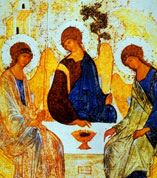
THE TRINITY If Christ is God then how does that work? This question naturally arises out of the affirmation of the Incarnation. God as Trinity; One Essence and Three Persons undivided and unmixed, unique and identical. This is not only a 'how does it work' response to the Incarnation but also an intimate insight into the nature of God Himself and what is meant by Divine Love. |
|
MONOTHEISM There is One God. No concept of Trinity may break this understanding. There is one God who created the world and gave the Hebrews his Word and Covenant in the Torah. This is the same God who gave His Word and covenant in the Person of Christ. |
|
CHRISTIANITY IS SACRAMENTAL As Christ sanctified the World with His Presence so the Church, in continuing His work, is called to act in a sanctifying way. This includes but is not restricted to liturgical life and a recognition of the Real Presence of Christ in the Eucharistic Feast |
|
ORTHODOXY Less a point in itself and more a summation of the beliefs above, orthodoxy is meant in the broadest possible sense. Orthodoxy is an expression of Union and Communion. Doctrinally, the foundation of Orthodoxy is the formulae of Ecumenical Councils. These Councils represent the broadest possible consensus of Christians and most of the greatest thinkers of the age were involved. These councils gave an intelligible but open-ended answer to the question What does ‘Christian' mean? This tradition embraces the Orthodox churches of the East, the Roman Catholic and some Protestant churches and many different forms, cultures, beliefs and practices. Orthodoxy is not a straight jacket (or at least isn't meant to be) but a complete articulation, multi-vocal but harmonic, of the experience of God. It makes the deeply personal experience of God sharable with others—at least vicariously—through all possible modes of communication; from the academic to the devotional to the artistic or even to facets of everyday life. Its discipline is much the same as the training required to produce a good performance of a Mozart concerto or learning to read and write, or paint, or dance, or sing. Orthodoxy is a way of sharing. What was lost to the inhabitants of Babel is in a way rediscovered in Orthodoxy. It does not stifle thought or speech but provokes them. Like Christ, it demands of us a response. A response, however, in good faith: struggle rather than glib dismissal. We are asked not to wash our hands of it but instead to roll up our sleeves and get to work. |