



















| |
||||
| |
|
|
||
| |
||||
| |
|
|
||
| |
||||
| |
|
|||
| |
||||
| |
||||
| |
||||
| |
||||
| |
||||
| |
||||
| |
||||
| |
||||
| |
||||
| |
|
|
|
|

The First Icons
There are three popular stories about the very first Icons and they are all quite different; one takes place (St Veronica's story) minutes before the Crucifixion, another (St Luke & The Virgin) some decades after His Death and the third a number of centuries later. As mythos, the stories spring from different sources, but they all have one thing in common - They are directly of Christ.
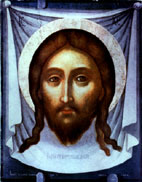 |
THE ICON NOT MADE BY HUMAN HANDS An icon of the headscarf of St. Veronica. While this episode is not related in the Gospels or Acts, this piece of Christian lore, an imaginative expression of the Incarnate Presence of the God who chose—and still chooses—to be as we are. |
SAINT VERONICA
According to a legend, whose popular form dates from the middle ages, when Christ fell under the weight of the Cross on the way to Calvary to be crucified, a woman gave Him her headscarf, so that He might wipe away the blood and sweat from His face. When the Lord returned the headscarf it carried the imprint of His Incarnate face. Saint Veronica, as the woman is known, received from the hands of the Lord Himself the very first image or icon of the face of Christ. Many manmade icons have been written of this first, Godmade, icon.
KING ABGAR
Definitely my favourite story of the acheiropoietos, the icon not made by human hands.
In about the third or fourth century the ruler of a middle eastern kingdom - King Abgar, struck up a correspondence with Christ. Letters were exchanged and King Abgar asked The Lord to send him a picture of Himself. Christ ascented and sent King Abgar a portrait. An icon of Christ painted by the Word of God Himself.
ST LUKE & THE VIRGIN MARY
The mythos of St Luke the Evangelist and his relationship with with the Blessed Virgin is well known: Like St Paul, St Luke never knew the historical Person of Christ but while Paul wrote with the authority of the Ascended Christ rather than those who knew his bodily Person, Luke, it was said (before the so-called 'higher' criticism) wrote his Gospel - the gospel that gives us the nativity story - from first hand accounts and particularly from the direct testimony of the Blessed Virgin Herself. St Luke also painted her portrait while he was with Her.
Saint Veronica's Icon (the most well known) testifies to, records, and opens into the historical earthly Christ at the penultimate moment of His Passion; the cloth of her headscarf touched his Incarnate face. The other two myths articulate the experience of and encounter with Christ Ascended. St Veronica's Veil and the icon written by Christ Himself for King Abgar are most truly called acheiropoietoi, icons made without human hands b ut St Luke's icon of the Madonna and Child is a different case: it was written by St Luke not by Christ, it is a portrait rather than a self-portrait.
This peculiar, and very touching, account articulates a somewhat different experience of Christ. The window that is an icon opens directly onto its subject, capable of piercing through into Heaven.