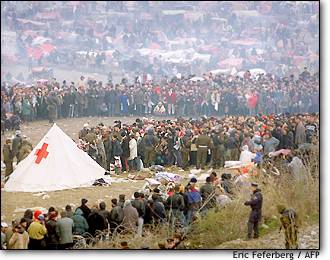
Hundreds of ethnic Albanian refugees from Kosovo line up to be registered by the Red Cross
in a camp after flooding over the Yugoslav-Macedonian border.
Albanians’
plight recalls history on Jewish holiday
By Martin Fletcher from NBC NEWS
SKOPJE, Macedonia, April 5 - Sunday’s Passover meal was a moving moment shared by
the few Jews and Israelis in the Aleksandar Hotel in the Macedonian capital. We were all
far away from our families during this important Jewish festival, but none of us much
minded.
Television journalists all, we were here to report on another exodus, this time not of
Jews, but of Muslims - Albanians fleeing a brutal and systematic campaign of killing,
looting and burning by Yugoslav Serbs.
We didn't have much for the Passover Seder: half a pack of matzoh, unleavened bread,
some lettuce and 12 boiled eggs. At first we spoke in murmurs and glanced around
surreptitiously, hoping not to draw too much attention in the restaurant.
But following the requirements of the Haggadah, the prayer book that guides Jews
through the festival, the noise level rose as we sang and prayed. Soon Christian friends
joined us in toasts of red wine and then we were laughing and shouting and felt no need to
be discreet. We had nothing to hide.
Soon, after a few drinks, the talk turned inevitably to the tragic and heart-wrenching
events we were witnessing. Everyone had their tales. One remembered a small dark man
trudging down the railway track from Kosovo, struggling with the burden of his frail old
father who lay across his shoulders, his paralyzed legs sticking straight out, as if
pointing the way.
Another, with reddened eyes, recalled the girl wrapped in a red blanked like little red
riding hood, lost in a wretched mass of desperate refugees. Huge, staring eyes wet with
tears, she was walking around in circles, calling out for her mother or father or for
anybody who knew her.
HISTORICAL REPETITION
There were the women lining the railway track, frantically scanning the exhausted new
arrivals from another trainload of refugees, searching for a familiar face, hoping to find
a husband, father or son. Many men were separated from their women, and all the women had
heard the rumors of shootings and massacres.
The Israelis at my table were hardened young men - news cameramen and sound recorders,
ex-paratroopers from the Israeli army who knew war firsthand. They all said at one time or
another they had to stop work to wipe tears from their eyes.
One told me that when he saw an old women fainting from fatigue, falling into the mud
at the roadside, he could only think of his grandmother who was marched by the Nazis to
her death in the Buchenwald concentration camp. In the present, he saw the past that he
escaped by being born a generation later.
All had the same awful association. These Muslims reminded them of their Jewish
ancestors who died in the holocaust. And the trains crammed with refugees from Kosovo, who
had been herded like cattle by the Serbs, indeed reminded me of my family’s past.
INDELIBLE IMAGE
I am thinking of what I witnessed Sunday morning. I was in the home of an Albanian Muslim.
In her living room were 12 refugees from Kosovo. Another arrived, a 76-year-old woman who
looked 120. Her face was more deeply lined than any I have ever seen, her eyes sunken and
staring and her skin a jaundiced yellow.
The Serbs forced this tiny old lady at gunpoint from her home, she said. They forced
her onto a train crammed with 9,000 people. After a seven-hour journey during which she
stood all the way in a human crush, she was dumped into an open field with no food or
water or even a blanket to warm her during the freezing and rainy nights.
After three days of unimaginable strain and misery, having swapped one hell for
another, she was finally allowed to enter Macedonia and rejoin those of her family who
fled Kosovo two days earlier.
I watched as she fell into her sister’s arms and both clung tight, sobbing loud
and long. All the refugees watched silently and my camera team filmed the reunion. As they
say in the movies, there was not a dry eye in the house.
I have covered refugee disasters in many places - Angola, Mozambique, Ethiopia, Sudan,
Somalia, Rwanda, Bosnia, Croatia - and it is always the same scene: fear, misery, death
and, for some, the joy of reunions. Reunion is the happy little sister of tragedy.
THE LUCKY ONES
Throughout my career, I have managed to avoid that hackneyed but accurate phrase to
describe these moments of joy. It is usually delivered with an ominous pause after the
first word - “These ... are the lucky ones.”
Perhaps it was the timing. The coincidence that this exodus of Muslims occurred at the
same time Jews remember their exodus from Egypt. It made me think of the exodus of my own
family from Austria.
I thought, as I rubbed tears from my eyes in a room full of sobbing people, that these,
indeed, are the lucky ones.
I did not mean they were lucky compared to the family members they left behind in
Kosovo, whose fate they did not know. I was thinking of my own family, the grandparents I
never knew. They, too, were forced at gunpoint from their homes, herded like cattle onto
trains and finally gassed to death in the extermination camps of Poland and Germany.
My grandparents and their aunts and uncles, their brothers and sisters, and their sons
and daughters did not have such luck. There were no reunions in my family. We didn’t
have any lucky ones. Except for my parents, who fortunately escaped from Austria just
weeks before World War II began.
So as I sit here and reflect on the past few tragic weeks, I guess my family has
something to feel lucky about after all.
NBC’s Tel Aviv-based correspondent Martin Fletcher is on assignment in
Macedonia.





 Disclaimer: The views expressed in the content and articles of this
website, do not necessarily express the opinions of the Zionist Organization of America,
nor the editor and creator of this website.
Disclaimer: The views expressed in the content and articles of this
website, do not necessarily express the opinions of the Zionist Organization of America,
nor the editor and creator of this website.