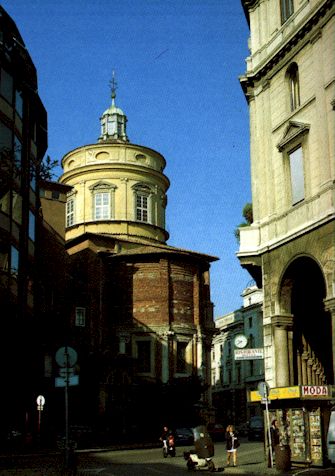
 St. Carlo Borromeo
 commissioned his favourite architect
Pellegrini to
design this church for the Jesuit order. Pellegrini's façade reflects the Baroque
concept of inspiring religious architecture. Decorative elements such as cornices
and columns enhance the splendour of the solid church structure, although the left
side with its double row of columns is much plainer and less agitated in comparison.
The magnificent interior has not been broken up by aisles, but divided into two
sections by arches originating from pilasters against the walls. In the church there
are several good paintings including: on the first altar to the right,
Saint
Ignatius Glorious by
Cerano; the second altar has curiously grouped
columns supported by angels and
Four Saints by
Bernardino Campi; the
first altar to the left,
Deposition by
Simone Peterzano. The XVI
century engraved confessionals which are very beautiful, are the work of the
Taurinis, while the wooden inlaid choir-stall near the apse, which comes
from the demolished church of
S. Maria della Scala, is attributed to
Anselmo del Conte (XVI century). The sacristy (entrance after the second
altar to the right) is said to be the most beautiful in Milan with its stupendous
carved cupboards.