ACADEMIC THE WEAVER AMERICAN F & SF
ON
BRITISH FANTASY AND SCIENCE FICTION
LORD
DUNSANY
Time and the Gods (1906)
SIR
ARTHUR CONAN DOYLE
The Lost World
The Poison Belt
J.R.R.
TOLKIEN
The Hobbit or There and Back Again
TERENCE
HENBURY WHITE
The Sword in the Stone (1939)
SIR
ARTHUR C. CLARKE
Expedition to Earth
JAMES
GRAHAM BALLARD
The Wind from Nowhere (1962)
The Drowned World (1962)
The Drought (1964)
The Crystal World (1966)
The Atrocity Exhibition (1970; rev.
ed. 1990)
Crash (1973)
Running Wild (1988)
BRIAN
ALDISS
Non-Stop
MICHAEL
MOORCOCK
Elric of Melniboné (1972)
The Fortress of the Pearl
The Bane of the Black Sword (1984)
Behold the Man
The Knight of the Swords
The Runestaff
JOHN BRUNNER
Jagged Orbit
The Shockwave Rider
M. JOHN HARRISON
The Pastel City
TERRY PRATCHETT
The Carpet People (1971, rev. ed. 1992)
The Dark Side of the Sun
Only You Can Save Mankind (1992)
Johnny and the Dead
Johnny and the Bomb
TERRY PRATCHETT & NEIL GAIMAN
Good Omens
TERRY PRATCHETT, IAN STEWART & JACK COHEN
The Science of
Discworld III: Darwin’s Watch (2005)
IAIN M. BANKS
Consider Phlebas (1987)
The Player of Games (1988)
The State of the Art (1989)
Use of Weapons (1990)
Excession (1996)
Inversions (1998)
Look to Windward (2000)
King Rat
Perdido Street
Station (2000)
The Scar (2002)
Iron Council (2004)
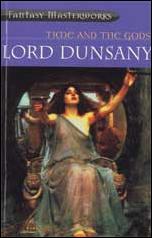
LORD DUNSANY – Time and the
Gods (1906)
(Collected in Time and the Gods, omnibus edition,
Fantasy Masterworks,
Gollancz, Orion
Publishing Group, London, 2003)
 While reading
some of the works of major authors in the field of fantasy (J.R.R. Tolkien, H.P.
Lovecraft, Robert E. Howard, Clark Ashton Smith), I became increasingly aware
that one influence they all shared was in the work of an earlier author, Lord
Dunsany. According to The Encyclopedia of
Science-Fiction, this Irish author’s full name was Edward John Moreton Drak
Plunkett. He was the 18th Baron Dunsany and lived between 1878 and 1957. His
descendants maintain a vast, rich, visually attractive website at www.dunsany.net
dedicated to his life and work.
While reading
some of the works of major authors in the field of fantasy (J.R.R. Tolkien, H.P.
Lovecraft, Robert E. Howard, Clark Ashton Smith), I became increasingly aware
that one influence they all shared was in the work of an earlier author, Lord
Dunsany. According to The Encyclopedia of
Science-Fiction, this Irish author’s full name was Edward John Moreton Drak
Plunkett. He was the 18th Baron Dunsany and lived between 1878 and 1957. His
descendants maintain a vast, rich, visually attractive website at www.dunsany.net
dedicated to his life and work.
I developed
an interest in Lord Dunsany’s fantasy works and in July 2006 I was lucky enough
to acquire an omnibus volume, Time and
the Gods, which contains no less than six collections of short stories. I
read the opening collection and I was pleasantly surprised to discover what
fantasy was like before editorial pressures, marketing strategies, computer
role-playing games and idea recycling took their toll.
Time and the Gods contains twenty short stories, most of which might have
been developed into thick fantasy novels by an author less generous with his
ideas. They illustrate two basic characteristics of fantasy writing: on the one
hand, fantasy feeds on the archetypal power of myths; on the other hand, it
does not have to recycle existing mythologies, as the author can simply imagine
new ones.
Imagination,
in fact, plays a key role in the collection. The opening short story, ”Time and
the Gods”, tells of young gods and their ageless servant, Time. They dream a
beautiful marble city into existence and, eons later, Time destroys it and the
gods weep for it. Imaginary powers clash in ”The Vengeance of Men”, in which
the gods ignore the prayers of desert tribesmen, who turn away from them and
build a city. The gods send Pestilence to decimate them and the High Prophet
imagines the gods’ end, making them uneasy forever. Imagination rules ”The
Dreams of a Prophet” and it feeds various visions of the after-life in ”The
Journey of a King” (though a mysterious hooded visitor who introduces himself
as THE END is the only one who can show the king what the afterlife is really like).
Quest is
also a recurrent theme. Unlike so many
characters in recent fantasy, however, Lord Dunsany’s gods and kings and
prophets do not go looking for treasure, fame or power (as a rule, they already
have those), but for more metaphysical aims. In ”A Legend of the Dawn”, various
gods go in search of a toy misplaced by Inzana, goddess of Dawn, child of the
gods. (And what if the golden ball that Inzana tosses across the sky were the
Sun itself?) In ”The Cave of Kai”, King Khanazar looks for the place where lost
days go. ”The Sorrow of Search” features two quests – one of travellers on the
road of knowledge, the other of a prophet in search of gods. Karnith Zo, the
young king in ”The Land of Time”, leads his army on a quest for Time’s castle
in order to destroy him and gain eternal youth.
Unlike
run-of-the-mill fantasy, which is usually predictable, Lord Dunsany’s stories
feature unexpected twists in the plot – some of which have more to do with the
pattern of Victorian parables than with fantasy. Thus, Time follows the besieging army back to its own country in
”The Land of Time”, ambushing and killing the soldiers one by one, and a neighbouring
nation invades the defenseless land. In ”The Secret of the Gods”, a prophet
overhears a secret of deities, but a serpent strikes him dead before he can
share it with other people. In ”The Relenting of Sarnidac”, a dwarf shepherd
who is ridiculed at home follows a procession of gods and, in another country,
is taken for a god himself – and worshipped. And, in ”The South Wind”, the
prophet Ord has a vision of the way in which Fate and Chance use gods as
chessmen in a game, but when he tries to pass this secret on the gods take his
sight, his hearing, then his memories, and finally turn his soul into the South
Wind that wails on and on.
From
beginning to ending, Time and the Gods is
a memorable collection worth reading and re-reading both for its content and
for its exquisite style. Lord Dunsany’s careful avoidance of issues specific to
a historical context led to a surprising effect: Time and the Gods cannot become outdated, for it is truly
perennial. (top)
T.H. WHITE – The Sword in the
Stone (1939)
This is
the first novel in a tetralogy dedicated to King Arthur and the knights of the
Round Table. It follows little Arthur’s education among funny characters like
King Pellinore or slightly anachronic ones like Robin Hood (herein called Robin
Wood) up until he becomes king of England.
As The Sword in the Stone is a book
originally destined to mid-twentieth-century children, it combines a lively
narrative of amusing incidents and a rather large amount of information
intended for the young readers’ education.
The most
memorable and charming element in the book’s plot is that Merlyn educates
little Arthur (called „the Wart” throughout the book) by turning him into
various creatures and allowing him to interact with fish, birds, insects and
mammals. The protagonist learns not only about swimming when Merlyn turns him
into a perch, for instance, but also about the ecosystem in the castle’s moat
and how to avoid being eaten by the predatory fish.
Since the
novel was published in 1939 (rather than, say, 1959), one of the shape-changes
takes little Arthur to an ant nest the inhabitants of which are
radio-brainwashed aggressive creatures that form a totalitarian society.
References to Adolf Hitler’s Third Reich abound, from salutation formulas
(„Hail, Barbarus!”) to summary executions and from slogans to propaganda
concerning „vital space”. (A point of satire may well be that the Nazi slogan
„Everything Not Compulsory Is Forbidden” appears here in a reversed form.)
After more
transformations which lead to Arthur’s crossing the North Sea with wild geese,
he still yearns for valiant deeds on the battlefield, and a wise badger asks
him: „Which did you like best, the ants or the wild geese?”
On the
other hand, numerous episodes in the book illustrate the way in which the feudal
society functioned. Sir Ector and the peasants in his village work the land,
hunt boars, celebrate Christmas. Technical aspects concerning tilting, archery,
knightuing ceremonies, hawk- and hound-hunting accumulate from one chapter to
the next, and the reader discovers by the novel’s ending that s/he has been
educated as well as entertained. Indeed, one’s vocabulary is considerably
enriched with terms from various areas of medieval life.
As far as
the (re-)creation of a fully functional society is concerned, The Sword in the Stone is light years
ahead of The Chronicles of Narnia,
for instance. Unfortunately, the novel was made into a superficial animated
film and most of the information (as well as most of the plot and the fun) got
lost in the process. For those who want to fully enjoy The Sword in the Stone, there is no substitute to reading it. (top)
J.
G. BALLARD
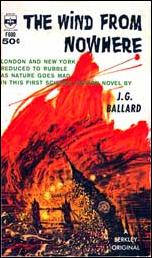
- Thee Wind from Nowhere (1962)
 In April 2005, due to my friend Horia Nicola Ursu,
I acquired eight novels by J. G. Ballard. They were by no means the first
Ballard books I read, but I finally had the opportunity to see his development
as a writer. I did so by reading in chronological order his first four novels.
The earliest one, The Wind from Nowhere,
had been written in 1961 and published for the first time in January 1962.
In April 2005, due to my friend Horia Nicola Ursu,
I acquired eight novels by J. G. Ballard. They were by no means the first
Ballard books I read, but I finally had the opportunity to see his development
as a writer. I did so by reading in chronological order his first four novels.
The earliest one, The Wind from Nowhere,
had been written in 1961 and published for the first time in January 1962.
Briefly, a global catastrophe occurs
because streams of wind start blowing all around planet Earth, accelerating
with five miles per hour every day. As the wind reaches unprecedented speed, it
tears down buildings, blows away cars, destroys planes and runs ships aground,
effectively destroying human civilization as we know it.
Far-fetched as this may sound, such a
pattern of violent circular winds is dominant in the upper atmosphere of giant
gas planets such as Jupiter and Saturn.
However, what makes The Wind from Nowhere a memorable book
is the way in which these extraordinary phenomena are perceived by ordinary characters,
and the ways in which individuals and societies cope with the catastrophe.
The opening chapter focuses on Donald
Maitland, who, due to a heavy wind that carries dust and reduces visibility,
cannot fly from
The next chapters switch to an
American submarine commander, Lanyon, whose mission is to travel from northern
Italy to southern France in order to retrieve a general’s dead body, and to a
British executive, Simon Marshall, who is in charge of a telecommunication
center involved in the government’s efforts to cope with the crisis.
As the wind’s speed increases to more
than 180 miles per hour, buildings collapse, the topsoil gets blown away,
industrial machinery is wrecked. People build corridors of sandbags (a
Blitzkrieg reminiscence that was actually used to fight
Meanwhile, an industrial magnate named
Hardoon uses his wealth, machinery and personal army to build a pyramid
designed to stand the cataclysmic wind. However, Hardoon proves to be cruel. He
refuses safety to the very people who built the pyramid. His goons murder
characters they were supposed to save, and Simon Marshall, in his dying
moments, broadcasts a warning to the world.
After a final confrontation, the
pyramid is flooded and topples in a ravine, while Maitland, Lanyon and a few
others escape. And the wind begins to subside, just as mysteriously as it had
started.
Part of the novel’s appeal consists in
the gradual development it is based on, a steady worsening of conditions which
the narrator documents with realistic details and backs up with scientific data
and global news. It begins with an average character in an average situation
(riding in a taxi to catch a flight which was delayed by heavy wind and poor
visibility), progresses through stages where individuals, communities and
societies react quite convincingly to extreme situations, and ends in a
complete disaster. Paradoxically, the readers feel relieved at the ending,
rather than appalled.
Another interesting aspect is that,
unlike Golden-Age hard science fiction, The
Wind from Nowhere features a balance between iron-willed, hyper-masculine
characters like Commander Lanyon and New-Wave, introspective characters such as
Donald Maitland. Moreover, the hard-SF axiom that with enough science and
enough technology Man will triumph over nature is shaken from the cornerstones.
Throughout the novel, some machines (cars, then trucks, then bulldozers) are
useful for a while, then the wind increases its speed and wrecks them, then
heavier machines are brought to save the wrecked ones. Finally, even the most
powerful product of technology, Hardoon’s pyramid, collapses under the forces
of nature, and the catastrophic wind reigns supreme.
This attitude towards technology is
the exact reverse of the axiom above, and central to Ballard’s vision.
Technology, he appears to say, is destined to become junk, and people might
have a more enjoyable time figuring out creative new uses for fragments than
acting as obedient users of shiny new products, following the instruction
manual step by step.
Last, but not least, The Wind from Nowhere is brief, clear
and to the point. It leaves the readers with a wish for more Ballard books,
which is why, after finishing it, I went straight to reading J. G. Ballard’s
next catastrophic novel, The Drowned
World.
But that is another story. (top)
J. G. BALLARD -
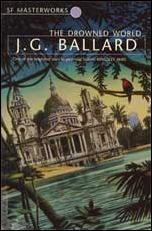
The Drowned World (1962)
 Unlike The Wind
from Nowhere, which was placed in what the audience back then perceived as
“the present”, J.G. Ballard’s next novel, The
Drowned World, is set in the near future, about seventy years from the
publication date. Due to intense solar activity, the polar ice-caps have
melted, coastal regions all over the world have been submerged and vegetation
is reverting to ancient forms from the Triassic.
Unlike The Wind
from Nowhere, which was placed in what the audience back then perceived as
“the present”, J.G. Ballard’s next novel, The
Drowned World, is set in the near future, about seventy years from the
publication date. Due to intense solar activity, the polar ice-caps have
melted, coastal regions all over the world have been submerged and vegetation
is reverting to ancient forms from the Triassic.
(I know, I know… Forty out of those
seventy years have already elapsed, global warming is real enough and the
ice-caps are melting.)
Consequently, most of the human
survivors have retreated to places like
A biologist, Robert Kerans, is in such
a lagoon area with a team of military personnel. What he realizes gradually is
that it is not only the vegetation that reverts to a deep-time version of
itself, but also the human psyche. Consequently, when Colonel Riggs decides to
retreat, Kerans, his lover Beatrice Dahl and psychologist Alan Bodkin prefer to
stay behind.
Soon enough, beside isolation,
deep-time psychic recession and prospective shortage of food and fuel, they
face another problem. Their lagoon area is invaded by a team of looters led by
a man named Strangman. Before long, he tries to seduce Beatrice and plays a
game of fake camaraderie and subtle intimidation with Kerans.
After a few diving expeditions,
Strangman and his looters erect a dam and pump out the water in a lagoon,
revealing London’s Leicester Square. Bodkin’s attempt to blow up the dam ends
in his being killed. After more violent treatment, escape and pursuit, Kerans
and Beatrice are nearly killed as well, but Colonel Riggs and his men turn up
in time to save them.
On finding out that Strangman is
likely to get a medal for his actions, Kerans blows up the dam himself,
narrowly escapes pursuit and heads south to infernally hot jungles. Although he
is wounded, his last message, scratched on a wall, is quite optimistic.
What one remarks throughout this novel
is that it is more “Ballardian” than the previous one. For instance, instead of
using multiple selective omniscience to switch from one character to another,
as he did in The Wind from Nowhere,
Ballard uses here selective omniscience to focus on a single character, Robert
Kerans.
Typically, Kerans is an educated
middle-aged white man, introverted, involved in the last stages of a relation
with a powerful, outspoken, independent woman. He prefers living alone, his
contacts with other people are rather few and far between, and he is inclined
to daydreaming.
In a particularly memorable episode in
chapter 9, “The Pool of Thanatos,” Kerans volunteers to don a heavy diver’s
suit and to visit a submerged planetarium, enjoys the underwater play of light
and vegetation on the planetarium’s glass dome and nearly drowns. Practical
issues of survival and comfort come second to obscure reasons emerging from
Kerans’s exploration of the deep-time psyche.
In this respect, the novel’s ending is
also Ballardian, as there is no overall promise of a return to normality or
reversal of the catastrophe, and the protagonist chooses to leave behind the
remnants of human civilization and head south into the jungle. Kerans is not
the only one to do so, either. His actions echo to some extent those of a
secondary character, Lieutenant Hardman. In the final chapter, “The Paradises
of the Sun,” Kerans meets Hardman again, almost blind and nearly starved to
death, and, out of a deep feeling of bonding, the protagonist feeds him and
takes care of him for a few days.
But, typically for a Ballard novel, as
soon as Hardman is a little better, he leaves again on his own, following his
obscure motives, without so much as “good-bye.” And Kerans, on his last legs,
follows his own path with a feeling of renewal, thinking of himself not as a
man about to die, but as “a second Adam searching for the forgotten paradises
of the reborn Sun.”
The Sun itself came back with a
vengeance in Ballard’s next novel.
But that is another story. (top)
J. G. BALLARD -
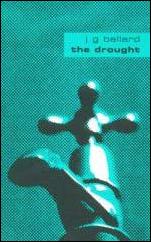
The Drought (1964)
 In July 2005, after finishing my first novel and delivering
it to my editor, I felt a strong urge to return to J.G. Ballard’s catastrophic
worlds. That is why, in only three days, I read The Drought, which in the
In July 2005, after finishing my first novel and delivering
it to my editor, I felt a strong urge to return to J.G. Ballard’s catastrophic
worlds. That is why, in only three days, I read The Drought, which in the
In many respects, The Drought is yet more ambitious than the previous two disaster
novels. Like The Wind from Nowhere
and The Drowned World, it gives no
specific time frame, which is why readers can (still) perceive it as happening
in the near future. It also gives practically no specific location, which is
why one might imagine it taking place either in Britain, in Ireland, in a
coastal region of the USA, in Australia or even in New Zealand.
Unlike the previous two novels, the
cause of disaster is not a natural one. More specifically, chemical residual
compounds of industrial origin, which have been dumped in oceans for years,
form a molecule-thick layer of polymers which prevents evaporation.
Consequently, for a few years, there have been no clouds and no rain.
The protagonist, Dr. Charles Ransom,
lives in a houseboat on a draining lake. Like Maitland and Kerans, he is at the
end of a relationship with a woman. His wife, Judith Ransom, has already
started a new love affair that her husband is aware of, a lot like Susan
Maitland in The Wind from Nowhere and
a little like Beatrice Dahl in The
Drowned World.
The government urges citizens to go to
the coast, and there is a large-scale exodus which most people from Larchmont
and
As conditions deteriorate, firefights
break out between desperate fishermen and Reverend Johnstone’s militia. Houses
burn down. Eventually, Ransom takes a few friends on a voyage to the coast,
where they find a swarming ribbon of shantytowns and armed forces with barbed
wire and machine guns preventing civilians from reaching the waterfront. Riots
follow.
Ten years later, small communities
such as the one led by Reverend Johnstone live on fish and distilled water
among a sea of salt crystal dunes. Ransom and his wife, Judith, are mere
scavengers. Encouraged by the appearance of a meager lion, Ransom takes a few
friends back to the town they left, in search of inland water.
After confrontations with Lomax and
with his ex-servant, Quilter, Ransom leaves the ruined town and, in a sea of
sand dunes, is caught up by the first rain in fifteen years.
What is easy to notice is that Ballard
made this novel more overtly inter-textual than the previous two. Richard
Lomax, a character of ambiguous sexual orientation, with eccentric clothes and
a fascination with fireworks displays, is repeatedly compared with Prospero.
His sister, white-haired Miranda, is sometimes compared to the homonymous
character in Shakespeare’s The Tempest,
once with “an imbecile Ophelia looking for her resting-stream,” and is often
said to have “a puckish face.”
The cretinous, swollen-headed Quilter
who acts as Lomax’s servant is occasionally called Caliban by his master, and
later on fulfils the original Caliban’s rape fantasy by having deformed
children with Miranda Lomax. His mother, on the other hand, turns into a benign
Sycorax, a fortune-teller on the margin of Reverend Johnstone’s settlement.
There is an Ariel figure as well,
young scavenger Philip Jordan. Since Philip lives from petty pilfering, travels
in a boat and has an adoptive Negro father who he keeps hidden safely, I also
felt he had a strong intertextual connection with Huckleberry Finn, although
the narrator never refers to Mark Twain’s character.
In the book’s second part, in Chapter
9, “The Stranded Neptune,” Reverend Johnstone is compared to “a demented Lear,
grasping at the power he had given to his daughters.” The comparison is
reinforced by the contrast between his two elder daughters, Julia and Frances,
who dominate the settlement and turn it “into a rigid matriarchy” and his
benevolent younger daughter, Vanessa.
Not surprisingly at all,
intertextuality cuts both ways. Some forms of behaviour depicted in The Drought re-emerged in other stories.
The survivors’ digging for cans of
food appears again in Harlan Ellison’s “A Boy and His Dog”, as well as
references to cannibalism. Also, the use of abandoned cars as a source of gasoline
and spare parts came to feature prominently in George Miller’s Mad Max films.
What also appears quite evident is
self-referentiality. For the third time in this novel, Ballard uses the
artistic device of mise-en-abime.
Just as in The Wind from Nowhere and
in The Drowned World, the protagonist
constructs a microcosm in his home, a collection of objects among which he
feels safe and which reflect his preoccupations and idiosyncrasies. Later on in
the book, this microcosm is wrecked, and the objects’ man-made order turns to
chaos. When seeing this transformation, which he cannot prevent, the
protagonist feels an intense sense of loss.
The reason why I chose to call these
recurrent scenes mise-en-abime is
that they reflect, on a small scale, what happens to human civilization at
large when confronted with uncontrollable forces of nature in Ballard’s
catastrophic novels.
And, after disasters caused by Air,
Water and Fire, it was only natural for J.G. Ballard to imagine a catastrophe
caused by Earth, unleashing the power of the mineral realm.
But that is another story. (top)
J. G. BALLARD -
The Crystal World (1966)
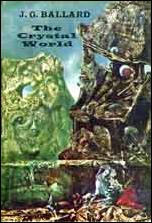 The final novel in Ballard’s tetralogy of elements
took me only two days to read, and constituted a pleasant surprise. To begin
with, The Crystal World is not
located in an Anglo-Saxon country, but in
The final novel in Ballard’s tetralogy of elements
took me only two days to read, and constituted a pleasant surprise. To begin
with, The Crystal World is not
located in an Anglo-Saxon country, but in
Dr. Edward Sanders attempts to travel
upriver to Mont Royal, but encounters difficulties. Apparently, there is some
trouble in the area, and the army are sealing it off. Gradually, Sanders finds
out that the forest around
As he gets closer to this phenomenon,
Sanders finds himself caught in dangerous games, such as a violent affair
involving a local mine owner, Therensen, a man, Ventress, and his dying wife,
Serena. Sanders’ own business is in a leproserie, with his ex-lover, Suzanne
Clair, and her husband, Max. And, to complicate matters, a young French
journalist, Louise Peret, starts a love affair with Sanders.
The phenomenon of crystallization
expands, engulfing birds, beasts, people and artifacts, and, as Sanders tries
to reach his friends, the situation around him becomes increasingly chaotic and
violent. Finally, after a narrow escape from the forest, Sanders examines his
own feelings and decides to go back to the crystal world.
What I found interesting, besides the
memorable images of crystallized trees, rivers, characters and so on, was the
“explanation” behind the phenomenon. Apparently, the emergence of anti-matter
galaxies causes the appearance of anti-time and the draining of time from
matter both in distant places in the Universe and locally, in three small areas
on Earth. Matter suffers a process like refraction, except the agent is not
light, but time.
The “explanation” offered to Sanders
in the novel is reminiscent of the rationale behind Cubist painting: the object
is rendered not from one perspective at one time, but from several
perspectives, at different moments, “simultaneously”. The effect, like in
Marcel Duchamp’s Nude Descending Stair
(1912), is mosaic-like, angular, quasi-crystalline.
The reason I’ve brought this issue
forth is that, throughout the four catastrophic novels, Ballard uses imagery
that is strongly reminiscent of famous schools of painting.
The
Wind from Nowhere, for
instance, displays numerous images of buildings being ruined and a particularly
bleak atmosphere, charged with dust and fragments of topsoil, grimy and dark,
much like Romantic paintings. Some of Victor Hugo’s grim sketches, which
occasionally incorporate random stains of coffee or wine, come to mind.
The
Drowned World, on the other
hand, with its lagoons, its steamy, hazy, tropical imagery, evokes
Impressionistic paintings, with their lack of clear-cut edges or precise
contours.
The
Drought brings to
mind Surrealist paintings. In the opening chapter, “The
In this context, it made sense for Ballard to
create an abundance of Cubist images in The
Crystal World. From isolated crystallized plants to a crystallized forest,
to crystallized people, helicopters, cars, to houses and churches turned into
wedding cakes and trapped in filigran webs among the surrounding crystallized
trees, Ballard orchestrated an unforgettable crescendo that is likely to remain
in the readers’ minds long after the individual characters and incidents have
faded away. (top)
J. G. BALLARD - The Atrocity
Exhibition
(1970; rev. ed. 1990)
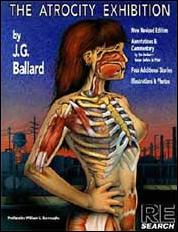 It
is probably not a secret anymore that I have a soft spot for the literary works
of J.G. Ballard. That is why, at the end of 2006, I spent a few days of my
winter holiday reading The Atrocity Exhibition. The novel had originally
been published in 1970. What I read, though, was an annotated, expanded and
revised edition published in 1990 (USA) and 1993 (UK), respectively, an edition
which I had received from Horia Nicola Ursu.
It
is probably not a secret anymore that I have a soft spot for the literary works
of J.G. Ballard. That is why, at the end of 2006, I spent a few days of my
winter holiday reading The Atrocity Exhibition. The novel had originally
been published in 1970. What I read, though, was an annotated, expanded and
revised edition published in 1990 (USA) and 1993 (UK), respectively, an edition
which I had received from Horia Nicola Ursu.
To call The Atrocity Exhibition “confusing”
does not begin to describe it. Sometimes it is labeled “a set of condensed
novels”, yet it is a far cry from Mircea Horia Simionescu’s General
Bibliography. However, since it is neither a novel (that would require an intelligible
plot) nor a collection of short stories (each of which would require an
intelligible plot), I suppose that “set of condensed novels” is as good a label
as any other. In my experience as a reader, only one book has proven less
intelligible and less entertaining – James Joyce’s Finnegans Wake (1939).
I think it is relevant that one person who found
this book interesting was William Burroughs, who wrote a preface to the
annotated edition (complete with a trademark cut-up paragraph).
Some characters in The Atrocity Exhibition preserve
their identity throughout, such as Dr. Nathan or Karen Novotny. The protagonist
and his wife, on the other hand, undergo changes in name and personality from
one chapter to the next. Their last name is Travis (Chapter One), Talbot
(Chapter Two), Traven (Chapter Three), Tallis (Chapter Four) and so on. In the
end-notes, the author explains that each chapter illustrates another imaginary
life (or role) of the protagonist, ranging from the most mundane (Chapter
Seven, “The Summer Cannibals”) to the most apocalyptic (Chapter Nine, “You and
Me and the Continuum”).
Yet even this element of logic is lost in the
final chapters, some of which were written and published as individual pieces.
They bear titles such as “Plan for the Assassination of Jacqueline Kennedy” or
“Love and Napalm: Export U.S.A.”
One of them, “Crash!”, discusses in essay form the
latent erotic charge of automobile accidents, whereas another, “The Generations
of America”, compiles a list of (mostly imaginary) murders in which the names
of killers and victims were taken from the pages of Time and Life magazines.
The effect of this danse macabre of ordinary names on a few pages is
more unsettling than a list of real assassinations would have been.
The book ends with two scientific articles in
which emotionally neutral nouns such as “the patient” have been substituted
with celebrity names. The resulting texts, “Princess Margaret’s Face Lift” and
“Mae West’s Reduction Mammoplasty” anticipate the public interest in celebrity
elective surgery that caused the broadcasting of endless documentaries after
2000.
The overall
effect of the protagonist’s name variations, gradual loss of focus in the final
chapters and fragmentation of each chapter into small sections bearing cryptic
titles is of growing incoherence, similar to some extent to the cumulative
effect of the final chapters in James Joyce’s Ulysses (1922).
However, The Atrocity Exhibition does have
a number of recurrent images and issues that provide it with a certain degree
of coherence. Media saturation is such a theme, celebrity overexposure is
another. Ballard returns time and again to the central element of late-20th-century
western civilization (automobiles) and to one of the most frequent causes of
death in technologically advanced countries (automobile accidents).
In this respect, the book’s main point appears to
be that the mediatic landscape, which juxtaposes celebrities, political
figures, car advertisements, atrocity documentaries and erotic imagery, has an
extremely unsettling effect on people’s subconscious (individual and
collective) to the point where erotic and (self)destructive pulsions are
hopelessly confused and misdirected. The title of Chapter Fourteen expresses
this media-induced confusion of subconscious pulsions in a concise, memorable
way: “Why I Want to F[**]k Ronald Reagan”.
One effect of the media-induced confusion is that,
at the book’s beginning, a sort of avant-garde media experiment is conducted with
the patients in a psychiatric hospital, yet Dr. Nathan (the rational character)
is unable to tell Mrs. Travis whether her husband (the protagonist) is a doctor
or a patient. Moreover, he thinks that the issue is no longer relevant.
Another effect of the mediatic barrage is an
attenuation of affect, an inability in ordinary people to react emotionally to
stimuli. The media and the public appear to be trapped in a vicious circle in
which an excess of appealing (or shocking) imagery leads to numbness, and increased
numbness leads to a need for more appealing (or shocking) imagery. Ballard had
a very personal reason to be emotionally numbed (his wife died in a car
accident in 1964, a few years before he started writing The Atrocity
Exhibition), yet his diagnosis of the mediatic effect on the general public
turned out to be correct. It is no coincidence that the emotionally inert,
media-obsessed teenager became such a recurrent element in cyberpunk fiction
later on, in the 1980s.
Last, but not least, I should mention that, as an
homage to Ballard’s work, Bruce Sterling wrote one of the Shaper/Mechanist
stories, “Twenty Evocations”, in the form of an Atrocity Exhibition chapter,
complete with cryptic titles for the sub-sections and the occasional ironic
cut-up paragraph. However, “Twenty Evocations” is a real condensed novel
that follows a Shaper, Nikolai Leng, from cloning to death.
Ballard himself did not stop here in his
exploration of the subconscious connections between automobiles, advertising,
erotic and (self)destructive pulsions. He developed a secondary character from The
Atrocity Exhibition, the psychopath Vaughan, into a protagonist for his
next major novel, Crash (1973).
But that is another story. (top)
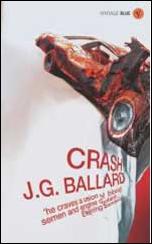 Crash
is Ballard’s novel that led a
publisher’s reader to writing the famous note: “The author of this book is
beyond psychiatric help.” (Quoted in John Clute and Peter Nicholls’s The
Encyclopedia of Science Fiction.) It narrows down the (satirical?) scope of
The Atrocity Exhibition to a single issue: the blurring of the
differences between erotic and destructive pulsions caused by the ubiquitous
presence of automobiles. Advertisements present cars as glamorous and sexy.
News and documentaries present them as dangerous and deadly. And the
subconscious of media-brainwashed drivers might simply begin to displace their
erotic pulsions to car-crash wounds. Or to instrument panels. (Or something…)
Crash
is Ballard’s novel that led a
publisher’s reader to writing the famous note: “The author of this book is
beyond psychiatric help.” (Quoted in John Clute and Peter Nicholls’s The
Encyclopedia of Science Fiction.) It narrows down the (satirical?) scope of
The Atrocity Exhibition to a single issue: the blurring of the
differences between erotic and destructive pulsions caused by the ubiquitous
presence of automobiles. Advertisements present cars as glamorous and sexy.
News and documentaries present them as dangerous and deadly. And the
subconscious of media-brainwashed drivers might simply begin to displace their
erotic pulsions to car-crash wounds. Or to instrument panels. (Or something…)
Enter protagonist Dr. Robert Vaughan,
ex-documentary producer, currently preoccupied to the point of obsession with
collecting photographs from crash sites, positioning casual sex partners in
crash-victim positions, imagining possible car-crash injuries on celebrities
such as Elizabeth Taylor and making narrator-witness “James Ballard”’s life interesting.
(At this point, it would be useful to remember that narrators are imaginary
entities that exist only as information – more specifically as discourse –
within works of fiction. No matter what name they bear, they are not to
be confused in any way with the physical authors who created them.)
The two male characters’ sado-masochistic relation
of domination and growing mutual dependence moves through a series of
increasingly disgusting, sexually explicit episodes in which sexual attraction
(both hetero- and homo-erotic) and violent pulsions are hopelessly mixed with
each other.
I am not going to bore (or offend) the reader with
any details concerning the plot. Suffice it to say that, given J.G. Ballard’s
tremendous literary talent, when he set his mind to shock and disgust his
audience, the effects were considerable. In all honesty, I rank Crash among
the most disheartening novels I have ever tried to read, right next to Naked
Lunch by William Burroughs. However, since, as far as I am concerned,
shocking and disgusting sexually explicit scenes are no substitute for suspense
in a novel’s plot, I also rank Crash as the third most boring book I
have dealt with so far (Finnegans Wake by James Joyce being second).
I am well aware that, like Naked Lunch, Crash
was made into a film directed by David Cronenberg. Yet I am also aware of a
dictum popular among psychologists: “Every written book is a defeated disease.”
Judging from this book’s content, it must have been a rather serious disease. I
am glad that J.G. Ballard was able to defeat it and subsequently could write
much more enjoyable books such as Hello, America (1981) or Empire of
the Sun (1984).
But that is a completely different story. (top)
J. G. BALLARD - Running Wild (1988)
 Unlike
more experimental works by J.G. Ballard, such as The Atrocity Exhibition (1970,
rev. ed. 1990), Running Wild appears to be reader-friendly, almost easy
to understand. It has the form of a detective novel, more specifically a police
procedural, narrated in the first person by Doctor Richard Greville, a
character involved in an official inquiry of mass murders and (possible)
multiple kidnappings in a suburb called Pangbourne Village. However, as the
story unfolds, readers get a nagging sensation that the deeper focus of the
story lies somewhere else. Just as Greville doubts the official theories of
international terrorism, conducts his own investigation and puts together a
more plausible (and more disquieting) explanation of the events, readers are
invited in the subtext to pick clues and construct a deeper interpretation of
this short novel.
Unlike
more experimental works by J.G. Ballard, such as The Atrocity Exhibition (1970,
rev. ed. 1990), Running Wild appears to be reader-friendly, almost easy
to understand. It has the form of a detective novel, more specifically a police
procedural, narrated in the first person by Doctor Richard Greville, a
character involved in an official inquiry of mass murders and (possible)
multiple kidnappings in a suburb called Pangbourne Village. However, as the
story unfolds, readers get a nagging sensation that the deeper focus of the
story lies somewhere else. Just as Greville doubts the official theories of
international terrorism, conducts his own investigation and puts together a
more plausible (and more disquieting) explanation of the events, readers are
invited in the subtext to pick clues and construct a deeper interpretation of
this short novel.
Luckily, the author was kind enough to provide
sufficient clues for the readers’ benefit. To me, the most relevant one turned
out to be a reference to George Orwell’s Animal Farm (1945) which
appears in one of the book’s last chapters: As a signal, an adolescent
character taps out the opening lines of Animal Farm over Pangbourne
Village’s intranet, and in response a girl types in the acknowledgement signal
“Snowball”. Then, according to Greville’s reconstruction, the whole massacre
starts.
I couldn’t help but wonder: Why Animal Farm rather
than any other cultural reference? And why “Snowball” rather than, for
instance, Mollie, Benjamin, Squealer, Boxer or Moses (to name but a few)?
It then dawned on me that political satires
needn’t be disguised as animal fables. They may very well be disguised as
detective stories or police procedural novels, too. And, to avoid any
accusations of imitation, Running Wild had to be structured in a form
different from (or radically opposed to) its predecessor.
The point of view in Animal Farm is
external to the events, and the narratorial tone is objective. (Indeed, the
tone in Animal Farm is a prime example of clarity, objectivity and
understatement.) In Running Wild, on the other hand, the narrator is
homodiegetic and his point of view is subjective. If in Animal Farm the
events are presented to the readers chronologically, in Running Wild there
is a permanent switch from “current” events (the police investigation) to
“previous” events (what the police assume happened in the suburb during the
massacre).
Both plots are focused on acts of revolt in a
small community. In Animal Farm, animals revolt against their human
masters. In Running Wild, teenagers revolt against grown-ups (parents,
servants, guards).
Perhaps the most striking difference between the
two revolts lies in their respective forms of expression. In Orwell’s fable,
the revolt is first articulated as a formal doctrine (Animalism), then
expressed in grandiloquent speeches and popular songs, and then it turns to
action. In Ballard’s short novel, the upper-middle-class teenagers’ resentment
is subliminal, inarticulate, and they are careful not to leave behind any
manifestos or explanations for their acts. Since they have grown up in a
media-saturated environment, they are well aware that silence and stealth are
more powerful weapons than any political or propagandistic message (which the
media are likely to distort, anyway).
Equally striking is the different behaviour of the
revolted after their initial success. In Animal Farm, the animals design
a flag, an anthem, a set of laws, distribute medals and decorations and make
construction plans for a better future. Significantly enough, there is a
doctrinal dispute between Snowball (who would like to initiate similar revolts
at neighbouring farms) and Napoleon (who would like to increase his own power
locally). As Napoleon wins, the animals at the farm simply get to work more and
more for less and less food, and the overall situation remains unchanged
(ruthless exploitation of the many by the few).
In Running Wild, on the other hand, the
teenagers who have succeeded in exterminating the adults in their local
community go underground and (to the baffled police forces) seem to have
vanished into thin air. No flag, no anthem, no set of laws, no medals, no
construction plans for a better future. No doctrinal dispute either – because
they plan to strike at other authority figures in the near future. It is no
accident that five years later, in the final chapter, an assassination is
attempted against a female ex-Prime Minister. Since exporting revolution was
Snowball’s purpose in Animal Farm, it is for this reason that the
rebellious teenagers have chosen his name as a password.
Even if Mrs. Margaret Thatcher goes un-named in
Ballard’s novel (much like Joseph Stalin had gone un-named in Animal Farm),
it gradually becomes clear to Doctor Greville that the teenagers’ revolt is
anti-consumerist, anti-yuppie, anti-neoconservative. To readers, it also
becomes clear that this political satire is anti-Thatcher, an implicit
criticism of shiny happy suburban gated communities where commuting yuppies can
manicure their lawns, follow their diet/ fitness/ personal development
substitute religions, raise their children and pretend that the rest of the
world does not exist.
J. G. Ballard’s publishing an anti-Thatcher satire
in 1988 (when Mrs. Thatcher was still in power) was an act of courage similar
to George Orwell’s publishing an anti-Stalin satire in 1945 (when Great Britain
was still allied with the Soviet Union in an effort to defeat the Axis). Yet
unlike Animal Farm, which features de jure equality among
animals, but a closed, bitter, hopeless ending, Running Wild hints at de
facto equality among the rebellious teenagers and features an open, hopeful
ending. There is no knowing where the self-styled freedom fighters will strike
next in their guerilla campaign against adults, nor who will decide to join
them.
And not even that un-named female ex-Prime
Minister is quite safe from them… (top)
MICHAEL
MOORCOCK – Elric of Melniboné (1972)
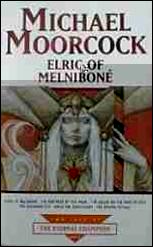 Of all the
characters created by Michael Moorcock, Elric of Melniboné is perhaps the most
famous. He is also the author’s favourite (according to the introduction of an
omnibus volume published by Gollancz in 2001) and his multi-volume saga begins
here, with a short novel originally published in 1972. Elric of Melniboné consists
in three parts and an epilogue. The plot follows a basic fantasy pattern of
quest, initiation and return, yet the protagonist refuses to fit the
expectations of the people he rules (or those of the common reader).
Of all the
characters created by Michael Moorcock, Elric of Melniboné is perhaps the most
famous. He is also the author’s favourite (according to the introduction of an
omnibus volume published by Gollancz in 2001) and his multi-volume saga begins
here, with a short novel originally published in 1972. Elric of Melniboné consists
in three parts and an epilogue. The plot follows a basic fantasy pattern of
quest, initiation and return, yet the protagonist refuses to fit the
expectations of the people he rules (or those of the common reader).
For Elric, descendant of a long lineage of emperors
of a civilization so advanced it appears magical (even demonic) to the more
barbaric nations around, has spent so much time reading and thinking that, at
the novel’s beginning, his notions of right, wrong and appropriate behavior in
various circumstances are very different indeed from those expected of a
Melnibonéan. His unusual attitude, as well as his physical weakness, make his
cousin Yyrkoon believe that he is unfit to rule and that someone stronger and
more ruthless should be sitting on the Ruby Throne. In other words, someone
like Yyrkoon himself.
That is why, in the novel’s first part, the
antagonist tricks Elric into joining a naval battle against an invasion fleet,
then shoves him into the sea.
Elric’s talents, however, include magic knowledge
and connections with powerful supernatural beings, which is why King Straasha
of the water elementals saves him and restores him to the Ruby Throne. And yet,
Elric’s unwillingness to take revenge creates an opportunity for Yyrkoon to
escape and kidnap the protagonist’s lover, Cymoril.
To find her, Elric makes a pact with Arioch, Duke
of Chaos, and, after travelling far and wide and conquering a city, he rescues
her only to discover that she has been bewitched.
Consequently, in the novel’s third part, Elric
travels to a netherworld where he goes looking for Yyrkoon in hope that his
enemy will undo the evil spell. Find him he does, but in a climactic
confrontation he has tu use an accursed black sword, Strombringer, that has a
malicious will of its own. And the plot’s twists are far from over.
Elric
of Melniboné operates ironically with the topoi of
swords-and-sorcery. Elric himself is a carbon copy of the genre’s most famous
character – Conan the Barbarian. Rather than being dark-haired, blue-eyed and
super-humanly strong, Elric is white-haired, red-eyed and physically weak.
Rather than loathing civilization, Elric is well qualified to judge its fine
points. And, rather than defeating sorcerers and witches with a strong arm and
a well-sharpened sword, Elric uses magic to invoke demons and unleash them
against his enemies.
Also, the final confrontation leads nowhere near a
conventional happy ending. Elric chooses neither to slay his opponent, nor to
marry his lover, nor even to rule as an emperor. Instead, he decides to travel
in the barbarian kingdoms and to let Yyrkoon rule Melniboné, the Dragon Isle,
in his stead.
Some of the irony is directed against the
protagonist. Although his friends warn him against Stormbringer, Elric
mistakenly believes that he can control the magic runesword. However,
Stormbringer has a destiny of its own, as it is supposed to bring chaos and
destruction to Elric’s world. That is something that the protagonist (and the
readers) will find out in the subsequent books from the Elric saga. (top)
MICHAEL MOORCOCK – The Bane of the Black Sword (1984)
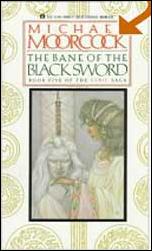 This book is a very good example of what John
Clute and Peter Nicholls call "a fixup" in The Encyclopedia of Science Fiction. The Bane of the Black Sword is made up of three "books"
of 50, 40 and 35 pages, respectively, and an epilogue of 35 pages. The four
sections are novellas that may well be published separately in magazines, but
the first three feature the same protagonist, Elric of Melnibone, while the
epilogue belongs to what Elric prefers to call his dreams.
This book is a very good example of what John
Clute and Peter Nicholls call "a fixup" in The Encyclopedia of Science Fiction. The Bane of the Black Sword is made up of three "books"
of 50, 40 and 35 pages, respectively, and an epilogue of 35 pages. The four
sections are novellas that may well be published separately in magazines, but
the first three feature the same protagonist, Elric of Melnibone, while the
epilogue belongs to what Elric prefers to call his dreams.
Each section has a self-contained plot
of the "swords and sorcery" type, and the third book, "The
Flamebringers", and the epilogue, "To Rescue Tanelorn", have
quite similar subjects: a barbarian horde led by an impressive chieftain nears
a city, and the protagonist seeks magic help and prevents the invasion in a
climactic battle.
The first and second book also feature
common elements: Elric is captured by enemies, but he invokes the magical help
of a divinity or demon, escapes, then summons an army to defeat his enemies.
Another recurrent theme is the
ambiguous relation between Elric and his semi-sentient sword, Stormbringer. On
the one hand, the sword helps him in battles, on the other hand it kills his
friends and relatives in the heat of skirmishes. Elric would like to be rid of
this bane, and suffers sincerely for the killing of his friends, but without
the sword he becomes powerless (Book One). The sword, in its turn, does not
bear separation from its master and returns to him even if it is cast away
(Book Three).
What is well worth noticing is that
Michael Moorcock wrote a series of novellas, but assembled them in such a way
as to read like a novel, and on the other hand, by mentioning Elric and some
imaginary lands from the first three sections, he connected the epilogue both
to the series of "Elric the Necromancer" and to the "Chronicles
of Castle Brass", which feature the city of Tanelorn. (top)
TERRY
PRATCHETT - The
Carpet People
(1971, rev. ed. Corgi Books, London, 1992)
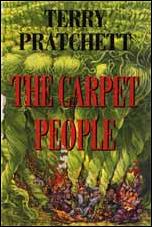 The Carpet People was Terry Pratchett’s debut novel (written at 17) and,
under pressure from readers, it was revised and republished in 1992. It tells
the story of tiny people who live among the hairs of an ordinary carpet,
threatened now and then by a terrible event, Fray (the footfall of ordinary
people). Two brothers and their tribe of hunters see their village destroyed by
Fray, travel to a nearby kingdom to save it from invaders, are captured by evil
creatures, escape, meet people who can remember the future as well as the past,
and finally help save the inhabitants of the empire’s capital (if not the city
itself).
The Carpet People was Terry Pratchett’s debut novel (written at 17) and,
under pressure from readers, it was revised and republished in 1992. It tells
the story of tiny people who live among the hairs of an ordinary carpet,
threatened now and then by a terrible event, Fray (the footfall of ordinary
people). Two brothers and their tribe of hunters see their village destroyed by
Fray, travel to a nearby kingdom to save it from invaders, are captured by evil
creatures, escape, meet people who can remember the future as well as the past,
and finally help save the inhabitants of the empire’s capital (if not the city
itself).
As a
fantasy novel, The Carpet People works
well enough, with an abundance of exotic creatures in a landscape where one
penny is the Carpet’s only source of metal, a sugar crystal is the size of the
Pentagon building and a burnt match is the size of the Chinese Wall.
As a
Pratchett novel, it works moderately well, too. One has a nagging suspicion
that the unimaginative Dumii and their Empire are satirical versions of the
English, whereas the fiercely independent Deftmenes and their kingdom are
caricatures of the Scots. There are passing comments on commerce being better
than armies at keeping an empire together and history being written by the
living, and an almost Tolkienesque (if not downright British) view that common
sense, prosperity, commerce and debate serve people better than idealism,
heroics and unnecessary slaughter. Yet, in order to defend their right to
common sense, prosperity, etc., people must be prepared to go to battle. (And,
rather than fight to death, fight to the enemy’s
death.)
The only
problem with this novel is that, by Pratchett’s standards, it is not funny
enough. It is not memorable (except for the landscape) and one does not have
the feeling that it deserves re-reading. Somehow, unlike so many of Pratchett’s
books, The Carpet People doesn’t urge
readers to talk about it with their friends, orshare it. It is rather worth one
reading, period.
But then
again, how many books written by 17-year-old authors deserve even that? (top)
TERRY
PRATCHETT - Only
You Can Save Mankind
(Corgi Books, London, 1992)
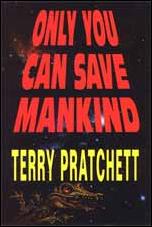 Only you can save
this reader, dear Terry!
Only you can save
this reader, dear Terry!
After
attending a book fare, after reading a book that was badly written and worse
edited, after giving up on a second book on grounds of high obscenity and no
plot to speak of, after struggling for a while with a third one that provided
little narrative traction, in sheer desperation I took my guaranteed medicine:
a book by Terry Pratchett written before the time he took it upon himself to
out-sell, out-franchise and out-tie-in J.K. Rowling.
It worked
like magic, and I felt ready to forgive Terry his latest three or four books.
Almost.
Only You Can Save Mankind concerns a
computer-game addicted boy, Johnny Maxwell, from a generic English small town,
with generic school-mates (black one, fat one, game-pirate one), generic
parents (complete with generic divorce) and generic games (Space Invaders type).
However, the aliens surrender and
Johnny has to escort them back beyond a cosmic Border, into safe space, on
their way to their home planet. Not only does he dream on successive nights of
being on board a starship, but he also has to persuade other players to stop
shooting at the aliens.
And then, in real life, he meets a
player from the game, a 13-year-old redhead who wins competitions in actual
reality and calls herself Sigourney in game-space. Naturally, her dream-version
of alien spaceships is not nuts-and-bolts (i.e. Star Trek), but rather corners, darkness, steam and slime (i.e. Alien). And her aliens are a lot uglier
and more aggressive than Johnny’s.
Beside poking fun at the teenage
popular culture with clichés like “In space, no one can hear you scream”
(Terry’s versions being “On Earth, No One Can Hear You Say ‘Um’ “ and “In
Space, No One is Listening, Anyway”)
and god-like figures such as the computer-game seller, Terry Pratchett gently
directs our attention to a very serious fact in the background of his
characters’ lives: Gulf War Two.
To the characters in
And we should care. We should never
forget the difference between what is real and what isn’t.
It is a good thing that (at least
before competing heavily against J.K. Rowling) Terry Pratchett thought about
teaching a few good lessons about vital values to a media-hypnotised
generation, and it is delightful to see him doing this gently, unobtrusively,
under the pretense of telling an amusing story.
And, yes, the story is amusing,
gripping, touching and delighting. Thank you once again for bringing joy to my
life, dear Terry! (top)
TERRY PRATCHETT, IAN STEWART & JACK COHEN – The Science of
Discworld III:
(Ebury Press,
Some time
ago, while reading The Science of Discworld, I was extremely impressed
by Terry Pratchett’s idea of using Discworld’s extraordinary popularity as an
opportunity to offer the reading public not only entertainment, but also
education. When The Science of Discworld II: The Globe was published, I
received it with as much enthusiasm. That is why, over the last two years, I
had been waiting with considerable interest the third volume in this series of
popular science.
Then, in
July 2007, completely out of the blue, I found a copy of Darwin’s Watch
and went through it in a few days. Further on, I shall share with you what I
have found out:
As you
probably know, The Science of Discworld dealt with astronomy, astrophysics
and the evolution of life on Earth, whereas The Globe focused on
ethology, anthropology and cultural studies. Darwin’s Watch deals
closely with evolutionism, but also with connected areas, such as genetics and
biochemistry. En passant, it demolishes theories like creationism and
discusses hypotheses such as parallel universes imagined by quantum physicists.
Although
numerous concepts in this book are either extremely new or very little known to
the general public, the three authors succeed very well to present them in an
intelligible and enjoyable way. And to provide the narrative glue among the
popular science sections, Terry Pratchett wrote a story in which the reality
Auditors have invaded Roundworld and conspire to prevent Charles Darwin from writing
The Origin of Species. In this alternative history, his (fictitious)
book The Theology of Species leads to a stagnation of science and
technology, humankind no longer develops space programs in the twentieth
century, and the next Ice Age wipes out life on Earth.
Or it would
have destroyed it in case the wizards from Unseen University had not stepped
in, led by Mustrum Ridcully…
Compared to
the first two volumes in the series, Darwin’s Watch is slightly shorter
and (at least to me) a little less captivating. Repeatedly, the authors mention
religious fundamentalism and its current effects, as well as the creationists’
lines of attack against evolutionism.
On the
other hand, the book’s last chapters praise the social, cultural and
educational framework that led to the emergence of scientists like Charles
Darwin and show the risks to which the British society exposed itself over the
last decades by moving away from the Victorian spirit and values.
All in all,
Darwin’s Watch is an instructive and (in geographical areas where they
maintain that the Grand Canyon is an effect of the Biblical Flood) necessary
read. On a fantasy literary market flooded with stereotypical books, such a
volume is like a breath of fresh air.
IAIN
M. BANKS
- Connsider Phlebas
(MacMillan,
London, 1987)
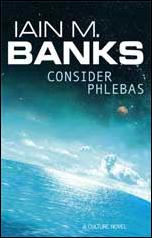 By
1990, at the time when I used to borrow fantasy and science fiction books from
the British Council, I heard about a Scottish writer, Iain M. Banks. At the end
of the Nineties, Costi Gurgu and Răzvan Stoica told
me a few things about some of his books. After 2003, when I started teaching an
optional course about British F&SF, I decided I had to pay more attention
to Banks’ books. Therefore, by Christmas 2004, thanks to Horia Nicola Ursu, I
received six novels and a collection of short stories which formed the
so-called Culture sequence.
By
1990, at the time when I used to borrow fantasy and science fiction books from
the British Council, I heard about a Scottish writer, Iain M. Banks. At the end
of the Nineties, Costi Gurgu and Răzvan Stoica told
me a few things about some of his books. After 2003, when I started teaching an
optional course about British F&SF, I decided I had to pay more attention
to Banks’ books. Therefore, by Christmas 2004, thanks to Horia Nicola Ursu, I
received six novels and a collection of short stories which formed the
so-called Culture sequence.
I read the first novel in the series, Consider Phlebas, whose title is
inspired by a few lines from The Waste
Land (1922) by T.S. Eliot (the fourth section).
“Gentile or Jew
O you who turn the wheel and look to
windward,
Consider Phlebas,
who was once handsome and tall as
you.”
Banks’s novel is also about a traveler, as you are
about to see:
In our galaxy, at a time when on Earth the late
Middle Ages are dragging on, numerous civilisations co-exist, some of them
human, others not. A non-human civilisation, called Idiran (which is a
theocracy), starts a conflict with a civilisation where humans and machines
live in symbiosis, the Culture.
In the midst of this conflict, a Culture ship is
destroyed, and the Mind on board hides in the tunnels of Schar’s World, a
sanctuary planet protected by the Dra’Azon advanced civilisation. The Idirans
save a human named Bora Horza Gobuchul from a planet led by a gerontocracy and
send him to retrieve the Mind.
Horza first teams up with space adventurers, on
board the Clear Air Turbulence, then
travels to an Orbital (a ring-shaped habitat which resembles Larry Niven’s
Ringworld a lot), where he is kept prisoner by a fanatic cult, then he witnesses
a media-covered game, and finally, after replacing the adventurers’ captain, he
leads the crew to Schar’s World, where he finds the Mind.
In point of plot, Consider Phlebas is a picaresque novel. Its structure is enriched
by a prologue, interludes, appendices and an epilogue that provide the readers
with other perspectives on the events and information to which the protagonist
has no access. The interludes, for instance, refer to a little girl with
flashes of genius, Fal ‘Ngeestra, who analyzes the crisis and decides on the
Culture’s next moves to retrieve the Mind from Schar’s World.
What I find interesting is that the narrator
focuses mainly on Horza’s actions, although the author’s point of interest is
the Culture. In this respect, Consider
Phlebas has an effect similar to the one of the first Star Wars film, A New Hope
(1977), namely that we are shown a few marginal fragments of an extremely vast
and complex universe that we can dimly perceive, but not imagine in all its
splendour.
The
protagonist Bora Horza Gobuchul, though human, is a Changer, i.e. he has the
ability to change his appearance, height and so on in a few days, and even to
regenerate peripheral parts of his body. On the one hand, in point of
abilities, he is like the Face Dancers in Frank Herbert’s Dune series. On the other hand, regarding adaptability and
attitude, he reminds one quite a lot of Abelard Lindsay, the protagonist of
Bruce Sterling’s novel Schismatrix
(1985).
Unfortunately, Horza is not convincing enough as a
character. The reasons for which he fights against the Culture seem superficial
enough – he dislikes them for their symbiosis with machines and that is about
it. His personal history is largely missing, and one of its rather important
elements (a young love for a female Changer, Kierachell) is introduced very
late, strictly for functional reasons regarding plot development.
Perhaps the only aspect connected to this personal
history that is used in an interesting way is a phrase which crosses Horza’s
mind at the beginning of the first chapter, in a tight spot. The same words
come to his lips in the penultimate chapter, when the protagonist is about to
go comatose. In the appendices, the readers find out that the phrase is the
first one from Kierachell’s favourite novel.
But these two elements seem rather scarce for a
protagonist…
The antagonist is Perosteck Balveda, an agent of
the “Special Circumstances” section of the Culture’s “General Contact”
organization. It is typical for the Culture to call its military “General Contact”
and its espionage “Special Circumstances”. Balveda, in her turn, develops an
intriguing relationship with Horza. Sometimes he is in her power, but she
undermines his position subtly, rather than attacking him violently. At other
times she is his prisoner, but opposes no resistance and has instead a docile
behaviour. At the novel’s ending, after Horza saves her life, Balveda also
saves him from an extreme situation, and the readers understand that the agent
might have killed the protagonist at any time, had she so wanted.
But the Culture’s ways are subtler than that, as
the author demonstrates…
Among the secondary characters there are Yalson,
Horza’s partner on board the Clear Air
Turbulence, and Captain Kraiklyn, a reckless, irresponsible leader who drags
his crew in senseless adventures such as robbing the Temple of Light or
exploring an abandoned Megaship in an Orbital. The direct consequence of these
poor decisions is the crew’s attrition. Some members of the Free Company perish
in the actions initiated by Kraiklyn, others prefer to leave sooner or later.
Somehow, these space adventurers reminded me of the Fortuna Miners’ Democracy,
a fourteen-character “nation” in Bruce Sterling’s Schismatrix.
Other memorable characters belong to the Idiran
warrior race, enormous tripedal creatures that become asexual when they reach
adulthood. Paradoxically, the narrator calls them “he,” preserving the neutral
pronoun “it” for machines like the drone Unaha-Closp or creatures such as the
Minds that manage the Culture’s ships and habitats. Among the Idirans, most of
whom are xenophobic and religious fanatics, a remarkable figure is Querl
Xoralundra, captain of The Hand of God
137 and the one who assigns the mission to Horza. Xoralundra is atypical
due to his tolerance, his rational decisions and his co-operation with
individuals from other species.
What I find worth emphasizing is the plot’s irony.
The most memorable case is that Horza, the Culture’s sworn enemy,
unintentionally helps agent Balveda find and retrieve the lost Mind which might
have been used by the enemies.
The Idirans, on the other hand, by the intolerance
and brutality with which they treat the few Changers they find on Schar’s
World, unintentionally alienate their ally Horza, who might have brought them
an invaluable service.
Also ironically, the Idirans’ exhausting voyage on
the frozen surface of Schar’s World does not make them more empathic and
understanding with the natives (which is the case with protagonist Genly Ai in
Ursula K. Le Guin’s novel The Left Hand
of Darkness) but more cruel and unforgiving.
All in all, Consider
Phlebas is proof that space opera has reached maturity and, in the hands of
an intelligent author, among huge ships, colossal habitats
and galactic wars, there is place for some irony and intertextuality. (top)
IAIN
M. BANKS
- Thee Player of Games
(MacMillan,
London, 1988)
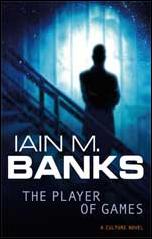 At
the end of 2005 I read a few books that ranged between inept and mediocre, but
all shared in complete boredom. As a remedy, I went back to Iain M. Banks’s
Culture series and read The Player of
Games. It proved to be enjoyable and entertaining.
At
the end of 2005 I read a few books that ranged between inept and mediocre, but
all shared in complete boredom. As a remedy, I went back to Iain M. Banks’s
Culture series and read The Player of
Games. It proved to be enjoyable and entertaining.
Nearly seven hundred years after the Idiran war, a
famous player of games named Jernau Morat Gurgeh is subjected to blackmail and
cunningly determined to go on a mission to the Azad Empire in the Lesser Cloud.
The Empire is held together by means of a game,
Azad (i.e. system), which determines who will occupy what position in society,
from humble clerks and petty officers to ministers and the emperor himself.
Gurgeh learns the Empire’s language (Eachic),
etiquette and game, adapts quite well, wins a series of games and ends up
playing against the Emperor-Regent himself, Nicosar. In the climactic ending,
Nicosar is determined to exterminate the audience who have witnessed his defeat
and kill Gurgeh, but (due to a drone’s protective field) kills himself instead
and, since the game is discredited, the Azad Empire falls apart.
Gurgeh returns to his home Orbital, Chiark, and
tells the story to his friends.
Compared to its predecessor, The Player of Games is more compact and better plotted. It also
leads the readers to understand to what extent the human beings in the Culture
are pawns moved around by the Minds (or Artificial Intelligences, if you
prefer).
In an early episode, Gurgeh is frustrated in his
wish to have an affair with a young woman, Yay Meristinoux. Consequently, he
travels to a nearby university, and on the way, in a game, he is accused of cheating.
This, in turn, leads to his wish to win in another
game, in front of a numerous audience, against a brilliant opponent, Olz Hap.
During a break, Gurgeh is tempted by an obnoxious drone, Mawhrin-Skel, to
cheat, if only a little, and later on the drone blackmails him, which leads him
to traveling to the Azad empire.
As Gurgeh plays against various opponents, in
games of increasingly higher importance, the drone that accompanies him,
Flere-Imsaho, reveals more and more about the Azad society on the one hand and
about the Special Circumstances’ plans for it on the other hand.
At the book’s ending, nothing is quite what it had
appeared to be. The supposedly demilitarized Culture ship that had carried
Gurgeh turns out to have been armed. The debauched Culture ambassador turns out
to have been an SC mercenary. Flere-Imsaho proves to be not a library drone,
but a Special Circumstances drone, complete with X-ray laser and protective
force fields. Even the narratorial voice turns out to belong to it.
The final Azad game also brings revelations
concerning the antagonist and the protagonist.
Throughout his meteoric ascension, Gurgeh meets a
number of threats. Blackmail, mutilation, bribery and assassination attempts
are used to determine him to either quit or accept defeat in the game. This
brutal approach, typical of the Azad society, culminates in Emperor Nicosar’s
style of playing. He is ruthless, he not so much defeats as crushes his
opponents in the game, and when he realizes that he is about to lose against
Gurgeh, he switches to physical violence.
This option is even further encouraged by the fact
that Azadian society has three genders. Males are expendable, as soldiers or
servants. Females are downtrodden, little more than slaves. Apexes concentrate
all power in society, with a de-facto monopoly on higher education, economy,
administration, politics, law-enforcement and the military. When faced with a
male opponent, the apex Nicosar feels free to despise him and even break the
game’s rules, switching from intellectual competition to physical aggression.
The protagonist, on the other hand, proves to be
so adaptable as to almost forget his identity. At a crucial point in the plot,
the drone Flere-Imsaho deliberately gets him to use the Culture’s Marain
language, to see messages from his friends at home, to discuss a few scientific
issues, in order to help him remember that he truly represents the Culture.
Ironically, however, once the Azad game has been
discredited and the Empire has fallen apart, the Culture does not move in to
take over. One cannot help but wonder which is preferable: the rigid hierarchy
based on totalitarian methods before Gurgeh’s visit, or the hopeless anarchy
and technological decline after his departure?
But, as I have come to suspect, Iain M. Banks’
Culture books offer no easy answers. (top)
IAIN
M. BANKS
– The State of the Art (1989)
(Orbit
Books, London, 1989)
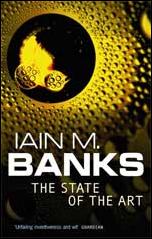 I
shall never get tired of remarking how books appear to change simply because
the readers change (and their perception changes with them). A case in point is
Iain M. Banks’ volume of short stories The
State of the Art.
I
shall never get tired of remarking how books appear to change simply because
the readers change (and their perception changes with them). A case in point is
Iain M. Banks’ volume of short stories The
State of the Art.
The first time I tried to read it was in 1990, back when I visited the British Council Library in Bucharest on a regular basis. It was the very first book by Iain M. Banks I was trying to read, I had no idea who or what the Culture was and, after going through some of the short stories (“A Gift from the Culture”, “Odd Attachment”) I simply gave up on the collection and returned it to the library.
Sixteen years later, after reading Iain M. Banks’
extensive essay “A Few Words on the Culture” and the first two novels in the
sequence (Consider Phlebas and The Player of Games, see above) I went
through The State of the Art in a dozen
hours.
And had that book changed!
The opening short story is “Road of Skulls”, which
one might categorize as science-fantasy. The next one, “A Gift from the
Culture”, deals with a female character who, after a change of sex, has decided
to move to a more barbaric world and finds herself first discriminated against
for homosexuality (living in a man’s body does not change Wrobik Sennkil’s
preference for men) and then trapped in a conspiracy. As one has learned to
expect in Iain M. Banks’ fiction, the conspiracy turns out to have several
layers. Also, “A Gift from the Culture” is notable for weapon design (a
sentient Culture energy gun that can only be used by one specific person) and
for a memorable opening sentence: “Money is a sign of poverty.”
“Odd Attachment” belongs to the type of short
story made famous in the Golden Age of science fiction by the likes of Isaac
Asimov, Robert A. Heinlein and Frederic Brown. It extrapolates, on a “What
if…?” basis, from a fairly common situation. In this case, Iain M. Banks uses
the game children play with daisy petals: “S/he loves me… s/he loves me not…”
And what if (the Scottish author wonders) a love-struck vegetable creature from
another planet played this game with a stranded astronaut?
“Descendant” is a short story about another
astronaut who, wounded and trapped inside an impaired Culture space suit, has
to walk hundreds of kilometers on a desert planet’s surface to the nearest
base. As the suit is sentient, the man’s gradual physical and mental
deterioration affects it to the point where one finds it difficult to tell who
says what in the increasingly incoherent dialogues.
“Cleaning Up” is another tip-of-the-hat to
Golden-Age science fiction. This time, Iain M. Banks gives us a variation on
the theme of the alien incomprehensible artifact that exposes the incompetence
of military and political authorities. However, the Culture’s inability to
dispose of slightly defective products and the Cold-War-minded obsession of
American generals to H-bomb Russia without retaliation combine in an unexpected
catastrophe.
“Piece” is not (technically speaking) science
fiction, but rather magic realism. Apparently, it is a letter from an atheist
who recalls events such as discussing the Big Bang theory versus Biblical
creationism with an old man on the bus, or Salman Rushdie’s Satanic Verses versus the Koran with a
young Muslim student. Yet the letter turns out to be debris retrieved from an
air-crash site, and the readers get to wonder whether the subtext points to a
God-governed Universe where every individual is given a chance to salvation.
Then again, Iain M. Banks’ being a self-declared atheist simply adds another
layer of irony to the text.
“The State of the Art” makes up half of the
volume’s bulk and is the most complex and engaging story by far. It is a
memorable novella because it examines the Earth in 1977 from the Culture’s
perspective. To them, Earthlings are hopelessly irresponsible.
Briefly, a hundred years after the events, a
Culture woman, Diziet Sma, tells how the General Contact Unit Arbitrary studied the Earth with
satellites, drones and even human agents sent on the surface. One of them,
Dervley Linter, decides to stay on Earth and live like the natives. Diziet
visits him in Paris, then in Oslo, finally in New York, and tries to dissuade
him.
Meanwhile, on board the Arbitrary, debates rage whether the people on Earth should be
contacted, prevented from nuclear self-destruction, left to their own devices
or simply obliterated with a small black hole.
In a back alley in New York, Dervley Linter is
killed under Diziet’s eyes. Later, the Minds on board Culture ships in the
vicinity decide that the people on Earth should not be interfered with. The Arbitrary collects its agents and
devices and leaves. Diziet writes the story and the drone that translates it,
Skaffen-Amtiskaw, adds section titles (all of them names of General Contact
Units), footnotes and an afterword of its own.
“The State of the Art” wonderfully balances grim
comments on the way in which people abuse the ecosystem and misuse material
resources with funny references to popular culture. The Culture characters are
fascinated not only with Earthlings’ religions and literary works, but also with
motion pictures such as Close Encounters
of the Third Kind. One character, Li, dresses up like Captain Kirk and, on
delivering a discourse one evening, goes even further:
“In his right hand he gripped a Star Wars light sword. Of course, the
ship had made him a real one.”
In the same vein, the ship’s Mind plays a
practical joke:
“Also while I’d been away, the ship had sent a
request on a postcard to the BBC’s World Service asking for ‘Mr. David Bowie’s
“Space Oddity” for the good ship Arbitrary
and all who sail in her.’ (This from a machine that could have swamped
Earth’s entire electro-magnetic spectrum with whatever the hell it wanted from
somewhere beyond Betelgeuse.) It didn’t get the request played. The ship
thought this was hilarious.”
Such amusing elements counterbalance episodes like
Diziet Sma’s visit to the Deportation Memorial in Paris, the haunted,
half-deserted, mutilated buildings in Cold-War Berlin or the poverty and
degradation of homeless people in the streets of Manhattan. And, beyond the
cultural references and the realistic descriptions, Iain M. Banks makes an
essential point: If we, people on Earth, do not solve our own problems, no one
will solve them for us.
The final text, “Scratch”, is not a story as such,
but rather a collage of text fragments similar to those in the “Newsreel”
section in John Dos Passos’ U.S.A. trilogy.
It pretends to deal with the present and future of Homo sapiens considered as the contents of a contemporary popular
record. As an implicit criticism of the gentle brainwashing the pop music
industry subjects us to, Iain M. Banks sacrifices meaning for the sake of
rhythm and alliteration, repeats platitudes until they become meaningless and
exposes contemporary Western culture’s obsession with materialism and instant
gratification.
And, since the Culture woman Diziet Sma and the
drone Skaffen-Amtiskaw had proven such interesting characters, Iain M. Banks
involved them in another plot in his next book, Use of Weapons (1990).
But that is another story. (top)
IAIN
M. BANKS - Use of Weapons (1990)
(Orbit Books, London, 1990)
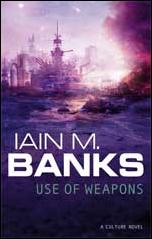 In
April 2005, during a short holiday, I read the fourth book in the Culture
series, Use of Weapons. Retrospectively, I think it is the most
ambitious novel in the sequence. Let us see why:
In
April 2005, during a short holiday, I read the fourth book in the Culture
series, Use of Weapons. Retrospectively, I think it is the most
ambitious novel in the sequence. Let us see why:
Use of Weapons answers
a question that readers must have asked themselves before: How does the Culture
get involved in smaller, less powerful and less advanced societies in order to
take them over gradually, while at the same time appearing to be neutral and
free of blame to competing societies that are as powerful and advanced as
itself (or even more so)?
Its
Special Circumstances branch hires mercenaries so that, by tipping the balance
of local conflicts in favour of one side or another, they will help create in
the long run the appropriate social and cultural framework that would make
acceptance of Culture values and lifestyles more likely.
Use
of Weapons follows the career of such a mercenary, Cheradenine
Zakalwe, through a number of campaigns in which he has to defend collapsing
regimes, convince retired political leaders to return to active life, conduct
campaigns against more numerous armies and so on. Zakalwe’s connections to
Special Circumstances are two characters that readers are already acquainted
with: the woman Diziet Sma and the drone Skaffen-Amtiskaw.
The
most striking feature of the novel is its plot. After a prologue featuring
Cheradenine Zakalwe and an older, more debauched mercenary, Cullis (comparisons
with William Shakespeare’s character Falstaff spring to mind), the plot starts
from a “present” situation and branches off in opposing directions. One set of
chapters heads into the “future”, following Diziet Sma’s efforts to locate
Zakalwe, persuade him to come back from retirement and send him on a mission to
retrieve a political figure in order to prevent the politician’s assassination
and the onslaught of a cluster civil war. Among these chapters is interspersed
another set, going into the “past” and highlighting key episodes from Zakalwe’s
career, all the way to his recruitment by Diziet Sma on behalf of Special
Circumstances and beyond that, to traumatic episodes from his youth. (Iain M.
Banks was kind enough to use increasing chapter numbers for one set and
decreasing Romanic chapter numbers for the other in order to prevent his
readers from feeling disoriented.) I dare say this is the most ambitious plot
structure I have encountered in any novel so far.
In
order to increase the novel’s coherence and to guide the readers towards the
book’s most important focus of interest, the author also uses a (more familiar)
flashback-comeback technique that connects chapters from the “future” to
adjacent chapters from the “past”. Recurrent flashbacks and images point to a
traumatic set of events in Zakalwe’s distant past that involve a small white
chair and a battleship, the Staberinde. Consequently, the reader’s
interest is gently steered away from a traditional focus (What is going to
happen next? How is this going to end?) and towards a Modernist one (What
events in the protagonist’s past have caused such present behaviour and states
of mind?). And Banks provides a few climactic revelations so staggering as to
justify this change of focus.
What
Zakalwe discovers moreover, to his (and the readers’) growing dismay, is that
there is no way out of his job as a mercenary for Special Circumstances. Diziet
Sma saves his life early on in order to recruit him for SC. Later, on several
occasions, Zakalwe nearly dies, yet the drone Skaffen-Amtiskaw and other
members of an SC support team save him. He attempts to retire several times
throughout the novel, but he either gets into trouble accidentally or acts as a
freelance justice-enforcer, which inevitably leads to his being spotted and
reactivated by Special Circumstances. And, by the book’s ending, he
deliberately asks Diziet Sma to leave his wounds untended so that he can
finally die, yet he is too valuable a tool to have his wish granted, and the
novel’s prologue and epilogue combine to suggest that, after Zakalwe’s being
revived and treated, he has gone back to his mercenary life.
Diziet
Sma’s attitude in Use of Weapons suggests that she is a much older,
wiser (even more cynical) woman than she was in “The State of the Art”. Her
care for the protagonist might lead the readers to believing that she has
strong feelings for Zakalwe, yet the way in which she deals with some of his
wishes (for professional reorientation, for retirement, finally for death)
point to the fact that, as far as she is concerned, the interests of Special
Circumstances take precedence over everything else. The most emblematic episode
in this respect occurs in Chapter Twelve, where Zakalwe fights a desperate
tanks-and-planes war against the armies of an empire, uses his inferior forces
brilliantly, outmaneuvers his opponents and practically wins. Nevertheless, the
night before the imperial forces’ collapse Diziet Sma announces him that he
must leave at once and allow his army to be defeated after all so that Special
Circumstances might score a diplomatic victory. No matter how many lives of
natives are lost, no matter how many people’s hopes are ruined, no matter how
much Cheradenine Zakalwe himself wants to lead the men who trust him to final
victory, Sma is adamant in furthering the interests of Special Circumstances
irrespective of any other factors.
Diziet
Sma’s assistant, the drone Skaffen-Amtiskaw, is instrumental in saving Zakalwe
a few times. On a memorable occasion, after Zakalwe is beheaded by savages on
planet Fohls and his head is retrieved by an SC drone while there is a spark of
life left in it, Skaffen-Amtiskaw assists in the growing of a new body for the
protagonist and, in a gesture that is typical for the peculiar (and rather
insensitive) humour of Culture artificial intelligences, it presents Zakalwe
with a hat.
Many
more memorable episodes and characters appear throughout the book, among which
a plane war fought not from aircraft carriers, but from tabular icebergs, and a
desert crossing with Dune (and Biblical) overtones that features an
ironic final twist typical for Iain M. Banks’ sophisticated storytelling. And
yet, despite their being suspenseful and spectacular, probably the most
impressive one is a quiet incident that does not involve the protagonist at
all.
In
the novel’s coda, “States of War”, Diziet Sma recruits another young man who
had been crippled in a war. Like the final section in John Fowles’ The
Collector (1963), this episode suggests that a large number of similar
events will happen in the future, and Diziet Sma probably handles dozens,
scores or even hundreds of mercenaries to serve the interests of Special
Circumstances. No matter how heroic, brilliant (and, finally, emotionally
devastated) Zakalwe may be, the coda makes us understand that he is a very
small, powerless pawn in a very large game that he has no hope to understand or
control – ever.
In
this respect, Use of Weapons provides an interesting counterpoint to The
Player of Games, as it offers a wider, better informed perspective on the
Culture’s dirty tricks. This perspective was to be further expanded and
detailed in Iain M. Banks’ next novel in the Culture series, Excession.
But that is another story. (top)
IAIN
M. BANKS – Excession (1996)
(Orbit Books, London, 1996)
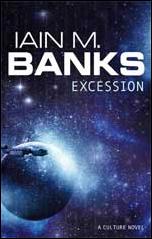 At
the end of 2006, during a long-awaited holiday, I decided to treat myself with
the last three novels in Iain M. Banks’ Culture series. The first one I went
through was Excession.
At
the end of 2006, during a long-awaited holiday, I decided to treat myself with
the last three novels in Iain M. Banks’ Culture series. The first one I went
through was Excession.
(What is an excession, by the way? I had no
idea.)
This novel’s plot is
essentially so simple that one could summarise it in one sentence: a spherical
alien artifact appears in our universe, causes various civilisations and
factions to compete for it, resists attempts at contact/ invasion with vast,
incomprehensible forces, then disappears without a trace into another universe.
What Iain M. Banks does surprisingly well is to
develop numerous secondary plots around it, making use of dozens of characters
and of a point of view not employed before in the series. Indeed, it is this
author’s trademark to change both the cast of characters and the point
of view or chronology in every new book instead of simply offering his readers
more of the same.
In Excession, the point of view is multiple
selective omniscience and the overall effect is of perceiving the Culture from
above, with more understanding of its structure, workings and patterns of
interaction with other civilisations than ordinarily available to its average human
citizen. Indeed, “human” is a key term here, because Excession finally
reveals to the readers what they had merely suspected throughout the previous
volumes in the sequence, namely that the real movers and shakers in the Culture
are not human beings, but the considerably more intelligent Minds of their vast
spaceships and habitats. As the story moves back and forth among human
characters, drones, aliens and sentient spaceships, the human characters from
the Culture are gradually revealed to have little power (individually, or even
collectively) and to be ruthlessly manipulated by the Minds.
One such case is a Culture woman, Dajeil Gelian,
who has been living on board the Eccentric ship the Sleeper Service for
forty years. Rather than encouraging her to move on and do something with her
life, the Sleeper Service reconstructs for her the setting of a key
period in her past and uses its connections with other ships and habitats to
set right a situation that (partly with its contribution) had gone wrong.
Another case is a Culture man, Byr Genar-Hofoen,
who is persuaded by agents of the Special Circumstances to leave for a while
his diplomatic mission with an alien civilisation (the Affront) and go looking
for the recorded personality of a woman (the captain of a Culture ship that had
first detected the alien artifact 2500 years before). What he finds out by the
end of the novel is that he has been used as a bargaining chip – more
specifically, the Sleeper Service wanted him as payment for its
involvement in the vast conflict triggered by the artifact.
A third case is a lovely (and conceited) young
girl from Phage Rock, Ulver Seich, who embarks upon a secret mission for what
she believes to be Special Circumstances only to discover gradually that she
has been fooled into acting on behalf of a conspiracy of Minds that the Special
Circumstances are trying to stop.
Also, readers discover that the Minds which
control the Culture are just as adept at manipulating not only individuals, but
entire civilisations as well. For instance, officially, the Culture has agreed
to de-commission (or even dismantle) most of its warships after the Idiran war.
Yet, as the novel progresses, readers find out a number of interesting facts:
First, that a relatively large number or Culture
warships have been camouflaged in a few secret places such as Pittance (a stray
planet core) rather than dismantled.
Then, that Pittance is on a course which will take
it deep into a zone controlled by the aggressive alien civilisation called the
Affront. (So, probably the mothballed war fleet will be used as a surprise
force in case the Affront attacks the Culture.)
Then, that a conspiracy of Culture ship Minds has
decided to help the Affront take over the mothballed war fleet and attack the
Culture as an excuse for getting the Culture to retaliate with massive force
and subdue the Affront.
And, finally, that responsible ships from Special
Circumstances such as the Sleeper Service (which had used its
Eccentricity as a convenient camouflage under which to develop both massive
engine power and a mind-boggling war fleet of its own) are able to put an end
to the conflict with minimum losses and to identify the members of the Mind
conspiracy.
Needless to say, what I found worrying, if not
downright frightening, was that the individual and collective power of decision
of human and alien characters throughout the stages of this conflict turned out
to be insignificant as compared to the power of the Minds.
However, vast and impressive and powerful as the
Minds may be, Iain M. Banks has imagined in this novel something beyond their
power to control or even understand. The alien artifact is approached
cautiously by representatives of various civilisations and factions and
nicknamed the Excession. “Excession: something excessive. Excessively
aggressive, excessively powerful, excessively expansionist; whatever.” Some
attempt to study it, some – to communicate with it, some – to overcome it with
brute force. By the end of the novel, a Culture Mind realises that, in each
case, the Excession reacted the way it was acted upon.
For instance, the Zetetic Elench ships come from a
Culture faction that expects to be transformed by (rather than to transform)
the civilisations it comes into contact with. The Excession absorbs some of
them.
The Affront is an aggressive civilisation. The
Excession meets some Affront ships with massive brute force.
The Culture is cautious and studies everything
before getting involved (preferably on a small scale, in subtle ways). The
Excession treats with caution the first Culture ships it encounters.
On the one hand, the civilisations and factions
formulate various hypotheses concerning the Excession. On the other hand, they
speculate on the ways in which they could use it in case they took it over. And
(rather typically for this kind of plot) the Excession disappears before anyone
can 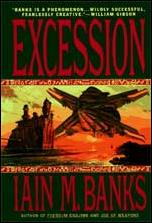 either
comprehend it or control it.
either
comprehend it or control it.
What else is there left to say?
Plenty, as a matter of fact.
One aspect that I feel bound to emphasise is that
Iain M. Banks is so subtle a writer that, even in a novel which offers a
generous perspective on the Culture, he still suggests that there is more about
this imaginary civilisation than words can tell in a novel (or half a dozen).
Older issues such as the Idiran War or the Culture involvement with the Azad
Empire are referred to now and then, yet no overall account is given anywhere,
no simple one-paragraph Asimovian explanation of these events that might allow
the readers to comprehend them once and for all. The subtextual suggestions are
that these events were too vast and complex for any human mind to understand
and that (possibly) no single entity in the Culture has access to all the data
concerning these events in order to put together such a synthetic, simplifying
vision.
Along the same line, new aspects of the Culture
are brought into focus which, cumulated with other aspects already dealt with
in previous books, enhance the overall complexity (both visible and suggested)
of this society. For example, three factions of the Culture are presented in Excession.
One is the Zetetic Elench, which I have already discussed. A second one is the
AhForgetIt faction, a current dedicated to the idea that the hedonistic aspects
of the Culture should be preferred to everything else. (It goes without saying
that they feel disinclined to take responsibility with anything, although some
of the external threats the Culture faces now and then make it necessary for
its citizens to act responsibly.) The third one is the Sublimers – people, drones
and Minds who believe they should transcend physical existence and become like
the Sublimed Elder civilisations. (The mainstream Culture points out that
transcendence should occur for an entire civilisation, rather than piecemeal,
as it does with the Sublimers, but then again, what if the members of this cult
should persuade more and more entities to join in?)
Another aspect worth mentioning is that, since the
Culture series occurred quite late in the development of science fiction, Excession
(as well as some of its predecessors) displays a relatively high level of
intertextual reference which readers have learned to associate with the genre’s
maturity. The Excession itself, for instance, re-visits a common theme of hard
science-fiction, the Big Dumb Object. Like the giant habitat in Sir Arthur C.
Clarke’s Rendezvous with Rama, (1973), it comes along, it triggers a
crisis, then it goes away before anyone has understood it completely or learned
how to put it under control. Like the asteroid in Greg Bear’s Eon (1985),
it opens gateways to other universes.
The factions in the Culture, on the other hand, as
well as the mentioning of Hegemonising Swarms, point in the general direction
of Bruce Sterling’s Shaper/Mechanist universe and more specifically to his most
anthologised short story, “Swarm”.
The fact that some civilisations (and even various
members of the Culture) choose transcendence and turn into Sublimed Elder
civilisations also represents an intertextual connection with Bruce Sterling’s Schismatrix
(1985) and, beyond it, with Sir Arthur C. Clarke’s Chidhood’s End
(1953).
Last, but not least, the reference to a
Mind-generated metamathematical space known as the land of Infinite Fun (or the
land of IF) points to other such AI-generated universes, from Greg Egan’s Permutation
City (1994) to the TechnoCore in Dan Simmons’s Hyperion (1989) and The
Fall of Hyperion (1990) and all the way back to William Gibson’s cyberspace
in Neuromancer (1984) and “Burning Chrome” (1982).
Then again, all the intertextual references add to
the readers’ pleasure and show that Iain M. Banks is such a major, talented
science-fiction author as to participate in a cultural dialogue with some of
the genre’s most representative writers. Excession is a valuable
addition to the Culture series, with its mixture of complex plotting, intricate
background, credible characterisation, suspense, humour and intertextuality,
not to mention enough spectacular fireworks and cosmic awe to satisfy the
hardcore readership of hard science fiction.
Enjoy. (top)
IAIN
M. BANKS – Inversions (1998)
(Orbit
Books, London, 1998)
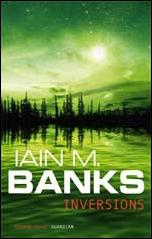 Before
reading Inversions, I was convinced that one could go through the
Culture books in any order whatsoever, as the author had taken care to
construct a different plot for each one, with a different set of characters in
a different location, on the one hand in order to suggest how vast and complex
the Culture is, and on the other hand in order to spare fresh readers from
frustration at not having read the previous books. Random reading might just
work beginning with any book in the series.
Before
reading Inversions, I was convinced that one could go through the
Culture books in any order whatsoever, as the author had taken care to
construct a different plot for each one, with a different set of characters in
a different location, on the one hand in order to suggest how vast and complex
the Culture is, and on the other hand in order to spare fresh readers from
frustration at not having read the previous books. Random reading might just
work beginning with any book in the series.
But not with Inversions.
Let us see why:
The plot is located on a planet whose inhabitants
are going through what we would call “Renaissance” or “early Modern Age”.
Briefly, they have just started experimenting with firearms, and a few decades
earlier a local Galileo Galilei named Naharajast aimed an experimental
telescope at the sky not only to change people’s view of the universe, but also
just in time to predict the catastrophic arrival of large meteors.
Consequently, an old empire has fallen apart,
smaller kingdoms have emerged, and an upstart historical figure much like
Oliver Cromwell, George Washington or Napoleon Bonaparte has won a considerable
number of battles, has had a king executed and has instituted a more
egalitarian Protectorate over some of these kingdoms. Nevertheless, the new
order has a number of internal and external enemies.
The story follows two narrative threads, each of
which is focused on one of the main characters. Odd-numbered chapters deal with
the Doctor, whereas even-numbered ones are about the Bodyguard.
The points of view are handled in an interesting
way. The prologue and the epilogue set the two stories in perspective, as one
of the narrators has added them many decades after the main events. The
“Doctor” chapters are told by a much younger version of the same narrator,
while the “Bodyguard” ones are told by a narrator whose identity readers are
supposed to guess as the story unfolds.
One problem with first-person narratives is the
reason why a character would tell the story. Iain M. Banks solves this problem
very convincingly on the “Doctor” narrative thread. In this case, the
narrator-witness is a teenager, Oelph, an apprentice to Doctor Vossil (the
personal physician of King Quience of Haspidus), who has to spy on her and
report on all her activities to another character whose identity is only
revealed at the book’s ending.
On the “Bodyguard” narrative thread,
unfortunately, the point of view is not handled so convincingly. Oelph claims
to have edited someone else’s manuscript, yet the “Bodyguard” chapters are
narrated in a selective omniscient point of view focused on DeWar, personal
bodyguard to General UrLeyn, Protector of the Tassasen Protectorate. At the end
of the novel, Oelph reveals the identity of this thread’s narrator, yet the
refined storytelling technique does not match that imaginary world’s stage of cultural
development.
What gradually transpires from the two stories is
that Doctor Vossil is an agent of the Culture’s Special Circumstances branch,
whereas DeWar is a Culture citizen who has chosen to forsake it and live in a
barbaric world on his own devices – in other terms, he “has gone native”.
Vossil’s uncanny knowledge of medicine (in Haspidus, male doctors are
incompetent and female doctors are unheard of), as well as her emancipated
attitude, DeWar’s stories of the land of Lavishia and of its inhabitants, some
unexplainable incidents and Vossil’s access to information exchanged in
supposedly private conversations combine to lead the reader to understanding
what Oelph and the other inhabitants of his world are incapable to conceive:
that both the Doctor and the Bodyguard come from another world.
If Oelph cannot figure that out for himself, there
are other things that he does understand. There are revenge plans that come to
fruition, secret benefactors or long-time culprits whose identity is finally
revealed, cunning methods to inflict harm brought to light and a few
unreciprocated passions fit for an Elizabethan tragedy.
Also in the good tradition
of the Culture books, there are some intertextual references along the way. The
most obvious one lies in the location – a planet orbiting two suns, Seigen and
Xamis. Readers will probably remember another, more famous planet orbiting two
suns – Brian Aldiss’ Helliconia.
The Renaissance background of warring kingdoms,
rebellious barons and borderland squirmishes, as well as the theme of an
isolated visitor from an otherworldly civilisation whose origins the natives
struggle to discover are linked more specifically to Helliconia Summer (1983).
On the other hand, Oelph’s point of view and his
situation (an apprenticed orphan who falls in love with an older, socially
superior woman while being aware that his feelings are doomed never to be
reciprocated) echo to some extent the story of apprentice torturer Severian and
his doomed love for chatelaine Thecla in Gene Wolfe’s tetralogy The Book of
the New Sun (1980-1983).
Last, but by no means least, in chapter 7 Doctor
Vossil mentions a time when both suns were under the horizon, the moons were
absent from the sky (or eclipsed, in one case) and the people of that world had
the extremely rare opportunity to see that what they had taken for a myth was
in fact real: there are stars in the sky. A two-paragraph intertextual
connection to one of Isaac Asimov’s most popular stories, “Nightfall” (1941) –
quite unexpected (and delightful).
After turning the last page of Inversions,
readers are left to wonder. There are very few hints (if any) concerning the
Culture’s long-term plans for this backward world. How (and if) these people
are going to integrate in a larger, space-faring civilisation is anybody’s
guess. And, as far as the readership of hard science fiction is concerned, Inversions
displays a totally atypical lack of advanced technology or spectacular
events. I, for one, believe that an average reader who approached this novel
without appropriate background knowledge both in the Culture sequence and in
the science fiction genre at large would be condemned to as little
understanding and appreciation of Inversions as Oelph. A fine novel it
is in many respects, but only to be appreciated by a sparse audience. (top)
IAIN
M. BANKS - Look to Windward (2000)
(Orbit
Books, London, 2000)
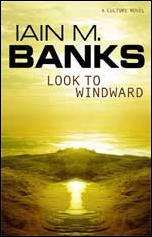 In
previous reviews of Culture books, I stated that they were written in such a
way as to allow readers to go through them in (almost) any order. Well, here is
a word of advice: you should read Look to Windward last. (Spoiler
warning: With all due respect to its predecessors, it is the best novel in the
sequence.)
In
previous reviews of Culture books, I stated that they were written in such a
way as to allow readers to go through them in (almost) any order. Well, here is
a word of advice: you should read Look to Windward last. (Spoiler
warning: With all due respect to its predecessors, it is the best novel in the
sequence.)
True to Iain M. Banks’ literary habits, Look to
Windward features a treasure of plot twists, one of which is set as early
as the prologue:
A female from the Chelgrian civilisation, Worosei,
tells in the first person how, during a civil war, she struggled desperately to
save her husband Quilan (trapped under a land destroyer) and how she had to
abandon him. Readers would expect her to be a protagonist-narrator and they
would also expect to follow her story throughout the rest of the novel. Yet Look
to Windward is told in the multiple selective omniscient point of view and
Worosei only turns up now and then in Quilan’s dreams and flashbacks. Contrary
to the readers’ initial expectations, it is he who survives and she who
perishes.
Suffice it to say that similar plot twists appear
throughout the book, even on the last page.
The plot is structured in three narrative threads.
One follows Mahrai Ziller, a Chelgrian dissident and famous composer who has
been commissioned by the Hub Mind of Masaq’ Orbital to compose a symphony. The
second one focuses on Major Quilan, who is to travel to Masaq’ Orbital and to
persuade Ziller to return to Chel. (At least, this is his cover story.) And the
third one deals with a Culture scholar, Uagen Zlepe, who studies the mating
habits of behemothaurs – flying creatures the size of dirigibles in an
environment known as an airsphere.
The first interpretation of a symphony is part of
a grandiose commemoration in the Orbital. Eight hundred years before, during
the Idiran War, two stars were turned to supernovae. In the book’s first
chapter, we find out that, eight centuries later, at a distance of eight
hundred light-years, the light of this cataclysmic event is about to reach
Masaq’ Orbital. And the Hub Mind has reasons of its own to commemorate.
The second narrative thread,
on the other hand, features a creative new reason for an old literary
technique. Modernist novels make extensive use of the flashback-comeback
technique, motivated as a rule by some sensorial stimulus in the present that,
by association, triggers a set of memories from the past. Iain M. Banks comes
up with a science-fictional explanation for this method. More specifically,
Major Quilan is on a mission so secret that, after his having been trained and
briefed, his memories have been erased from his mind and stored in an implant.
As he completes each stage in the mission, a fragment of memories is
transferred from the implant to his mind in order to help him deal with the
next stage.
(To increase the intertextual complexity of the
narrative technique, Quilan’s implant also contains a construct – a dead
character’s personality – that advises the Chelgrian throughout his mission,
much like the construct Dixie Flatline counsels protagonist Henry Case in
William Gibson’s Neuromancer.)
The third narrative thread involves one of the
most spectacular and memorable environments in science fiction. The airsphere
ecology is partly based on Dr. Carl Sagan’s speculations concerning forms of
life in the atmosphere of gas giants, but Iain M. Banks’ vivid imagination
makes it extremely impressive, complex and dynamic.
Beneath the spectacular images, creative narrative
techniques and surprising plot twists, however, there lies a more serious
issue. The Culture, a civilisation that loves to pretend it is rational, peaceful
and equidistant, actually has a widespread discreet involvement in other
civilisations in an effort to make them more like itself (initially) and to
absorb them (finally). As a rule, this process takes place smoothly, one might
say almost naturally.
Nevertheless, when they try to reform the
caste-based Chelgrian society and to make it more egalitarian, a terrible civil
war results and five billion Chelgrians are killed. The Culture puts an end to
it by publicly admitting its guilt and by offering apologies (as if any amount
of apologising could resurrect the victims).
When Chelgrians attempt to retaliate, the Culture
sends a technologically advanced terror weapon to kill the perpetrators in
peculiarly cruel and impressive ways. (Attentive readers will spot here a
successful attempt to up the ante on the liquid-metal T 1000 in Terminator
2: Judgement Day.)
In the subtext, Iain M. Banks contrasts the
Culture’s propaganda and its deeds. When it causes genocide, it calls it a
“mistake”. If other civilisations attempt to repay it in kind, it calls that
“terrorism”. (I wonder if that sounds familiar…)
All in all, Look to Windward is the
crowning achievement of the Culture series, equal (if not superior) to each and
all of the previous books in the sequence in terms of plotting, imagery,
narrative technique, intertextual references and satirical subtext. Some of its
scenes, as well as its ending, rival in terms of sheer emotional impact on the
reader with the best pages in Dan Simmons’ Hyperion Cantos.
Highly recommended. (top)
CHINA MIÉVILLE – Iron Council (2004)
(Winner of the
Arthur C. Clarke Award, 2005)
(Pan
Macmillan,
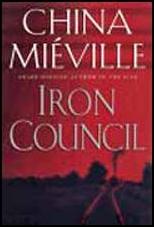 In another article I wrote that, as I was rushing
through the last three hundred pages of Perdido
Street Station (2000), I felt increasingly sorry that it was going to end.
On the other hand, it took me fourteen months to read the third novel in the
Bas-Lag sequence, Iron Council. (I so
often felt tempted to start reading something else that I went through
sixty-five other books.) Let us see why:
In another article I wrote that, as I was rushing
through the last three hundred pages of Perdido
Street Station (2000), I felt increasingly sorry that it was going to end.
On the other hand, it took me fourteen months to read the third novel in the
Bas-Lag sequence, Iron Council. (I so
often felt tempted to start reading something else that I went through
sixty-five other books.) Let us see why:
In so many respects, Perdido Street Station pushed the
envelope of fantasy, announcing
To begin with, Iron Council seeks to outdo the previous two novels, switching from
steam engines and clockwork to golems and elementals. Its fantastic images and
events are surrealist, flamboyant, creative to a degree with which only Jeff
Noon might hope to rival. However, it also seeks to outdo its predecessors in
terms of left-wing lecturing, and that tends to dampen the readers’ enthusiasm.
Perdido
Street Station contained a
subtextual polemic with the covert conservative ideology of J.R.R. Tolkien’s The Lord of the Rings (1954-1955). In
Tolkien’s Middle Earth, a character’s moral stance is determined primarily by
race. (Elves, for instance, are by definition noble and good, if somewhat
distant.) In
Iron
Council, sadly
enough, pushes political speechifying into the text, right under the readers’
eyes. Time and again, the novel alternates between debates on how to start a
revolution and scenes whose purpose is to show how inhuman and cruel and
oppressive the fascist militia is. Had Iron
Council been published a century and a half earlier, its revolutionary
fervour might have struck a true chord. As it is, the theme of trade-union
struggle and workers’ solidarity was treated brilliantly, decades ago, by
first-rank modernist writers such as John Dos Passos (the
One of Iron Council’s narrative threads follows the (mis)adventures of
poorly-paid railway workers whose job is to build Bas-Lag’s first
transcontinental railway. They cross wild regions, meet exotic people and
ferocious creatures, and finally choose to live free, rather than endure the
militia’s oppression. Fine and well, except Karl May gave a more convincing
treatment of this subject in his novel Winnetou
(1893).
The other narrative thread focuses on
a revolution in New Crobuzon, complete with hot-headed revolutionaries,
barricades, bitter street fights, martial law, summary executions and a
last-minute reckoning with a traitor. Fine and well (again), except Victor Hugo
gave a more enjoyable and memorable treatment of this subject in his novel Les Misérables (1862).
Time to re-examine the
tearing-the-envelope-to-pieces statement I made earlier on.
In Karl May’s Winnetou, much of the novel’s attraction lies in the male
friendship between the Apache protagonist and the Caucasian narrator-witness.
There is mutual admiration, as well as a sense of evolution through which the
two characters guide one another.
China Miéville turns this male frienship/ mutual admiration
theme into a homosexual love affair between Judah Low (Iron Council’s ambiguous protagonist) and Cutter (a witness
character), a love affair which leads to rather explicit scenes. Whether
sexually explicit scenes (homoerotic or otherwise) are welcome in fantasy works
is up to the readers to decide...
Victor Hugo’s Les Misérables, on the other hand, derives much of its
considerable emotional impact from the artful way in which the characters’
existence is constructed, page after page, before
they get to the barricades. Since we know Jean Valjean, Éponine, Enjolras, Marius de Pontmercy, Gavroche,
Grantaire, Mabeuf and Javert so well, we deeply care for each of them (yes,
even for the implacable Javert) and when one of them is hurt or killed, we, the
readers, are extremely moved.
In Iron
Council’s climactic chapters,
The bitterest thing to say about Iron Council, however, has nothing to do
with nineteenth-century literature, but rather with twentieth-century history.
At the core of China Miéville’s novel
lies a didactic urge to show the readers how a right-wing totalitarian régime uses militiamen armed to the teeth to force
convicts and free men to build a transcontinental railway, and how the
oppressors threaten, torture and sometimes kill the workers in order to
accomplish this goal.
It is a sad irony that in the
twentieth century a totalitarian régime indeed
used militiamen armed to the teeth to force convicts and free men to build a
transcontinental railway (among other things) and indeed the oppressors threatened,
tortured and killed the workers (by the tens of millions) in order to
accomplish this goal. But the totalitarian régime I refer
to was left-wing, based in the Soviet Union, and the irony is on the writer
China Miéville and on his ill-advised
notion to mix socialist trade-union ideology and fantasy writing.
So, if (according to this brilliant,
imaginative British author) lessons we must learn about totalitarian,
oppressive régimes, let us learn them from a
first-hand non-fictional source. Read Aleksander Solzhenytsyn’s The Gulag Archipelago (1973). (top)