BRITISH F & SF THE WEAVER INTERVIEWS
ON
AMERICAN FANTASY AND SCIENCE FICTION
ROBERT E. HOWARD
The Conan Chronicles Volume 1: The People of the Black Circle
(2000)
ROBERT A. HEINLEIN
Starman Jones (1953)
Double Star
Glory Road
POUL ANDERSON
The Broken Sword
RAY BRADBURY
Fahrenheit 451
CLIFFORD D. SIMAK
Time and Again (1951)
ALFRED BESTER
The Stars My Destination
PHILIP K. DICK
The Cosmic Puppets
The Simulacra
Martian Time-Slip
Blade Runner (Do Androids Dream of Electric Sheep?)
URSULA K. LE GUIN
Tales from Earthsea (2001)
The Other Wind (2001)
ROGER ZELAZNY
The Chronicles of Amber (2000)
Nine Princes in Amber (1970)
The Guns of Avalon (1972)
Sign of the Unicorn
The Hand of Oberon
The Courts of Chaos
Jack of Shadows (1971)
GENE WOLFE
The Shadow of the Torturer
The Claw of the
Conciliator
JOHN VARLEY
Millennium
ROBERT E. HOWARD – The Conan Chronicles Volume 1: The People
of the Black Circle (2000)
(Gollancz,
Orion Publishing Group, London, 2004)
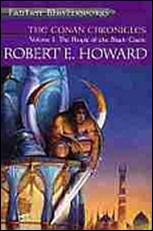 Conan the Cimerrian appears to have become, like Don
Quijote or Lemuel Gulliver or Sherlock Holmes, one of those characters familiar
to hundreds of millions of people who, in most cases, have little or no
acquaintance with the original literary texts. According to Stephen Jones, the
one who edited the two massive volumes published as The Conan Chronicles, Conan is perhaps the second most popular
twentieth-century literary character (after Edgar Rice Burroughs’ Tarzan). Yet,
rather typically for our media-saturated environment, my acquaintance with
Conan was roundabout.
Conan the Cimerrian appears to have become, like Don
Quijote or Lemuel Gulliver or Sherlock Holmes, one of those characters familiar
to hundreds of millions of people who, in most cases, have little or no
acquaintance with the original literary texts. According to Stephen Jones, the
one who edited the two massive volumes published as The Conan Chronicles, Conan is perhaps the second most popular
twentieth-century literary character (after Edgar Rice Burroughs’ Tarzan). Yet,
rather typically for our media-saturated environment, my acquaintance with
Conan was roundabout.
In the late 1980s, I saw some posters
from a German glossy magazine advertising two motion pictures, Conan the Barbarian (1982) and Conan the Destroyer (1984), starring
Arnold Schwarzenegger. Then, in 1990, I watched Conan the Barbarian. In the early 1990s, I leafed through paperback
editions of Conan collections.
On the one hand, I was rather
disappointed to find out that, like his pen-friend and fellow pulp-writer H. P.
Lovecraft, Robert E. Howard had been subjected to posthumous “collaborations”
and pastiches that had stretched his imaginary realms rather thin. (A point
driven home once again in the mid 1990s by a weak Conan television series
starring Ralph Moeller.)
On the other hand, I was amazed by the
exquisite and influential art by “Fantastic” Frank Frazetta that graced the
covers of those paperbacks.
Then, in June 2006, the long wait was
finally over. My favourite book importers, Mr. and Mrs. Hanu from Nautilus, brought from Great Britain The Conan Chronicles, two volumes from
“Fantasy Masterworks”, complete with maps, an introductory article by Robert E.
Howard, well-documented afterwords by Stephen Jones and spectacular cover art
by John Howe.
I took these elegant volumes home
(along with two dozen other books) and gradually discovered that Howard’s
original Conan stories are more than convincing and dynamic and cinematic.
They are addictive.
Editor Stephen Jones ordered the Conan
stories according to their internal chronology. The first volume opens with
“The Hyborian Age”, a back-story that covers circa ten thousand years and shows
how, through migration, evolution, technological progress (and sometimes
regress) and in spite of various natural cataclysms, there emerged the various
ethnic groups that populate Conan’s world.
Some of the texts included in The People of the Black Circle are mere
fragments or drafts, others are complete stories (most of which were originally
published in Weird Tales) and the one
that gives the volume its title is a short novel in its own right.
There are recurrent patterns
throughout the stories – characters, incidents and settings that echo one
another, yet are never quite identical, like the complex shapes to be found in
the depths of the Mandelbrot set. As a rule, Conan mistrusts town-dwellers and
the cities he visits (either inhabited or abandoned) sooner or later turn into
traps. Also as a rule, opponents will use sorcery and will call demons,
monsters or animated statues to their help. In almost every story there is a
damsel in distress (either a princess, a temple dancer, a lady-pirate or an
innocent girl) and sooner or later there is nudity – after all, the Conan
stories provided prime inspiration to the artists who made covers for Weird Tales. And, whether he is
confronted with sorcery, deceit, treachery or enemy armies, the protagonist
will triumph due to a combination of superhuman force and cunning.
Despite the similarity of plotlines,
situations and characters (partly due to Howard’s writing all the Conan stories
in only three years), there are enough plot twists and turns to keep readers
hooked. The rhythm of incidents is frantic, the action is relentless and the
stories have a cinematic quality and a raw energy that few fantasy authors have
matched since.
In later decades of the twentieth
century, various writers found it easy to mock or to openly criticize the Conan
stories for their naiveté, their lack of psychological depth, their sexism or their
racism. However, few fantasy characters indeed have Conan’s archetypal quality
and (truth be told) many fantasy authors began their writing with Robert E.
Howard pastiches. Indeed, in terms of importance in shaping the field of modern
fantasy, Howard rivals with Lord Dunsany and J.R.R. Tolkien.
So, when all is said and done, editor
Stephen Jones and the people at Gollancz are due thanks for acquainting (or
reacquainting) readers with the original Conan stories in The People of the Black Circle. I, for one, can hardly wait to
begin reading the second volume. (top)
ROBERT
A. HEINLEIN
- Staarman Jones (1953)
(New English
Library, London, 1976)
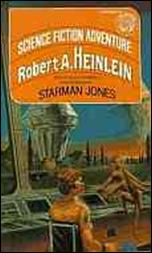 This is one of Robert A. Heinlein’s “juveniles”, a
science-fiction novel destined to a young audience (10-15, I suppose). It
features an adolescent protagonist, Max Jones, and a rite-of-passage plot.
This is one of Robert A. Heinlein’s “juveniles”, a
science-fiction novel destined to a young audience (10-15, I suppose). It
features an adolescent protagonist, Max Jones, and a rite-of-passage plot.
Briefly, young Max is a farm boy whose step-mother remarries and sells
the farm. He runs away, armed only with his uncle’s astro-navigation books, meets
a savvy tramp, Sam, and, after being turned down by the astrogators’ guild, he
embarks with forged documents on the Asgard.
He works his way up through the ranks from stewart’s mate to chartsman
to apprentice astrogator, helped by photographic memory, fatherly advice from
Sam and a good word with the Captain from a lovely passenger, Ellie (a
diplomat’s daughter who befriends Max).
The astrogator dies, the captain and the assistant astrogator
miscalculate, the ship ends up in unknown space. After an interlude on an
Earth-like planet where they confront unfriendly centaur creatures, Max is
promoted to captain, takes the ship back to known space and gets official
admission to the astrogators’ guild.
What makes the novel appealing to the young audience is the
rags-to-riches story, where a farm-boy rather similar to the small-town readers
goes through standard “adventures-for-boys” events: stowaway on a ship,
promotion for merit, adventure, excitement, a brush or two with exotic natives
and, finally, social recognition.
Also, typical for Heinlein’s novels, there is a father figure. Sam,
ex-Imperial Marine, is a knowledgeable character who keeps an eye on Max,
advises him now and then and saves a life or two. He is even more likeable for
breaking rules (for instance he forges documents and at one point runs an
illegal casino) and then enforcing them in a commonsensical way when he becomes
chief-of-police. As one has learned to expect from Heinlein’s novels, Sam dies
at a crucial moment and makes the readers shed a tear or two.
Ellie (that would be Eldreth Coburn) is there as a love interest. She
teaches Max some dancing, goes through a ritual of teasing repartee and
basically schools him in the social aspects of dealing with the opposite sex.
Lest readers get the wrong idea, near the novel’s ending she proves to be an
excellent 3-D chess player and she lectures Max on how girls need to pretend to
be silly in order to get by in life.
The antagonist, Mr. Simes, is portrayed as a bully who uses petty
regulations to humiliate other people and ruin their chances in life. He is
doomed by incompetence and tries to promote himself to captain after the death
of old Captain Blaine, but he goes too far, threatens another officer with his
gun, and Sam uses this as an excuse to kill him.
Heinlein kept the novel short (207 pages) and divided it into 22
chapters, which makes the reading easy and enjoyable. He also used exposition
lightly (which made him famous) and, at least this time, he went easy on the
preaching. Starman Jones makes one
wonder how hard one must write in order to create “light” reading of such good
quality. (top)
CLIFFORD
D. SIMAK
- Timme and Again (1951)
(Ace Books,
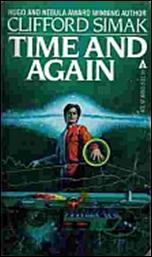 Time and Again is
the story of a man, Asher Sutton, who succeeds where many others have failed.
He flies a ship beyond a barrier set up by the inhabitants of Cygni 61 and
contacts them.
Time and Again is
the story of a man, Asher Sutton, who succeeds where many others have failed.
He flies a ship beyond a barrier set up by the inhabitants of Cygni 61 and
contacts them.
The novel, however, begins in 7990
with a visitor from the future warning Sutton’s boss, Christopher Adams, to
kill Sutton on his return from Cygni 61. The reason is that Sutton will write a
book which will help the android liberation movement.
Sutton returns, and his colleagues
realize that he is no longer human. His ship was rebuilt, but is no longer
functional, nor can it support life. Sutton’s body was rebuilt as well, and the
protagonist spends some time finding out what his new skills are.
Before long, Sutton finds out that a
terrible war is raging across time. One side wants him dead, and they send
agents to kill him. Another side, which calls itself Revisionist, wants to make
Sutton’s as-yet-unwritten book sound like a piece of propaganda, meant to
reveal humankind’s manifest destiny to conquer and rule all the galaxies. The
third side intends to help Sutton write his book as he means to – a manifesto
of destiny as something inherent to every living thing.
The plot moves at a fast pace, with
violent incidents that bring Sutton in the power of one camp, then in the hands
of another. He goes through a duel, travels to an asteroid, is kidnapped in a
ship and, as a result of a letter from a distant ancestor, he is stranded in
the far past in the late 20th century.
Sutton spends a decade there, working,
thinking and developing his unusual abilities, then travels back to the future
and negotiates with Trevor, head of the Revisionists. He finally refuses to
write a piece of propaganda, offers the androids the possibility to scan his
body, study the way in which he was redesigned, multiply his skills and fight
Revisionists to a standstill, then retires to write his book.
What he never finds out, and what the
readers discover on the book’s last page, is that androids are not to live as
equals amongst humans, but to outnumber and eliminate them gradually.
Throughout the events in the book, androids create and maintain the illusion
that some humans are on their side, yet in the end it turns out that even
Sutton’s closest ally, Eva Armour, is an android too.
On the one hand, Time and Again surprises by a contrast between what it says and how
it makes the readers feel. One issue concerns space flight, humankind’s
expansion throughout the Milky Way, relations with extraterrestrial
civilizations. However, there are no pages evoking the beauty of outer space,
the vastness (or weirdness) of the Cosmos.
Another issue concerns time travel.
One way in which people do travel in time is to live to an old age. As they do
so, they notice how the world around changes technologically, culturally and
also linguistically. However, in Simak’s book, a character may travel thousands
of years to the past and, on arrival, have conversation with a distant
ancestor. No culture shock, no linguistic differences. Hardly plausible.
The core issue, however, is androids’
liberation movement. In the novel, androids are marked and treated as slaves.
They are human in every respect except reproduction and, in theory, people
mass-produce them to help maintain a galactic empire in which humankind rules
despite its being vastly outnumbered.
What comes as a revelation in the
book’s last pages is that androids have developed means to manufacture other
androids and that they use these unmarked androids to spy on humans.
One cannot help but wonder whether the
androids in Time and Again, treated
as slaves, organized in a liberation movement, struggling against a
conservative, privileged race, were not inspired by the Civil Rights movement
in the US. For, as William Gibson loves to remind his readers, science fiction
is not about the future, really, but about the present. And Time and Again was published in 1951. (top)
URSULA
K. LE GUIN
– Tales from Earthsea (2001)
(Ace Books,
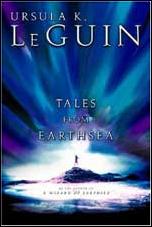 In November
1998 (after considerable resistance due to my being a Tolkien fan) I gave in to
temptation, bought and read Ursula K. Le Guin’s The Earthsea Quartet (Penguin Books, London, 1993). It did not take
me long to realize how foolish I had been in not reading it earlier on.
In November
1998 (after considerable resistance due to my being a Tolkien fan) I gave in to
temptation, bought and read Ursula K. Le Guin’s The Earthsea Quartet (Penguin Books, London, 1993). It did not take
me long to realize how foolish I had been in not reading it earlier on.
However, when reaching Tehanu (1991), the last novel in the
omnibus volume, I had a distinct feeling that something was wrong. Bits and
pieces of the trilogy (for a trilogy it had been) were put together in an
attempt to create a novel with little plot and less suspense. I felt rather
disappointed.
Then, in September 2005, I bought and
read Tales from Earthsea. It was all
that Tehanu had failed to be.
Tales
from Earthsea does not attempt to be a direct sequel to the
existing novels. It moves, in postmodern manner, from grande histoire to petite
histoire, and from unified storyline to separate fragments. Paradoxically,
it is more relevant to the Earthsea sequence than its predecessor and more
coherent as well.
The book opens with the writer’s
introduction, which deals with the ways in which time changed Ursula K. Le
Guin, Earthsea and even the readership. It provides a few items of information
regarding the contents of the collection and a rebuke of the commodification of
fantasy, a phenomenon which drains the genre’s significance and power.
The first story, a hundred-page
novella, is called “The Finder”. It is the tale of a boy, Otter, who is dragged
into slavery, menaced by a wizard obsessed with quicksilver, helped to escape,
then sheltered on the
“The Finder” is based on a conflict of
ideas. Should magic power be used for competition and personal profit, as the
wizards of the Dark Time use it? Should one use it for secrecy and sheltering a
few, as the Women of the Hand do? Should one use it for spreading knowledge,
trust and peace to everyone, as the protagonist proposes? Between the lines,
Ursula K. Le Guin, a master story-teller, provides answers to these questions.
None are easy or safe, yet Otter is prepared to risk even his life to sustain
his point of view.
“Darkrose and Diamond” goes against
the grain of fantasy stories. Diamond is a merchant’s son, gifted with musical
talent and magic abilities. Rose is a witch’s daughter. They grow up together,
yet Diamond’s father, Golden, decides his son should keep away from Rose and
music and should study wizardry instead.
Standard fantasy stories would then
show how Diamond completed his training and went on to achieve grand deeds.
Ursula K. Le Guin, however, illustrates the point that only a few of the
magically gifted become wizards.
Diamond realizes that he cannot
dedicate his life to the study of magic. He leaves his master and returns to
Rose, yet she rejects him. Halfway through the story, the protagonist finds
himself devoid of everything he enjoyed in life: Rose, music and magic.
Intent on acting like a man, Diamond
then chooses to help his father manage the family business and for a few years
leads a prosperous (but joyless) life. Luckily, at his coming-of-age party,
Rose and her travelling band make an appearance and he has a second chance to
express his feelings. Rose refuses to become a merchant’s wife, but Diamond is
happy to join her as a travelling musician.
The story draws a distinction between
ways in which people’s life changes. Choosing one’s way (either as a wizard, a
merchant or a musician) is one thing. Being forced in a professional direction
(no matter how grand or respected) is quite another.
“The Bones of the Earth” provides
another piece of The Earthsea Quartet
background puzzle. It tells the story of a wizard, Dulse, whose power and
knowledge come from the ground. In his old age, he remembers some key episodes
from his apprenticeship and from his long-time relationship with Silence, his
most gifted apprentice.
Dulse senses that an earthquake is
about to destroy a city and port on the
“On the High Marsh” begins as the
story of a vagrant who finds shelter in widow Gift’s house, on the
Gradually, the widow realizes that the
newcomer is none other than Archmage Ged, come to hunt down his opponent,
Irioth. However, the summoner has found a home and peace, and would rather stay
with Gift than follow Ged back to Roke. And Ged allows him to stay.
“On the High Marsh” is the sort of
story that readers needed in order to figure out what Ged did as an Archmage in
the decade-long interval between The Tombs
of Atuan, where he is still young, and The
Farthest Shore, where, as an old man, he reaches the climactic end of his
career.
“Dragonfly” tells the story of a girl,
Irian, who is unhappy with her true name and her position in the world. A failed
wizard, Ivory, takes her to Roke School as a joke, yet her arrival and
admission (a breach of a multi-secular tradition to initiate only boys in the
high art of wizardry) brings a latent conflict to a point of crisis.
More specifically, after Ged’s return
from the wall of death (as told in The
Farthest Shore) and the crowning of King Lebannen, the Master Summoner
Therion feels that the “natural” order of things has been broken and needs to
be re-instituted. Ged’s loss of magic power suggests a new Archmage should be
elected. King Lebannen’s coronation should be repeated, with the Archmage
performing the ritual this time. Therion (himself returned from the dead) has
persuaded quite a few Masters and students that he should be the next Archmage.
The Patterner, on the other hand, has
prophesied that the new Archmage will be “a woman of Gont”. He offers shelter
and advice to Irian and she challenges Therion to meet her on Roke Knoll, a
place where things can only be what they are. Therion’s magic proves useless in
that powerful place and he turns into a lifeless heap of rags and bones. Irian,
on the other hand, turns into a dragon and flies to join her kin in the western
isles. And the Doorkeeper decides to admit girls as well as boys in
Like other stories from this
collection, “Dragonfly” focuses on the urge for development, self-discovery and
self-awareness, and insists on change, tolerance and sharing, rather than
tradition, segregation and elitism.
The book ends with a descriptive
essay, “A Description of Earthsea”, which clarifies and systematizes background
information concerning people, languages, history and the magic arts. Among
other things, it states that Ged was Earthsea’s last Archmage, which
contradicts the Patterner’s prophecy in the novella “Dragonfly”. Which of the
statements is true I shall probably find out when I read the next Earthsea
book, The Other Wind (2003).
But that is another story. (top)
URSULA K. LE GUIN – The Other Wind (2001)
(Orion, London,
2003)
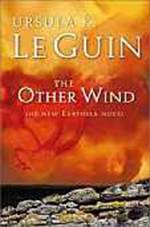 In a review
dedicated to another Earthsea book, I confessed how intensely (and foolishly) I
resisted a friend’s invitation to visit this high-fantasy realm. For a few
years now, to my surprise, I have felt an increasing urge to go back and revisit
it. Luckily, so did Earthsea’s creator, Ursula K. Le Guin, and in the summer of
2007 I had the pleasure to read the latest addition to the Earthsea sequence, The Other Wind.
In a review
dedicated to another Earthsea book, I confessed how intensely (and foolishly) I
resisted a friend’s invitation to visit this high-fantasy realm. For a few
years now, to my surprise, I have felt an increasing urge to go back and revisit
it. Luckily, so did Earthsea’s creator, Ursula K. Le Guin, and in the summer of
2007 I had the pleasure to read the latest addition to the Earthsea sequence, The Other Wind.
The new Earthsea novel takes place a
few years after the events in Tehanu.
King Lebannen’s reign is threatened by three types of crisis at once. A
political one – the Kargish king sends forth his daughter, Princess Seserakh,
for Lebannen to marry, and refusal might easily lead to war. A physical one –
in the west of the Archipelago young dragons have taken to burning fields,
crops and forests and to driving people away. And a metaphysical one – in the
dreams of a Mender called Alder, his dead wife and a host of other shadows
compel him to help tear down the stone wall between the dry land of the dead
and the fertile land of the living – the very wall the mending of which had
cost Archmage Ged his magic power in The
Farthest Shore.
The action’s setting moves quickly
from Gont to Havnor, then to Roke, and the multiple selective point of view
switches in turn to Alder, to old Ged, to his wife Tenar and to King Lebannen.
There are numerous connections with the earlier novels and stories in the
sequence (with some spectacular and memorable scenes involving Orm Irian, the
dragon-girl) and new developments in terms of characterization and background.
There is also a visible streak of
feminist ideology that influences character behavior. Male characters are
mostly presented as isolated – sometimes emotionally, sometimes physically –
and as competing with one another. Ged, for instance, leads a quiet life by
himself on the island of Gont, on what used to be Ogion’s farm, while his wife
Tenar and his adopted daughter Tehanu are on an extended visit in King
Lebannen’s court. Azver, the Master Patterner on Roke, keeps himself to himself
in the Immanent Grove (and, paradoxically, almost every companion on Lebannen’s
quest joins him rather than accepting the stiff official invitation to the
School of Magic). King Lebannen feels emotionally isolated even from Tenar. And
when Alder approaches two wizards for help, one of them, Seppel from Peln,
stops his terrible dreams only in exchange for his magic gift of mending.
Female characters, on the other hand,
are presented as supportive of one another and co-operative. Tenar, for
example, provides emotional support at one point or another to Alder, to
Lebannen, to Princess Seserakh and to young Tehanu. Princess Seserakh
unintentionally gives Tenar a moral boost by offering her a chance to speak her
native tongue, Kargish (which she has not done in decades). And Tehanu and Orm
Irian co-operate to bridge the gap between people and dragons.
This (slightly optimistic) view of
relations among women culminates in Part IV, “Dolphin”, during a stormy crossing at sea, when, in order to drive
away Prince Seserakh’s sea-sickness, Tenar invites her, Tehanu and Orm Irian to
join a gambling session and (unlike the emotionally isolated, worried male
characters) they all have a good time.
If one were to compare The Other Wind to the novels in the
original Earthsea trilogy, one might discover it is somewhat longer than any of
them. However, it is also deeper and richer in its exploration of relations
among characters and in its character development. The author paid particular
care to explore not only the characters’ daytime thoughts, but also their
reveries and their nocturnal dreams. In this respect, the opening pages of the
final section, “Rejoining”, contain a masterful mosaic of symbolic dreams.
And, speaking of book length, when
compared to the bulky average fantasy volumes of watered-down prose, The Other Wind appears to be compact,
economic and very enjoyable in its elegance. For, in the realm of high fantasy,
Ursula K. Le Guin has very few rivals. (top)
ROGER ZELAZNY – The
Chronicles of Amber (2000)
(Gollancz,
Orion Publishing Group,
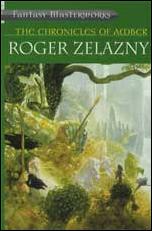
In
1994, a friend whom I had acquainted with J. R. R. Tolkien’s The Lord of the Rings (1954-1955) tried to
repay me in kind and told me about Roger Zelazny’s Amber sequence. However, it
was only in the summer of 2006 that I finally acquired an omnibus volume from
Gollancz containing the first five novels in the series. After the first dozen
pages I was almost outraged. By the end of the first novel I was tempted to
start reading the second one as well. Halfway through the 770-page volume I
could no longer put it down. And, when I finished it, I was genuinely sorry it
had ended.
How
could mere words printed on paper cause such a change? Let us begin with the
beginning... (top)
ROGER
ZELAZNY
– Nine Princes in
Amber (1970)
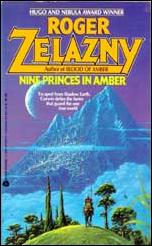 Nine Princes
in Amber opens with the
all-too-familiar situation of a protagonist-narrator coming to his senses in a
hospital, staring at blank walls and struggling to remember who he is, as he
suffers from amnesia. Too often, such an opening scene is written by overworked
professional authors who suffer from a block and stare at a blank sheet of
paper.
Nine Princes
in Amber opens with the
all-too-familiar situation of a protagonist-narrator coming to his senses in a
hospital, staring at blank walls and struggling to remember who he is, as he
suffers from amnesia. Too often, such an opening scene is written by overworked
professional authors who suffer from a block and stare at a blank sheet of
paper.
Moreover, the protagonist-narrator’s
tone of voice reminds one of Philip Marlowe, the private detective in Raymond
Chandler’s novels. Nevertheless...
After fighting and bullying his way
out of hospital, the hero gets to
Then, to the readers’ growing
astonishment, Roger Zelazny mixes the topos of an amnesic hero with a
Chandleresque tone of voice, Tarot cards that can be used both for telepathic
communication and teleportation and… metaphysics. (Or is it psychoanalysis?)
As Corwin finds out from one of his
brothers, Random, they are supposed to leave the Earth, travel among other
Shadow worlds and reach Amber, the one true realm of which all others are only
imperfect copies. On the one hand, one might argue that this notion that our
world is only a pale, inconsistent copy of some ideal, eternal, immutable realm
goes back all the way to Plato. On the other hand, however, as the Shadow
worlds must first be imagined by one of the Amber princes and only then become accessible,
Corwin wonders now and then whether these Shadows are mere representations of
the Amberites’ psyche. (And, of course, readers are left to speculate who
imagined Earth and us, its inhabitants.)
Corwin is also caught in a violent
struggle. As he nears Amber, he finds out that some of his brothers (Eric,
Caine and Julian) have joined forces to minister the kingdom in their father’s
absence. Or maybe to usurp him. One of Corwin’s sisters, Deirdre, accompanies
him to the underwater realm of Rebma, where a mirror-image of the Pattern in
Amber can be found. Corwin walks the Pattern, facing terrifying hallucinations,
and his memory is restored.
Readers find out that he was exiled on
Earth since the Black Death through the Napoleonic Wars to the late 20th
century. For the rest of the sequence, memories of plagues, wars and famous
people such as Sigmund Freud haunt the hero every now and then. (I wonder where
the makers of Highlander got their
inspiration for both the subject and the flashback-comeback technique…)
Since Corwin suspects Eric of the
worst possible intentions, first he fights him in a duel, then he teams up with
another one of their brothers, Bleys, raises an Army and a fleet in Shadows and
leads them forth to besiege Amber. As they progress to the one true realm,
among the exotic, flickering realities around them they occasionally glimpse
tanks or an atomic explosion from our reality.
The final battle does not fare well,
however. Corwin is taken prisoner, humiliated at Eric’s coronation (even if he
crowns himself first, as a defiant gesture), his eyes are put out and he is
imprisoned. Intertextual elements from The
Count of Monte Cristo come to play, as Corwin’s eyes slowly regenerate, he
tries to scratch his way out through the cell’s door and then a visitor from
another cell, Dworkin (a Leonardo da Vinci type of artist who created the Trump
cards), shows him the way to freedom by means of painted landscapes and magic.
As Corwin recovers in a lighthouse, he
can see the results of the curse he cast when he was mutilated: a black road
has been open all the way to Amber castle and malevolent creatures can travel
down it from Shadows to the one true reality and besiege it.
Ironically, by the end of the first
novel the hero realizes that it is his responsibility to contain this new
menace – after all, it was he who opened the way for it in the first place. He
sends a defying note to his brother Eric and promises himself that, despite
Amber physical laws that prevent the functioning of firearms, he will return
with guns blazing.
At this point, readers discover they have been caught in a complex literary trap. Whatever Corwin wants to achieve, they have barely seen him plan, much less put to practice. The narrative tone has charmed them, the deadpan mixture of registers has proven to be almost Tolkien-grade, there are unanswered questions (such as “Who caused Corwin’s amnesia and psychiatric treatment?”) and the fantasy realm of Amber has barely been sketched. In other words, the audience is eager to find out more about Corwin’s future (as well as his past) and about his environment, which (like themselves) the hero seems to discover for the first time and simultaneously to remember from long ago.
Besides, Nine Princes in Amber is so brief and narrated at such a frantic
pace that one is easily convinced there is no harm in reading one more slim
novel to see what happens next and what other intertextual references Roger
Zelazny has up his sleeve. (top)
ROGER ZELAZNY – The Guns of Avalon (1972)
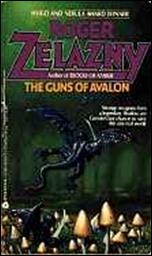 The second
novel in the Amber sequence focuses on the fruition of Corwin’s vengeance
plans. He travels to a realm similar to our Earth, gets large amounts of
diamonds, uses them to pay for large amounts of firearms with special
ammunition and, with an army of volunteers, travels among Shadows to besiege
Amber once again.
The second
novel in the Amber sequence focuses on the fruition of Corwin’s vengeance
plans. He travels to a realm similar to our Earth, gets large amounts of
diamonds, uses them to pay for large amounts of firearms with special
ammunition and, with an army of volunteers, travels among Shadows to besiege
Amber once again.
However, since Corwin is not half as
cynical and ruthless as Jack of Shadows, for instance (and since Roger Zelazny
is a master story-teller), at the last moment he feels bound to assist his
brother Eric in defence of Amber against besieging Chaos creatures that had
travelled up the black road.
This twist in the plot had been
foreshadowed ever since the novel’s opening chapters, in which Corwin first
helps an old acquaintance, Ganelon, defend a Shadow realm against Chaos
creatures, then does the same for his brother Benedict.
On the other hand, The Guns of Avalon creates the
conditions for more plot development in the subsequent novels. Corwin meets an
attractive young woman, Dara, who introduces herself as Benedict’s
great-grand-daughter. Besides having a love affair with her, the protagonist
teaches her a lot about the Amber royal family. Too late, in the turmoil of the
novel’s final battle, does he realize that Dara is in fact a Chaos creature who
has just walked the Pattern, gained immense knowledge and power, and has turned
into a serious threat to Amber. Like the dark road, Dara is a menace whose
potential was heightened by Corwin’s careless actions, and therefore he feels
responsible to deal with the consequences.
In terms of structure, The Guns of Avalon is perhaps the most
straightforward in the sequence, with few intertextual elements (Ganelon – a
connection with The Song of Roland, Lancelot
du Lac – an echo from Arthurian legends, and some furies from Greek mythology)
and a strong narrative drive. However, brief and dynamic as it is, the novel
whets the readers’ appetite for more Amber books.
And Roger Zelazny was kind enough to
provide more. (top)
ROGER ZELAZNY – Jack of Shadows (1971)
(Signet, New
American Library, 1972)
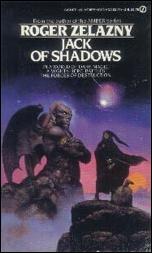 I have fond
memories about Jack of Shadows. In
November 1990, it was the first foreign book I bought – an exquisite French
edition from Presses Pocket with silver covers and an interior illustration by
Siudmak. I read it twice, then translated some of it for my girlfriend.
I have fond
memories about Jack of Shadows. In
November 1990, it was the first foreign book I bought – an exquisite French
edition from Presses Pocket with silver covers and an interior illustration by
Siudmak. I read it twice, then translated some of it for my girlfriend.
Later, in the fall of 1999, an
American friend, Tracey Rosenberg, offered me a copy from Signet as a gift. In
2006, after having read the first five Amber books, I read Jack of Shadows in English and discovered a book that sounded (and
felt) rather different from the sugar-coated French translation I was familiar
with. Then again, the reader himself had become different from prolonged
acquaintance with Corwin of Amber…
On the one hand, this novel’s
protagonist appears both more selfish and more superficial than Corwin, Sam, or
even Hell Tanner. The world in which he operates, however, is rich and
memorable, suggesting that there is much more about it than the narrator cares
to tell us.
Briefly, it is an Earth which is
tide-locked to the Sun. The light side is inhabited by human beings, defended
from sunlight by means of a force field and governed by the rules of science.
The dark side, on the other hand, is inhabited by fantastic creatures of every
description, defended from freezing by means of a shield of spells and governed
by the rules of magic. When darksiders die, they are reincarnated at the
Western Pole, in the dung pits of Glyve, and (in case they are not dragged into
slavery by the Baron of Drekkheim) they go back to their usual power struggles
and enmities.
The protagonist Jack of Shadows,
however, is a creature of Twilight that draws magic power not from a fixed place
(as darksiders do), but from shadows. He is a thief and a trickster who,
frustrated in his wish to marry Evene and executed by his enemies, returns and
plans a terrible revenge.
Jack’s plans involve dodging his
various enemies (one of which, the Lord of Bats, cunningly imprisons him in a
jewel), travelling to the light side and using a computer on a campus to
retrieve Kolwynia, a lost magical key that literally enables him to bring down
an artificial satellite with a spell, move mountains and conquer his enemies
one by one.
Unfortunately, in the process of
acquiring super-human magic powers, Jack loses almost all traces of humanity.
He shows no mercy to his defeated enemies (which is why he acquires the name
Jack of Evil) and he can only boast the friendship of one character –
Morningstar, a horned winged colossal demon that has been cursed by the gods to
turn half to stone on a mountain top in Twilight and to be freed at sunrise
(which is supposed never to occur).
What the protagonist discovers after
taking revenge on all who had wronged him is that he cannot terrorize the lords
he has defeated into maintaining the magic shield – and he cannot maintain it
by himself. Consequently, he must look for a solution, and he descends to the
center of the Earth to set the planet in motion, so that light and darkness
might alternate all over its surface. This entails the loss of his magic
powers, the unmaking of his kingdom, the release of all those he kept
imprisoned and, very nearly, the loss of his life.
Jack’s story, written and published at
the height of the martial-arts movie fad, carries a message radically opposed
to the usual underdog-gets-revenge plotline of
And yet, in the novel’s final paragraphs,
someone rushes to his rescue – the only character to which the thief has shown
kindness without expecting anything in return. For Jack has caused the sun to
rise and fall, after all…
On second thoughts, despite its
lacking the evocative power of The
Earthsea Quartet, for instance, or the plot complexity of The Lord of the Rings, or the minutely
researched background of The Broken Sword,
Jack of Shadows has quite a few
things going for it:
It is brief and clear.
It is self-contained. (Indeed, it leaves
no room for a sequel, which is a rare thing in the fantasy industry.)
It features a clear subtextual
message, rather than an adventure-for-adventure’s-sake escapist routine.
It provides ample room for the
reader’s imagination.
It moves at an alert pace.
It makes good use of Chekhov’s Law
(with a stone, rather than a shotgun).
It deserves and rewards a second
reading.
Recommended. (top)
BRITISH F & SF THE WEAVER INTERVIEWS