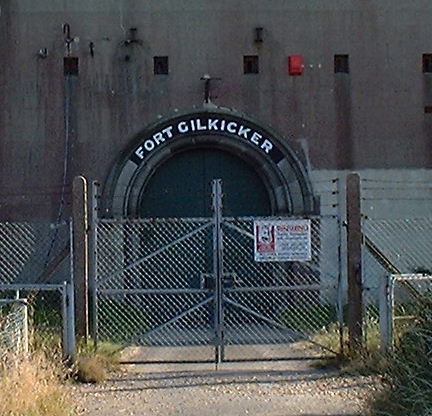
FORT GILKICKER
Solent Landmarks
Fort Gilkicker
Facts and Dits
More Information
| A
Quick History
The area around the fort has been used for fortifications since the Tudor times. The remains of Forts, moats ,batteries and redoubts lie scattered around Gilkicker point. The current Fort Gilkicker has a far shorter history, being built in the 19th Century. |
|
||
| A Time Line | 3 Crisis, three forts. | ||
| Tudor period
The first castle is built 1545 Haselworth Castle built at Gilkicker point 1588 Castle reported to be in ruins |
Haselworth was one
of Henry the VIII's coastal defences and was probably sited near the current
location of Fort Monkton.
Henry's Castle building spree was caused by the dispute with Rome over his divorce. Southsea castle is another nearby example of a Tudor Coastal fortification. |
||
| 1700's
The area is defended 1779 Temporary fort built at Gilkicker point 1780 Work started on a new fort at Point Gilkicker. 1790 The New fort completed, and Named Fort Monckton. |
The building of fortifications
in the 1779 was caused by a French-Spanish invasion threat. The Franco-Spanish
forces planned to take advantage of British forces being engaged across
the Atlantic in the American war of independence.
Fort Monckton is an excellent example of fortifications of this period. |
||
| 1800s
The Fort is built 1852 6 gun earth built battery constructed 1860 Royal commission recommends strengthening of the battery 1863 Work started on new fort 1869 Fort rebuilt and obtained its current name of Fort Gilkicker. |
The rebuilding fort
of 1860 is one of the buildings often refereed to as "Palmerstons Follies"
These were built in the last great fort building period in Britain, triggered by political events in France and technological advances. Lord Palmerston was the Prime minister at the time and his name has been attached to these Victorian forts ever since. Palmerston acted on the findings on the "Royal commission on National Defences" which first started its investigations in 1859. The resulting fortifications never saw action and therefore gained the the insult of "folly" . |
||
| 1900
9.2" guns installed on the fort roof and a large earth bank built around
the front wall
1906 Barrack converted to married quarters n 1917 3" AA gun fitted 1944 Used as Communication centre for D Day 1956 Coastal defence disbanded |
The Earth bank covered up the original casement gun openings. By 1970 all bar two of the cast iron shields used to protect the guns had been removed for scrap. | ||
| 1986
Fort obtained by Hampshire Council
Used as building store 1999 Propsal to convert fort to flats and museum |
Uncovered?
The proposals for the conversion include removing the earth bank, perhaps the Forts true face will be seen again |