|
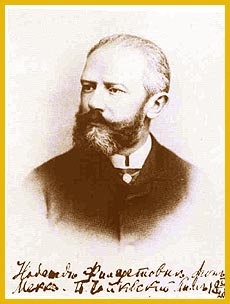
The Fourth Symphony is dedicated to Madame von Meck, Tchaikovsky's
admirer and patron, or rather "To a friend", in accordance with her wish for discretion. She had
first written to Tchaikovsky in December 1876, and there thus begun a strange exchange of letters
reflecting their platonoc love.

Madame von Meck soon gave her favourite composer a "commission":
"Please, be so kind, Piotr Ilyich, as to compose a piece for violin and piano which might be called
"Reproach"� it should express an intolerable moral prain, such as is conveyed in the French phrase
"Je n'en peux plus!", it should reflect a broken heart, a trampled faith, a wounded pride, a lost
happiness; in short all that is dear to men and of which they are mercilessly deprived. I also want
it to reflect impatience, a yielding to despair, the helplessness of the soul and even death."
A vast project, indeed!
Instead of the requested 'Reproach', Tchaikovsky composed a symphony,
of which he himself described the design in a letter written to Madame von Meck from Florence, in
February 1878. This letter is too important not to be quoted:
"How happy you made me, dear Nadezhda, with your letter which arrived
this morning and in which you tell me that by listening to my symphony you experience the same
feelingsthat I myself had experienced while I was composing this work, and that you keep my music
locked up in your heart. Do you want to know if, while composing this symphony, I had design in
mind? � Our symphony really has a design but I shall only explain it to you very briefly�
The introduction contains the seed of the symphony, it is the
primary idea which determines the rest. It represents "fate", a force of destiny, which prevents
us from enjoying happiness, which jealously makes sure that our joys and appeasements are never
unmixed, which hangs above our heads like the sword of Damocles and inexorably distils a slow
poison into the soul. We have to submit, to resign ourselves to a sadness without end�
Pain and despair grow more and more terrible; is it not wiser to
forget reality and seek refuge in dreams? Oh joy, the sweet, the tender dream appears at last. A
pure human vision goes by and calls me� Little by little, the soul yields to dreams. Forgotten are
sadness and despair� Happiness is here.
But no, it was merely as illusion, and we are awakened by merciless
fate. All our experience is succession of painful realities and fleeting dreams, illusions of
happiness. There is no haven. We drift on this ocean until we are swallowed up by the waves. This
is more or less the design of the first movement.
The second one reflects another aspect of our sufferings. It is the
melancholy that seizes you in the evening when, alone and tired from work, you try to read, but the
book drops from your hands. A flood of memoirs appears. It is good to remember your youth but
painful to realize that it is lost for ever. You miss the past, and yet you would not like to
retrieve it, you are to weary!
As for the third movement, it does not express my definite emotion.
It is a succession of capricious arabesques, of those vague images that cross your mind when you
have had some wine and feel the first signs of drunkeness. Your mind is empty. Your imagination is
carried away and unfolds unexpected visions. A drunken peasant, a street song� soldiers marching
in the distance� incoherent pictures like those on the verge of sleep � strange, eerie pictures
divorced from reality.
Fourth movement: if you find no joy in yourself, look for it in
others. Mingle with people, for they know how to give themselves up to pleasure. Description of a
village fair. You think you have forgotten your sorrows by watching the joys of others. But no,
destiny is there and calls you to order!
The others are indifferent and ignore you, they leave you to your
solitude, to your anxiety! See how joyful they are! Those happy people who can give themselves up
to simple, spontaneous feelings.
That, my dear friend, is what I can tell you about our symphony. It
is far from clear. But this is because of the very nature of music, which does not admit of
detailed analysys.
P.S. While I was composing, I was seized with black hypochondria,
and the score certainly shows the effects. It is a sincere echo of my personal impressions. But it
is merely an echo of them� "
Composed between May and December 1877, the fourth symphony had its
first performance on 10 February 1878, conducted by Nicholas Rubinstein.
The text is given from the booklet of Russian firm "Melody" to CD "Tchaikovsky. Symphony 4. Capriccio Italien.
Fatum. Svenlanov. The USSR Symphony Orchestra."
There it is, dear friends!
One lady-admirer has written to her idol and asked him to compose a piece for piano and violin - and
he replied with a symphony, and what a Symphony! ...
|
|