Alien Artifacts1
(Click at the pictures
for full size)
 The
Scythian artifact
The
Scythian artifact
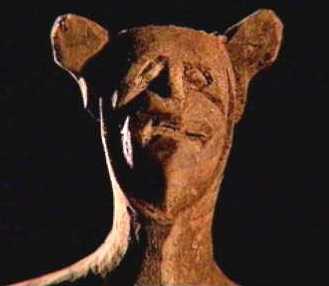
The Greek historian Herodotus, the Greek
geographer Strabo, the prophet Jeremiah, and other authors
describe Scythian
men of war as cruel, blood-drinking
monsters, who fashioned drinking cups from their enemies’
skulls (for the curious: by cutting off the calvaria).
In German, the expression Parter und Skythen
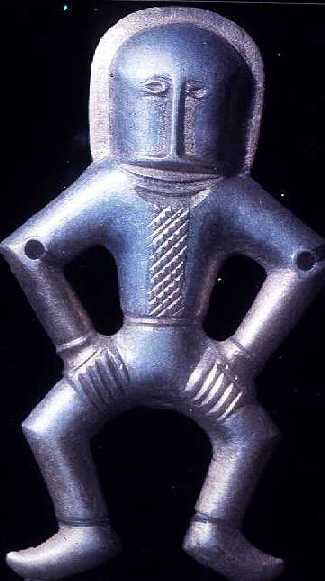
(Parthians and Scythians) is synonymous with horror. The Scythian artifact found in
Altai region. According to archaeologists
Scythian art burst upon the scene around 700 B.C. These artifacts
had been preserved in frozen tombs until their discovery in
Siberia in the Altai area near the border of China.
This strange humanoid artifact is not looking like any other
Skythian finding.One more time what were the model for the
ancient artist ?
 Top of Page
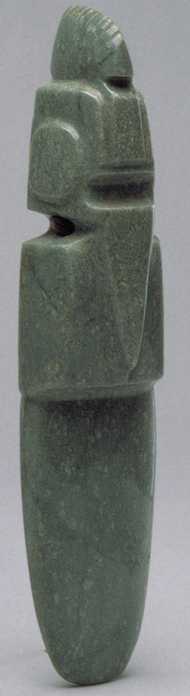
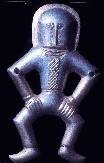
 The Bird Pendant
Many bird-form pendants of Costa Rica feature a lower section
shaped like a workaday celt or ax. The stone celt of teardrop
shape was the common working tool in the ancient Americas, and in
some instances the shape itself took on greater, perhaps even
sacred, significance. To the modern eye, the minimal rendering of
the crested bird headdress, the large, flattened earflares, and
the acutely angled beak creates the impression of a helmeted
warrior or spaceman. (1st–5th century, Costa Rica;
Guanacaste-Nicoya). This is the official explaination for this
artifact. Do you think that this is a bird-form?
Top of Page
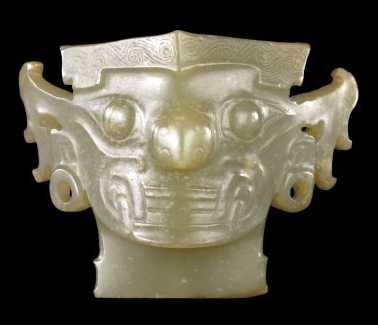
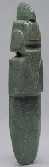
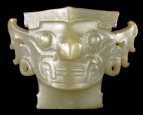 Jade face
Late Neolithic period, around
2000 BC , China- This jade carving combines a human-like face
with large tusk-shaped teeth. The face is finely carved with
thread relief indicating distinct features. Its hair is
represented by tiny scrolls and lines. A number of similar faces
have been found in China, mainly from Neolithic times. They were
a subject of great curiosity throughout early Chinese history:
being collected in later periods, and copied, to some degree, by
later carvers.One such face was uncovered in a tomb contemporary
with the Shang period in Jiangxi province, southern China.
Another was discovered in a Western Zhou tomb of the tenth to
ninth century BC near Xi'an, in Shaanxi province, northern China.
We do not know what these ornaments signified to the Neolithic
peoples who made them, nor to those who chose to be buried with
them in subsequent eras. Another human race ? Ancient Man-Species , Alien
or a fantastic creature?
Top of Page
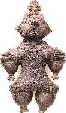 The
Dogu's Mysterious Suit
The
Dogu's Mysterious Suit
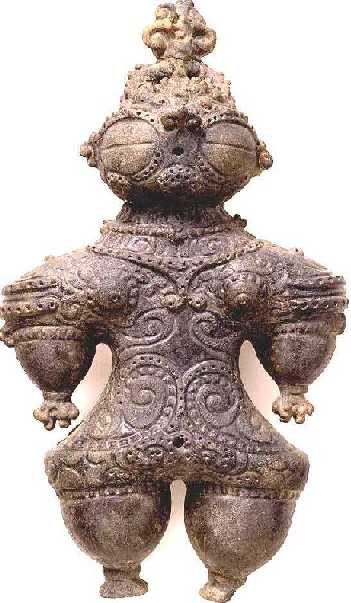
The Jomon Period (c. 12, 000 - 300 BCE)
is named for the cord-marked patterns found on much of the
pottery produced during this time. Dogu is a clay figure made at
Jomon period. This type of figure is called 'snow goggle-eyed
figure'(Syakou-ki-dogu in Japanese). Many versions of this figure
have been unearthed, almost always broken as if on purpose. Many
archaeologists believe that the shaman would transfer pain,
particularly that of childbirth, into the figure and then smash
it, thereby 'releasing' the pain. However, we may never find out
the real reason, and the purpose of the Dogu may be unknown
forever.
At the picture : Dogu (clay figurine). From Ebisuda, Tajiri-cho,
Miyagi, Japan, Late Jomon Period, 1000-400B.C
We can see at the clay figurine modern
like glasses ? , at the mouth a air breather ? at the chest a
strange breastplate (with air-inlet ?) . Does this image
reminding to us a wet or a space suit ? Notice also the strange
appearance of hands and arms.
Top of Page
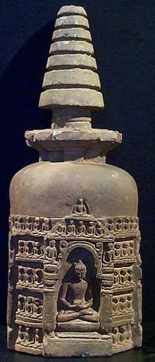
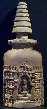 The unusual stupa
A stupa is a memorial
- a symbol of Buddha, as the enlightenmeent principle, pointing
indirectly to both the teacher and his teachings. It is
specifically a reminder of his final passing.A stupa is made from
elements of the earth, it ‘grows’ out of the ground. As
a religious symbol its purpose is to reach, not only towards
‘heaven’ (in the broad sense of the religious
achievement), but to help lift us beyond our animal nature,
beyond the limitations of the sense realm. Enlightenment is about
this going-beyond; it is about transcendence. The accompanying
mind states of happiness, joy and freedom often have a feeling of
lightness about them; there is a sense of ‘feeling
high’, of being unburdened. This symbol of rising up, or
being uplifted, is commonly found in religious speech and
writing. (Picture
: An unusual early votive stupa with images of the Buddha.1st
-2nd century CE.)
Top of Page
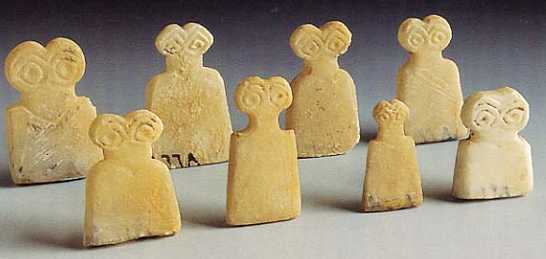
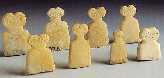 The Eye Idols
Eye idol, 3500–3100 B.C.;
middle–late Uruk period, excavated at Tell Brak,
northeastern Syria
This type of figurine, made of stone and having incised eyes, has
been excavated at Tell Brak, where thousands were found in a
building now called the Eye Temple. Many are incised with
multiple sets of eyes, others with jewelry, and still others with
representations of "children"—smaller eyes and
body carved on the body of the larger idol. The idols are thought
to be offerings—wide eyes demonstrate attentiveness to the
gods in much Mesopotamian art.
Compare the eye idols images with the drawings at the following
links. Do you see something similar?
The
Rongorongo of Easter Island
The Nazca Lines
Top of Page
BACK to
Alien Artifacts
BOOKMARK
THIS WEBPAGE COMING MANY EVIDENCES !!!
|
Do you believe that aliens gave or
left the secret knowledge to Ancient Men with their appearance on
Earth or there were times that Ancients had a civilization
compatible to ours?
Checkout those relevant articles:
Ancient
Flying Machines
Ancient
Artificial Mysteries
Ancient
Electricity
Sign
Ancient
MysteriesGuestbook
 The
Scythian artifact
The
Scythian artifact