
Unknown Geoglyphs
| The Nazca Lines | The Giant of Atacama | The Candelabra of the Andes | Last Update:28/08/2001 |
 The Nazca Lines
The Lines were first spotted when commercial airlines began
flying across the Peruvian desert in the 1920's. Passengers
reported seeing 'primitive landing strips' on the ground below.
No one knew who had built them or indeed why. Since their
discovery, the Nasca Lines have inspired fantastic explanations.
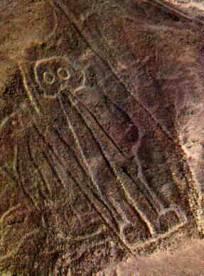
There are also a few anthropomorthic figures situated on the
slopes, the most famous being the 32 metre Astronaut (left) and
E.T, discovered by Eduardo Herran in 1982 (E.T relevant : Unknown hieroglyphs). They are located
in the Pampa region of Peru. The desolate plain of the Peruvian
coast which comprises the Pampas of San Jose (Jumana), Socos, El
Ingenio and others in the province of Nasca, which is 400 Km.
South of Lima, covers an area of approximately 450 km2, of sandy
desert as well as the slopes of the contours of the Andes.
(Click at the pictures for full size)
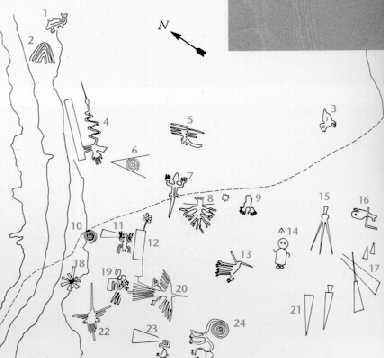 1. Killer Whale,2.
Wing,3. Baby Condor,4. Bird,5. Animal,6. Spiral,7. Lizard,8.
Tree,9. Hands,10. Spiral,11. Spider,12. Flower,13. Dog ,14.
Astronaut,15. Triangle,16. Whale,17. Trapezoids,18. Star,19.
Pelican,20. Bird,21. Trapezoid,22. Hummingbird,23. Trapezoid,24.
Monkey,25. Llama,26. Trapezoids.
1. Killer Whale,2.
Wing,3. Baby Condor,4. Bird,5. Animal,6. Spiral,7. Lizard,8.
Tree,9. Hands,10. Spiral,11. Spider,12. Flower,13. Dog ,14.
Astronaut,15. Triangle,16. Whale,17. Trapezoids,18. Star,19.
Pelican,20. Bird,21. Trapezoid,22. Hummingbird,23. Trapezoid,24.
Monkey,25. Llama,26. Trapezoids.
 The Giant of Atacama
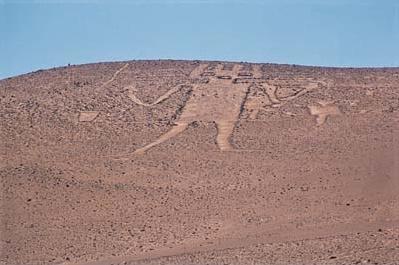
The lines at Nazca aren't the only landscape figures this region
boasts. 850 miles south of Nazca is perhaps the world's largest
human figure, etched into the side of Solitary Mountain. The
Giant of Atacama at Cerro Unitas is an incredible 393 feet high
and is surrounded by lines similar to those at Nazca (Click at the picture for full size)
 The
Candelabra of the Andes
The
Candelabra of the Andes
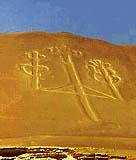
Just 130 miles from Nazca, dug into a sloping hill at Pisco Bay
on the Peruvian coast, this drawing looks very much like a
candlestick - which gives it the name of "The Candelabra of
the Andes". There has been much speculation about the
purpose of the 595 foot high candelabra, but no definitive
answer. It is constructed in a different manner to the Nazca
lines, using trenches up to one metre in depth, and is best
viewed from out at sea - it can be seen from as far away as 12
miles. Pottery found near the figure has been carbon dated to 200
BC
 Back
to Back
to Unknown Hieroglyphs-Geoglyphs |
Return to Ancient Mysteries |
