|
Introduction |
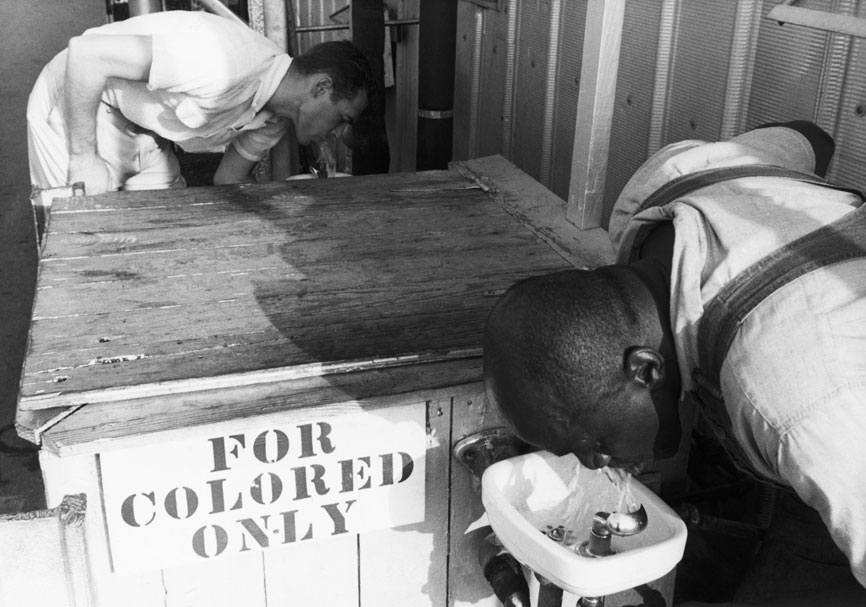
Segregation came from the law that was introduced saying that blacks and whites were "equal but separate". Everything that was done in everyday life was segregated. Taking the Bus to school or work meant that black people had to sit in the back, and if all the seats in the front were taken, then black people would have to give up their seats to the white person. This was also the same thing with schools, restaurants, drinking fountains, even bathrooms.
In the Plessy v. Ferguson case of 1896, the supreme court ruled that "separate but equal" laws did not violate the 14th amendment, which states that all Americans are equal under the law. Because of the decision stated above, states across the U.S. passed racial laws, also know as the Jim Crow laws, which were aimed at separating the races. These laws forbade the marriage of blacks and whites. It also created separate schools, separate streetcars, waiting rooms, railroad coaches, elevators, witness stands, and public restrooms. |
The Segregation System |
Segregation could be found all over the United States, but the place that it was seen very clearly was in the school system. Starting with elementary school all the way to college, kids were being sent away or being separated in different classes, different parts of the classroom, or sitting on the floor. These little kids who couldn't understand why this was, were being trained at a young age to separate themselves. They are unknowingly being taught to "know their place in the world". But as they got older they would see the truth in what is happening to them. Especially when they graduate high school and go to college. There was a case where a College would not admit a student because he was black. He applied to the school and was welcomed with open arms. Then as he walked up to the college to register, they noticed his skin color and decided that he couldn't go to their college. Segregation is a horrible type of discrimination, that should have definitely not been in the schools. |
| Challenging Segregation in Court |
The law stated that the races were to remain "separate but equal" but that was just the beginning. They separated the people but they were nowhere near being equal, especially in the eyes of the government, who ironically, created the law stating they were to be treated as equals. It took years for Blacks and Whites to be equal in anyway. But it would have taken even longer if it had not been for the Civil Rights Movement. People decided to take a stand for what they knew was wrong and they fought for it. |
| The Case of Brown v. Board of Education of Topeka |
The case origins
In the early 1950s, the school system of Topeka, Kansas, was just like the school system all over the United States, segregated. Which meant different schools for different races. Reverend Oliver Brown protested that this was unfair to his eight-year-old duaghter Linda because they lived near a "white" school yet Linda had to take a long bus ride to her "black" school all the way across town. The case was taken to court and the ruling was that segregated public schools were "inherently unequal" and therefore unconstitutional. The legal reasoning
While there was fairness to this case, especially since it included five other cases identical to this one, many of the justices did not see how this verdict was made. They saw it as a "force of legal precedent" because it contradicted the Plessy v. Ferguson ruling which stated that "separate but equal" did not violate the fourteenth amendment. Thurgood Marshall (see also influential leaders page) was a lawyer who spent years trying to fight Jim Crow, local laws that requires segregated facilities, in court. Marshall had recently won two cases that challenged segregation at graduate schools. In 1952, the supreme court agreed to hear Browns' case which took to years because the court was deciding how to interpret the fourteenth amendment.
The Ruling
In the end, Chief Justice Earl Warfen claimed that segregated schools were not and could never be equal. On Monday, May 17, 1954, Warren read the unanimous decision: "Does segregation of children in public schools....deprive children of....equal oppurtunites? We believe it does.... to separate them....solely because of their race generates a feeling of inferiority....that may affect their hearts and minds in a way unlikely ever to be undone." -Brown v. Board of Education of Topeka
|
civil rights | segregation | influential leaders | challenges | triumphs
|
