Civil Rights Movement: A brief look into the beginning.
|
Thomas Jefferson said in the Declaration of Independence that "all men ar ecreated equal" and have the right to "life, liberty, and the pursuit of happiness". Because of these words a whole new system of life began. But throughout history, some Americans have had trouble trying to get the most basic civil rights.
The Fourteenth Amendment stated that a person could not be denied the right to vote on account of race. But still the African Americans of the 50s and 60s still lived as second class citizens, more so in the South then anywhere else.
During the 50s and 60s, African Americans and also other Americans fought the government and society for equal rights no matter what race. The people who fought for equal rights usually were faced with some very painful walls to keep them from succeeding. But nevertheless, Equality came to the U.S. and the civil rights movement paved the way for even movements for rights. |
How would civil right movement have effected us now if it had not been successful? |
If the civil rights movement had not been successful many things would be different. One, there would be segregation in the classrooms and your friends who are of different race then you, would probably be in different sections of the classroom or the school altogether. Many of the inventions that we have now were invented by more than one person and someone in that group of inventors is not white. Without the collaboration of the races, and their brains, we might now have all the technology that we have now. Many things have been positively influenced by the success of the Civil Rights Movement, which if taken away could have a very negative affect, not only on technology, but also on the lives of the citizens of the United States. Black and White working together have made many accomplishments in life including many vaccines, electronics, music, television, radio and in politics. But without this collaboration, the world would not be as it is today. |
Civil Rights Timeline |
1954- Brown v. Board of Education
1955- Montegomery bus boycott
1957- School desegregation crisis in Arkansas
1957- Southern Christian Leadership Conference (SCLC) is formed to "carry on nonviolent crusades."
1961- Freedom riders begin a bus ride therough the South to protest segregation
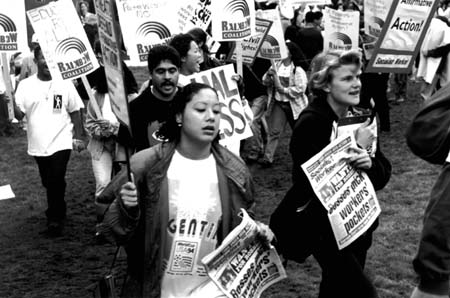
1963- More than 250,000 people march to Washington to demand immediate passage of the civil rights bill
1964- Congress passes the Civil Rights Act
1965- Malcolm X is assasssinated
1965- March from Selma to Montegomery to fight for voting rights
1965- Congress passes the Voting Rights Act
1967- Rioting in Detroit and more than 100 other cities
1968- Martin Luther King Jr. is assassinated. |
Standard 11.10 Students analyze the development of federal civil rights and voting rights. |
- Explain how demands of African Americans helped produce a stimulus for civil rights, including President Roosevelt's ban on racial discrimination in defense industries in 1941, and how African Americans' service in World War II produced a stimulus for President Truman's decision to end segregation in the armed forces in 1948.
|
- Examine and analyze the key events, policies, and court cases in the evolution of civil rights, including Dred Scott v. Sandford, Plessy v. Ferguson, Brown v. Board of Education, Regents of the University of California v. Bakke, and California Proposition 209.
|
- Describe the collaboration on legal strategy between African American and white civil rights lawyers to end racial segregation in higher education.
|
- Examine the roles of civil rights advocates (e.g., A. Philip Randolph, Martin Luther King, Jr., Malcolm X, Thurgood Marshall, James Farmer, Rosa Parks), including the significance of Martin Luther King, Jr. 's "Letter from Birmingham Jail" and "I Have a Dream" speech.
|
- Discuss the diffusion of the civil rights movement of African Americans from the churches of the rural South and the urban North, including the resistance to racial desegregation in Little Rock and Birmingham, and how the advances influenced the agendas, strategies, and effectiveness of the quests of American Indians, Asian Americans, and Hispanic Americans for civil rights and equal opportunities.
|
- Analyze the passage and effects of civil rights and voting rights legislation (e.g., 1964 Civil Rights Act, Voting Rights Act of 1965) and the Twenty-Fourth Amendment, with an emphasis on equality of access to education and to the political process.
|
civil rights | segregation | influential leaders | challenges | triumphs
|
