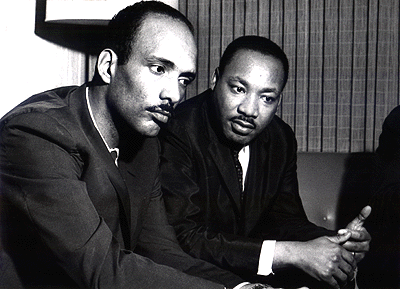
Thurgood Marshall
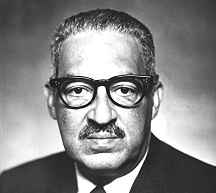
He was born in Baltimore, Maryland on July 2, 1908. After completing high school, Marshall went to Lincoln university in Pennsylvania. He married his first wife, Vivian Burey, right before graduation. Sh died 25 years later of cancer. In 1930, he applied to the University of Maryland law school, but was denied entry because he was colored. Marshall was accepted to the Howard University of Law school where he began to apply the constitution to the lives of Americans. Marshall's first major case was when he successfully sued The University of Maryland for not letting a student into their school because he was black. Marshall worked a lot of cases to get rid of government segregation and then, later, he was appointed by president John F. Kennedy to the U.S. Court of Appeals for the Second Circuit. During his term he wrote many decisions that supported immigrants and colored people. After retiring from his position as an Associate Supreme Court Justice, he left a legacy of triumphs over the laws of segregation. He died January 24, 1993. |
 |
Rosa Parks
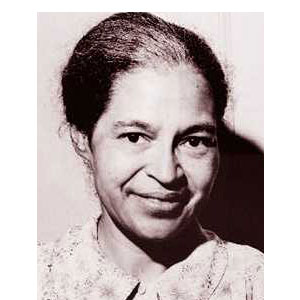
Rosa Parks started protesting segregation before anyone realized it. She would not drink out of water fountains that were labeled "colored only" and when possible she would not use segregated elevators and climbed the stairs instead. She joined the NAACP in 1943 and soon became the secretary for the Montegomery chapter. Parks wanted to make a difference in her community and the injustice on the bus woke up the community to start fighting for their rights. |
 |
The Little Rock Nine
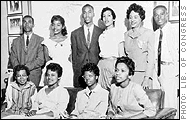
When the desegregation of schools started, Martin Luther King and the other leaders need brave kids to take on the challenge. The nine highschoolers in the picture (see right) were brave enough to go to a high school with all white students and face the brutality that was soon to await them behind the doors to the school.
Even after the Brown v. Board of Education case was closed, people still were reluctant to open their schools to desegregation. One of these schools was Central High. The Little Rock Nine were the first black students to go to Central High and they went through alot. Their first day of school, they had to be escorted to every class by federal soldiers. Just to get to school everyday, they had to fight through angry mobs of people and face the heart of racism. Several of the Little Rock Nine actually graduated Central High. |
 |
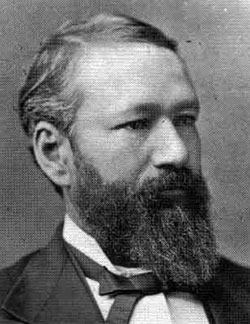
Homer Plessy
Homer Plessy was an activist of European and African Descent. He was arrested for sitting in the wrong car on a train. When taken to trial, Plessy fought that the "separate but equal" law was a violation of the 13th amendment, which states that slavery was abolished and all blacks were free people, and the 14th amendment, which states that a person born or naturalized (to become a citizen) are citizens and the government cannot refuse them life, liberty, or property without due process of law or deny any person the equal protection of the laws. The Plessy v. Ferguson case (above) formalized legal segregation in the U.S. until the Brown v. Board of Education case, which outlawed segregation. |
 |
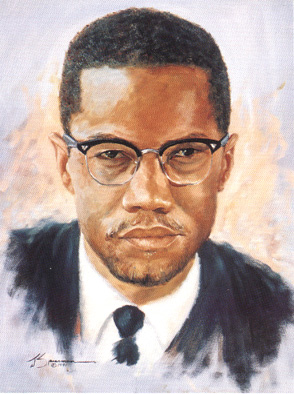
Malcolm X
In his early years of life, Malcolm was "alienated" from white society. His father was allegedly killed by some white rascist but the trial was never done and the killers were never found or tried for their crime. His mother, after the death of her husband, had an emotional collapse leaving Malcolm and his siblings in the care of the state. At the end of eighth grade, Malcolm quit school and was soon after arrested for criminal behavior. While in jail, Malcolm joined the Nation of Islam, or the Black Muslims, which belived in black superiority and separatism from the whites. Later in his life, Malcolm urged Black people to go to Africa and work with world organizations to get equality. Malcolm X was killed by gunmen, but he is still influential to the people of this time. |
 |
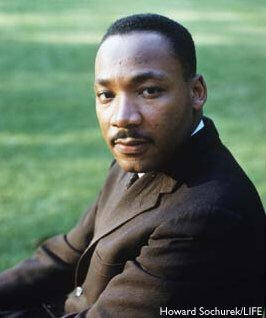
Martin Luther King Jr.
Dr. Martin Luther King Jr. was born in Atlanta on January 15 1929. He was the Founder of the NAACP, Atlanta Chapter. King graduated from Morehouse College, went on to study Crozer Theological Seminary, and Boston University where he study up on Mahatma Ghandi. He married his wife, Coretta Scott in 1953, and became Pastor of the Dexter Avenue Baptist Church in 1954. After the bus incident with Rosa Parks (see above) he led the bus boycott that lasted until 1956 when the Supreme Court declared the desegregation of buses.
In 1960, students became involved and started sit-ins where they would go to a segregated diner, sat down and didnt do anything. King supported this non-violent movement and tried to improve the SNCC (Student Nonviolent Coordinating Commitee). In 1961, the students started Freedom rides, where they rode bus with white students from one place to another place, and they criticized him for not joining in.
On August 28, 1963 The March on Washington began, where over 250,000 protesters gathered in Washington D.C. and King gave his most famous speech, "I Have A Dream". King kept working to create equality between both races and recieved a Nobel Peace prize in 1964.
In 1967 King ran a Poor People's Campaign where he confronted the economic problems in the South. The following year, he ran a strike for sanitation workers in Memphis. That day, King gave his last speech, "I've Been To The Mountaintop."
The next day, April 24, 1968, King was assassinated. |
 |
civil rights | segregation | influential leaders | challenges | triumphs
|
