The year is 1971. The Big Three are launching
counterattacks to fend
off the foreign small-car invasion. Ford has
its Pinto, Chevy the two-time
Motor Trend Car of the Year Vega (ahem...); but
Chrysler, lacking the investment
capital to develop its own, adopts two of the
first captive imports: the Plymoth
Cricket and the Dodge Colt.
Many may not recall the infamous Cricket,
imported
from (surprise) Great
Britain and enjoying a life expectancy just
barely
into the five digit figure on the ado,
but nearly twenty years later, the made-by-
Mitsubishi
Dodge Colt nameplate is still
going strong. Originally a solid little rear
drive platform with a strong hemi-head
four-banger, the Colt stepped into the modern
age in 1979 with the adoption of
front-wheel drive, an innovative eight speed
dual-range gearbox, and in '84 a
wild turbo version that was arguably the first
true pocket rocket. A year later, the
revised Colt Turbo debuted, using the same
drivetrain
on d much-improved sus-
pension and, in partnership with its sister,
the Mirage, was sold at the new chain
of Mitsubishi dealerships.
By 1989, however, the Colt was beginning to
get
lost in the flood of sporty
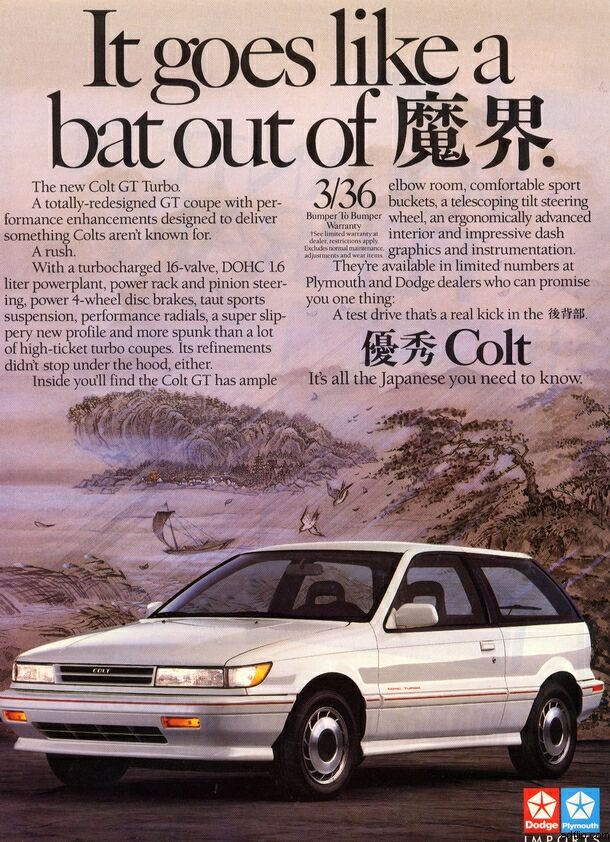
little hatchbacks. Enter the Dodge Colt GT DOHC
Turbo.
This was another quantum leap forward for the
Colt, and an impressive
volley in the war for the enthusiast buyer's
buck. The new Colt matched an
even stronger powerplant with a more refined
functional, and highly capable body/chassis.
This new engine was updated with multi-point
fuel
injection, double overhead
cams, and four valves per cylinder. The frosting
on this high tech cake was the
turbo. Combined with the quad valves in each
head, this engine had a very broad
powerband. Normally, a street turbo must be
rather
small to reduce turbo lag, but this
leads to poor flow at high RPM. However, add
a few more valves and more air can get
in and out of the cylinder, curing the high rev
asthma. The three thousand RPM
spread between the torque and power peaks was
indicative of the success of this
design. The Colt DOHC Turbo generated a meaty
141 ft/lbs. at a relatively low
3000 RPM, then held on all the way to a 135 HP
peak at 6000 RPM and continued
to breathe freely all the way to its 7000 RPM
redline.
Not only was the output of this engine
impressive,
but the way it was delivered
was surprisingly sophisticated. This little 1.6
liter belied its humble origins with
smoothness and refinement. It came on boost
without
a dicey explosion, more like
the rush of a swing on a grade-school playground.
The fact is, this whole car belied its humble
origins. From the engine to the
gearbox to the look and feel of the interior
and controls, there was refinement. Such
finesse was not to be expected from what was
essentially a hopped-up economy car,
but somebody forgot to tell the Colt GT Turbo.
From the driver's seat, the view was
commanding.
The shifter fell easily to hand
and moved with an expensive feel, firm but slick.
The seats themselves were widely
praised by our many-sized editorial staff. and
distinguished themselves as a rare
design that offered good support to the lower
lumbar region of the occupant's
back. A very handsome wheel adjusted by tilt
and telescope and enclosed extra-large
size tach and speedo, the latter good for a
whimsical
150 MPH. Rear headroom al-
lowed a six-footer to sit straight and proud
in an unusually hospitable environment.
The Colt's Turbo rendition was pretty from the
doors forward, but the unique tail
was a bit awkward. The car looked and felt tall,
high on its springs and tall-bodied.
Most editors liked it a lot-sorta. Testers seemed
to feel it was almost pretty, cute
but funky. "The tail has some strange compound
curves," said one; several
mentioned that they'd like to see it lower.
Overall,
certainly a very attractive and
modern hatchback. We think.
On the road, the Colt GT Turbo squirted
through
traffic like a powered water gun,
shooting into holes in the highway slalom course
with confidence and quickness. The
chassis was very happy on the back roads, too.
This car needed to be on an autocross
course. Though the spring/shock setup tended
toward the soft end of the spec-
trum, the grip produced was prodigious. Once
accustomed to the moderate body
roll, the driver found a real charger that was
exceptionally quick in the transitions and
swept around bends with good balance. Our
editors'
notes often lauded the han-
dling capabilities of this Dodge by Mitsubishi.
Once all this swooping and flinging about
needed
to be slowed, some very
assertive four-wheel discs dropped anchor with
authority (and produced a nose-dive
of truly historic proportions). While stability
remained very good, the view of the
pavement through the windshield did take a little
getting used to.
After braking hard and analyzing the
composition
of the asphalt approaching
tight corners, we were able to drop down a gear
to blast outta there. We matched
revs 'cause the synchro was just a tad slow,
yyyaannnggaa, heel and toe no problem,
good pedals, turn-in... wow! lots of roll, but
it went right where we wanted it...
made the transition to a kiss of power, waited
for the apex-made it late,
squeezed it down as we straightened the wheel
and zowie! holy smoothness, Bat-
man, the Colt was just whistling away, clean
and sure! This was probably the best
powerful front-drive car we'd tried for taming
those sometimes dicey tendencies.
In fact, in our testing, the Colt was over a
second faster than some competitors in a
single five-second segment of our course, the
segment coming out of a tight turn to
the finish lights.
Much like its bigger Eclipse/Talon sib ling,
the
1989 Colt Turbo and its twin, the
Mitsubishi Mirage, represented an amaz ing amount
of car for the dollar. Base price
was just $11,969, including most of the Turbo
features less air--cheap for this kind
of performance and refinement. Furthermore, the
car was so little known that
buyers seldom found themselves in a bidding war
with a hundred others.
