|
Waqf in the Words and Works of Imam
Khomeini:
An
Analytical Survey of the Sahifeh-ye Imam
By Mansoor Limba
Posted: February
25, 2006
Abstract:
A cursory examination of the 22-volume
Sahifeh-ye Imam—the largest ever compiled
anthology of Imam Khomeini’s speeches, messages,
interviews, religious decrees, permissions, and
letters—reveals that pious endowments [awqaf]
undoubtedly occupy a distinct station in both
the words and works of Imam Khomeini, the Great
Leader of the Islamic Revolution and the
Idol-Breaker of the 20th Century.
In particular, the following three salient
features are indicated in the encyclopedic
authentic reference source from its first volume
up to the 21st volume (volume 22
being the indexes of the whole voluminous
treatise) with respect to the Imam’s treatment
of pious endowments:
1. The Imam left no stone unturned in
campaigning against any arbitrary use of
“endowments” as exemplified by his strong
condemnation of the Pahlavi regime’s attempt to
utilize “Ministry of Endowments” to control the
‘ulama’ and religious affairs (vol. 1, pp. 390,
392; vol. 2, pp. 473, 483, 485-486, 488).
2. As a grand religious authority [marja‘ at-taqlid],
the Imam paid special attention to the proper
utilization and spending of endowed properties
as well as gave full support to awqaf
institutions as demonstrated in his letters,
decrees [ahkam] and permissions [ijazat]
(vol. 2, p. 161; vol. 7, p. 14;
vol. 13, p. 219; vol.
17, p. 416; vol. 19, pp. 418-419;
vol. 20, pp. 60-61; vol. 21, pp. 270,
347-348, 382).
3. As a philanthropic man, the Imam also
manifested in his humble ways the spirit of
waqf. For instance, pursuant to Article 142
of the Constitution of the Islamic Republic of
Iran which empowers the Supreme Court to probe
the assets of high ranking political authorities
before and after their respective incumbencies,
the concerned highest judicial body investigated
the meager assets of the Imam and the result
showed that not only that nothing had been added
to his assets during his tenure as the Supreme
Leader (vol. 13, pp. 523-524) but instead, a
plot of land in Khomein he inherited from his
father was given by him as an endowment [waqf]
to the indigent people of the locality (vol. 19,
p. 232)!
In sum, Imam Khomeini has clearly demonstrated
to us the lofty station of waqf both in
theory and practice.
Statement of the
Problem
This paper sought to examine awqaf [pious
endowments] in the words of Imam Khomeini as
recorded in Sahifeh-ye Imam. In
particular, this article attempted to address
the following queries, thus:
-
As the sole
reference source of the study, what is
Sahifeh-ye Imam? To what extent is it
reliable as an academic source of inquiry?
-
Chronologically,
what are the accounts of Sahifeh-ye Imam
on awqaf?
-
Analytically,
what aspects of Imam Khomeini’s personality
can be deduced from these chronological
accounts of Sahifeh-ye Imam on awqaf?
Diagrammatically, this research inquiry can be
presented as follows:
Figure 1
Diagrammatical Representation of the Study
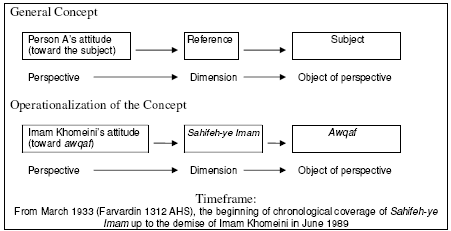
Initially, this
paper gave a bird’s-eye-view of the Sahifeh-ye
Imam, the sole source of account of the
present analytical survey and examined its
academic credibility.
Then, lengthy
chronological accounts of the Sahifeh-ye
Imam on awqaf are made. In these
accounts only the actual words and writings of
Imam Khomeini about the pious foundations are
quoted. Thus, introductory headings in each of
the documents, and the footnotes where waqf
or awqaf may be mentioned—which are
not actually parts of the Imam’s words and
writings, unless otherwise stated—are not
covered. Equally excluded is Volume 22 of the
Sahifeh being the comprehensive index
of the encyclopedic work.
Thereafter, an
analysis of the chronological accounts is
conducted to arrive at an overall picture of
awqaf in the words and works of Imam
Khomeini. In the conclusion, the findings of
the study, which are actually the restatement
of the answers to the points of clarification,
are stated.
The Sahifeh-ye
Imam
Published by the
Tehran-based Institute for the Compilation and
Publication of Imam Khomeini’s Works (ICPIKW)
in the year 1378 AHS (1999) named as the “Year
of Imam Khomeini” being the centennial year of
his birth, the Sahifeh-ye Imam has been
so far the largest anthology of Imam
Khomeini’s literary works including his
family-related letters, religious permissions,
socio-political letters and telegrams, decrees
and orders, messages, speeches and statements,
interviews and dialogues, and others.
The
family-related letters open an impressive
window on the private life of the Imam. These
letters show that not only was Imam an ideal
role model in the realms of scholarship and
ijtihad, struggle and jihad, and
politics and leadership for his disciples, but
also his subtle soul and his self-disciplined
and dutiful personality urged him not to shirk
his duties in the non-political spheres.
Imam
Khomeini’s letters of authorization to a
choice of people in the financial and
religious law [shar‘iyyah wa hasbiyyah]
affairs, either chosen by himself or in
response to individual requests for
authorization, form another part of
Sahifeh-ye Imam. We can conclude from the
collection of authorizations issued by Imam
Khomeini and particularly from the letters
written by His Eminence to his official
representatives that he has been diligent and
scrupulous in issuing the permissions. Except
the cases of authorizations that have been
issued for the prominent and pious scholars or
for the persons who were closely in contact
with and known to him, generally the Imam has
not issued any authorizations without a
written endorsement of the just informed
persons. An index of the religious
authorizations issued by Imam Khomeini during
the period of his stay in the holy city of
Najaf is included at the end of volume one of
Sahifeh-ye Imam.
Another component of Sahifeh-ye Imam is
the telegrams and letters written by Imam
Khomeini to different persons, religious
scholars, local and foreign diplomats and
political leaders, various political parties
and societies, and ordinary people, which
embrace a variety of themes. The
diverse addressees of these letters and the
vast span of time that they cover, beside the
variety of their themes and subjects, all add
to the significance of these letters as a part
of the wealth of documents that relate
fragments of the history of the Imam’s
movement and His Eminence’ positions and views
on different issues.
A
large number of decrees and orders of His
Eminence Imam Khomeini, as the marja‘
of many of the Shi‘ah people and as the Great
Leader of the Revolution and the Islamic
Republic of Iran have survived, which are
exactly printed in the collection. The decrees
published in Sahifeh-ye Imam include
those issued for the formation of the
Revolutionary Council, the transitional
government and appointment of its members;
confirmation of the Constitution; approval of
the presidential decrees; decrees on the
foundation of different revolutionary
institutions; decrees for installing and
deposing the judiciary, military, and law
enforcement officials, and the Leader’s
representatives in various institutions and
organizations; the military orders issued by
him as the Commander-in-Chief of the Armed
Forces, as well as His Eminence’s directives
and orders issued response to the requests of
government officials on diverse issues.
Imam
Khomeini’s different religious and political
messages comprise some of the most important
written works of Imam Khomeini collected and
chronologically published in Sahifeh-ye
Imam. Issuing and publishing these
messages was in fact the most important direct
channel through which Imam Khomeini kept in
touch with the people and his followers.
In
the age of communications, the mass media’s
interviews with the intellectual and political
leaders with the aim of elucidating their
viewpoints, and dispel ambiguities and enigmas
through answering the reporters’ questions, is
one of the effective means of establishing
communication and direction in the public
opinion. Being aware of the importance of this
phenomenon and in the absence of restrictions,
Imam Khomeini granted unconditional audience
to journalists and pressmen. The best part of
his interviews took place during his sojourn
in Paris. As a result, the numerous interviews
by the leading world news agencies, radio-TV
networks of various countries, and Iranian and
foreign newspapers and periodicals with Imam
Khomeini, and his concise yet categorical and
well reasoned out answers to the questions
have become part of the compendium of the
Imam’s valuable socio-political works, which
in the anthology have been presented to the
esteemed readers.
So
far, Imam Khomeini’s speeches and messages
have been published in hundreds of works under
various titles and styles (summarized or
complete, thematically or chronologically) in
manifold languages by his devotees and
cultural institutions both inside and outside
Iran. Imam’s devotees and the cultural
institutes accomplished this both within and
without Iran. Undoubtedly, these works
particularly his socio-political works are
among the published works with the highest
circulation in Farsi language. Among the
published books from Imam Khomeini’s general
works (before the establishment of this
Institute), some have been outstanding.
Despite the demerits and defects which can be
seen and have been the point of some
criticisms in Sahifeh-ye Nur, it should
be stated that this work from the time of
publication of its first volume up to now has
so far been the most comprehensive reference
for the researchers and those interested in
the works of Imam Khomeini. Worthy of
acknowledgment are the valuable efforts and
endeavor of the compilers of Sahifeh-ye Nur
from the Ministry of Culture and Islamic
Guidance, and the Organization of Islamic
Revolution’s Cultural Documents, and the dear
ones who have rendered valuable assistance in
the different stages of compilation and
publication of this work for all those who
have benefited from this pathway to the
treasure of the Imam’s literary works in their
research, seminars, speeches, and references.
Among the merits of Sahifeh-ye Nur are
its lengthy introduction by Ayatullah, lucid
titles, chronological arrangement, table of
contents, skillful editing, as well as
relative comprehensiveness. In a bid to
present a complete series of all the literary
works of Imam Khomeini and keeping in view the
main shortcomings and defects existing in the
Sahifeh-ye Nur, the Institute has
published the present work entitled,
Sahifeh-ye Imam. During many years in the
different department of this Institute, the
existing texts in the Sahifeh-ye Nur,
newspapers, periodicals, and books have been
collated with the cassette recorded tapes,
handwritings and original manuscripts of Imam
Khomeini’s works which are at the disposal of
the Institute, and the final text is
meticulously selected. All the date
inconsistencies and other defects existing in
the Sahifeh-ye Nur and other sources
concerning the identification of each of the
Imam’s works have been investigated, and the
authentic and final facts have been presented
at the beginning of each piece of work along
with its identification (headings). Apart from
the mentioned points, the most important merit
of the Sahifeh-ye Imam over the
Sahifeh-ye Nur and other published books
on the Imam’s works is the inclusion of over
2,000 cases of his works and documents from
among the unpublished works of the Imam, which
become available for the public for the first
time. The meticulous selection of the indices
(proper names, subjects and terms, Qur’anic
verses and hadiths, etc.) and their
presentation in one volume (volume 22), which
provides easy access to selected topics and
subjects of the first 21 volumes.
From the above
scrutiny of the Sahifeh-ye Imam, it
becomes clear that it has so far been the most
comprehensive and reliable collection of Imam
Khomeini’s
literary works. So, it is only proper to take
this anthology as the sole reference in
objectively examining the
pious endowment
in Islam in the light of Imam Khomeini’s words
and deeds.
Sahifeh-ye Imam’s
Account of Waqf: A Chronological
Survey
In the first
volume of the anthology, Imam Khomeini
delivered a speech (September
9, 1964 [Shahrivar 18, 1343 AHS / Jamadi al-Awwal
2, 1384 AH]) addressed to seminary
students, clerics, merchants, and other
residents of Qum on the danger of the
penetration of Israeli influence in Iran and
the plots perpetrated by the imperialists in
the Muslim countries. Part of the speech is as
follows:
Creation of Endowment Ministry
Now
the gentlemen (i.e. the government) want to
create an Endowment Ministry!
It thinks it can copy the practices of other
countries and bring the clergy under the
authority of this ministry. You will take this
dream to the grave with you, (God willing). Do
you think that you can make the Muslim clergy
become like the Christian clergy? It’s
impossible. The Shi‘ah clergy are independent;
they do not depend on any country. Let them
come forward and tell (the world) whom they
depend on. This is an independent clergy. We
do not have to worry as to whether these
respected religious students, who live with
only thirty or forty tumans each month and
work very hard, are supporters of another
government or country. They are independent in
their own ideas. It is amongst these people
that human beings are found, that the
Mudarrises of this world are found. They won’t
let this happen. We won’t be brought under
this and that minister. To hell with what that
minister says. The government is mistaken, it
is mistaken once again.
Elsewhere in the
speech, Imam Khomeini said:
If
you want to create an Endowment Ministry,[10]
then we should organize it, not you. We should
appoint people for it, we do not accept your
appointees. You are not eligible to appoint
people for it, we have to do it. Let us
select the head of cultural affairs. Let us
select the Endowment Minister, then you’ll see
what will happen: everything will be as it
should be, it will not be as it is now with
all these misappropriations. Then you’ll see
how we eliminate this poverty with these very
same endowments. Submit to a few Islamic laws,
give us permission to take Islamic taxes off
the people, just as Islam took it off them by
the sword, then you’ll see if there remains
one poor person (in this country). We’ll build
roads for you; we’ll buy ships for you, just
let us handle the religious endowments. But
you won’t allow it.
I
know that this that I say now falls on deaf
ears. Nothing will happen. You people will
leave here and I will leave too and nothing
will happen. They won’t do anything about
this matter. This is a pain which we all have
to suffer. What should we do?
In the second
volume, while in exile in Najaf, Iraq, the
Imam wrote the following letter on January 12,
1968 (Dey 22, 1346 AHS / Shawwal 11, 1387 AH)
to Husayn Fumani in reply to the latter’s four
questions on economic and endowment issues:
In His Most Exalted Name
Shawwal 11, 1387 AH
His Eminence ‘Umdat al-A‘lam wa Thiqat
al-Islam Mr. Fumani, may his graces last:
Your noble missive was received. I pray for
your good health and confirmation. As for the
issues that were mentioned:
1. As for the “key-money,” this is a detailed
account that I have covered in the book,
Tahrir al-Wasilah, volume 2. If the
“key-money” is being taken from the person who
has in turn taken it from the owner of the
property—in the same manner that I have
indicated there—there is no problem. And if
someone decides not to vacate the property
that is rented to them unconditionally, or to
obtain “key-money,” this is not permitted.
2. “Key-money,” in cases where it is lawful is
subject to khums.
3. The bank money, in cases where it is a loan
with interest, is unlawful but if it is
without interest or if it frees one’s self
from usury, it is unobjectionable.
4. The place that has been endowed to
Hadrat Sayyid ash-Shuhada’
(‘a) cannot be turned into a mosque. It
must be used for the same purpose that it was
endowed. I hope for your benevolent prayers.
May peace be upon you.
On December 21,
1972 (Azar 30, 1351 AHS / Dhu’l-Qa‘dah 11,
1392 AH), while still in exile in Najaf, Iraq,
Imam Khomeini stated the conspiracy of the
Shah’s regime in destroying the foundations of
Islam in a letter to Muhammad Shari‘at
Isfahani (Shaykh ash-Shari‘ah) in Pakistan.
The text of the letter is as follows:
In His Most
Exalted Name
Let me inform
Your Eminence that your respected letter dated
the fourth of Dhu’l-Qa‘dah arrived. I am
anxious of your illness. I hope you will
recover soon and regain your sound health by
the will of God. I am physically fine but
spiritual indispositions and troubles both
inside and outside the religious seminary are
troubling me a lot.
Lately, in Iran
some laws are in the process of being ratified
and with their implementation, everything
belonging to the religious scholars if
anything is left, will be lost such as the
approval of controlling the endowments in the
ordinances of the scholars, mosques, pulpits,
theaters, and others; rather, even appointing
religious reference authorities and heads of
theological schools.
I
have been receiving letters and visits from
Iran, but with the contradiction and diversity
of views what can I do? I ask God, the
Exalted, to rectify the situations. In regards
to the funds that you favored in Lahore and
the stipends that you appointed, have you
written something on what manner should I deal
with you? For the time being, the high
expectations of assistance that they have
cannot be met given the present situation in
Najaf, the severance of relations and the many
difficulties which I am experiencing.
Therefore, if there are funds in the region
and you require my permission for them, do
inform me so that I can grant my approval;
there is no problem after my confirmation of
the school being beneficial. At the margin of
(your) letter, it is thus written: “In regards
to the twenty tumans, it has not been stated
if it has been requested or not.” I did not
understand the point. Perhaps, it has been
mentioned in the previous letters. For the
time being they are not also available. I hope
for benevolent prayers from you. May God’s
peace and mercy be upon you.
In
still the same volume (Volume 2), the Imam
sent a message dated March 14, 1972 (Esfand
23, 1351 AHS / Safar 8, 1393 AH)
to the ‘ulama’, preachers and
Muslim nation of Iran about the ruling body’s
plan to eradicate Islam and the Qur’an. Below
is part of the message which touches on the
“endowment organization”:
Now,
as what has been repeatedly reported, in the
process of implementing these dangerous
imperialist plans they have started subjecting
the mosques, places of mourning, religious
schools, and other Islamic centers as well as
the status of the clergy under the supervision
of the anti-Islamic endowment organization.
They want to make the ‘ulama’,
preachers and congregational prayer leaders as
the implementers of the illegitimate designs
of the tyrannical regime and filthy agents of
imperialism, or to impel them to retreat and
surrender the fortresses of Islam to the
enemies and agents of the foreigners.
The Imam also
added:
Now,
silence in the face of these plans and
atrocities is tantamount to suicide, welcoming
a gloomy death, and the fall of a great
nation. Before it is too late, it is necessary
for the silence to be broken, and protest and
denial to begin. It is for the ‘ulama’
and preachers of Islam to expose in the
mosques and gatherings the behind-the-curtain
plans of the establishment. In this great
tragedy that has befallen Islam and the
Muslims, especially the distinguished
‘ulama’ and honorable preachers; they
should not refrain from any kind of actions.
The grand religious authorities should express
their respected views in the printed media. In
this backbreaking state of affairs, those who
cooperate and have good relations with the
establishment, or endorse these plans and
activities of the endowment organization and
other corrupt organizations and help in their
advancement, or have been stipendiary of the
endowment organization and the tyrannical
regime, should be rejected, disgraced and made
known to the nation. With those who have been
appointed and designated by the corrupt
organizations to occupy the pulpit and altar,
the nation of Islam should not justly deal,
not attend in their gatherings, and not to
listen to their sermons. Moreover, they should
point them out to each other and reject them
from the Islamic society, and refrain from
mosques and assemblies that are supervised and
run by the endowment organization. As a
gesture of protest and disapproval, the
distinguished ‘ulama’, honorable
preachers and congregational prayer leaders
should stage a strike in an appropriate manner
and stop going to the mosques and mounting the
pulpits for a limited period of time, and be
certain that a collective protest and public
strike would be fruitful and the tyrannical
regime will retreat. It is necessary for the
Muslim people, at the time of the ‘ulama’
of Islam’s strike, which is for the
preservation of the laws of the Qur’an, to
support them and follow suit.
In yet another
message dated March 15, 1973 (Esfand 24, 1351
AHS / Safar 9, 1393 AH) recorded in the same
volume, while still in Najaf, Imam Khomeini
exposed the new plot of the Shah’s regime of
uprooting Islam to the Union of Islamic
Associations of (Iranian) Students residing in
Europe, America and Canada. Part of the
message is as follows:
Of
all these the most lamentable is the state of
affairs in Iran wherein through the
publication of copies of the Qur’an; feigning
Islam; and in the name of ‘Religious Corps’,
endowment organization and other deceitful
titles, the regime is commissioned to uproot
Islam all at once, to degrade and subjugate
the Islamic nation ever more, and to make the
mosque and altar of the Prophet of Islam (s)
as a sort of propaganda agency of its
anti-Islamic (royal) court. For the
implementation of these sinister plans the
regime is totally in need of the help and
assistance of the servant and devoted
pseudo-clergymen. Through their cooperation it
wants to manage the mosques and other Islamic
assemblies, control and supervise religious
ceremonies, and penetrate the theological
schools. Now, it is for the Muslim educated
generation and the enlightened and wary
people, with all efforts and in every possible
way, to inform the Muslim nations of Islam,
the Islamic leaders, and the heavy and
gargantuan responsibilities of the ‘ulama’
of Islam to make the people aware and
ostracize the group of deviant
pseudo-clergymen who have been directly and
indirectly serving the tyrant regime. If only
the Islamic nation is aware of the luminous
principles of the Qur’an and the heavy
responsibilities of the ‘ulama’ and
leaders of Islam, the pseudo-clergymen and
court-akhunds would be silenced in the
society. If the ill-reputed fake turbaned men
and pseudo-clergymen who are silenced in the
society do not able to deceive the people, the
tyrannical regime will not succeed in the
execution of the sinister plans of the
imperialists. First of all it is necessary to
settle the issue of the pseudo-clergymen. They
are the most dangerous enemies of Islam and
the Muslims today, and by their hands and the
hands of the stooges of imperialism, the
menacing plots of the old enemies of Islam are
put into action. They must be removed from the
theological schools, mosques and Islamic
gatherings so that we could sever the hands of
the imperialist aggressors and enemies of
Islam from the realm of Islam and the Holy
Qur’an and defend the independence and
preservation of the Muslim countries and
Islamic nation.
While in Qum
shortly after his triumphant return to Iran
after almost 14 years in exile after the
victory of the Islamic Revolution, Imam
Khomeini mentioned the way of spending the
religious alms in Gilan Province in a letter
dated April 14, 1979 (Farvardin 25, 1358 AHS /
Jumadi‘ al-Awwal 16, 1399 AH) to Sayyid Asghar
Nazimzadeh as recorded in Volume 7 of
Sahifeh-ye Imam. Below is the text of the
letter:
In His Most Exalted Name
Jumadi‘ al-Awwal 16, 1399 AH
His Eminence Sayyid al-A‘lam and Thiqat
al-Islam Mr. Hajj Sayyid Asghar Nazimzadeh,
may his blessings last:
You are kindly informed that the alms you have
collected out of the holy shrines and spent in
Gilan Province, as well as the religious taxes
you have received and spent from the
Department of Religious Endowment and
Charities, are religiously approved. I beseech
the Almighty God for the continuation of your
success.
In Volume 13 of the anthology, Imam Khomeini,
while residing then in Jamaran, north of
Tehran, highlighted the autonomous status of
the Holy Shrine in Qum in relation to all
other organs and establishments in his
permission [ijazah] dated September 16,
1980 (Shahrivar 25,
1359 AHS / Dhu‘l-Qa’dah 6, 1400 AH) granted to
Ahmad Mawla’i, the then Custodian of the Holy
Shrine in Qum.
Ahmad Mawla’i stated
thus in a letter dated August 15, 1980 (Mordad
24, 1359 AHS) to the Great Leader of the
Islamic Revolution:
As
you are aware, during the previous regime, the
management of the holy shrine of Fatimah
Ma‘sumah (‘a) was under the
jurisdiction of the Endowments [Awqaf]
Organization, and it has been so for years.
But in this period of the Islamic
Revolution—with due consideration to the fact
that Qum is the seat of Shi‘ism and the vast
theological center which is expanding day by
day—it has been pursuing its activities
independently of the Endowments Organization
and all the other government organs so that it
can perform its important duties better than
before. Your honor’s instructions and views
are needed on this matter.
In
reply, the Imam stressed the Holy Shrine’s
autonomy: “The management of the Holy Shrine
of Qum and all its endowments should be
separate from the Awqaf Organization
and be placed directly under the control of
the Jurist [faqih].”
On
January 26, 1980 (Dey
24, 1359 AHS / Rabi‘al-Awwal 7,
1401 AH), Imam
Khomeini, while residing in Jamaran, Tehran,
submitted to the Supreme Court the list of his
assets and possessions where an asset he gave
as an endowment is also mentioned.
Following is the text of the declaration of
assets and possessions:
Name: Ruhullah
Family: Mustafawi,
known as Khomeini
Identification
Card No.: 2744
Issued: Khomein
Profession:
Clergyman
1. Unmovable
property (with particulars):
a. One house
consisting of men’s quarters and private
quarters and in Qum, in Bagh-e Qal‘eh as it is
known.
b. A
plot of land, a patrimony. According to Mr.
Pasandideh,
it is of joint ownership between me and him
and the heirs of (my) late brother (Mr.
Hindi). Again, according to Mr. Pasandideh,
the value of my share of the rent is four
thousand rials per annum which is not being
paid.
2. Movable assets
including cash bank cash balance or bank
deposit shares and other unmovable assets with
their approximate values:
a. There is a
little money in Tehran which has been either
gifted or given to me in fulfillment of vows.
b. I
have no furniture. There are a few household
things in Qum and Tehran that belong to my
wife. There are two carpets in the house which
have been given to me to be counted as
khums
in case I wish to do so. As such they do not
belong to me or to my heirs. They should be
given to the poor Sadat (or Sayyids).
There are a few books remaining from the ones
that were looted in the days of the deposed
Shah. I don’t know as to how many there are.
Besides, there are a few books presented to me
by their authors during the time of my stay in
Tehran. I don’t know their approximate price.
But they are not so many. The furniture now in
the house in Tehran I am living in, belongs to
the landlord of the house, Ahmad
knows about it.
3.
All the sums of money in the banks or in the
house or with persons which Mr. Pasandideh is
aware of, are religious in character, except
the small amount already referred to. They
are not mine, and nor do my heir have any
right to them. I have specified in my will as
to what has to be done about them.
As
recorded in Volume 17, on April 26, 1983 (Ordibehesht
6, 1362 AHS / Rajab 12 1403 AH),
Muhammad Rida I‘timadiyan, the then Deputy
Prime Minister and Head of the Endowment
Organization, and Sayyid Mahdi Imam-Jamarani
and Muhammad ‘Ali Nizamzadeh, then
representatives of Imam Khomeini in the
Endowment Organization wrote a letter to the
Imam, asking his opinion about securing the
funding of the endowments from income sources.
Below is part of the said letter:
In His Most
Exalted Name
Recently, the budget commission of the Islamic
Consultative Assembly (Majlis) has eliminated
the budget allocation of this organization
that exceeds one-hundred million tumans
annually. It is of the opinion that the entire
required budget can be secured from the
incomes of the endowments and to spend all
surplus incomes in charity. With the
explanation that has been personally given to
the representatives of the Majlis, the
legislators were of the opinion that the
matter be referred to the eminent Imam as to
whether it is possible to secure the budget of
the Endowment Organization which is between
thirty and forty percent of the total income
of the endowments from the income sources, or
as before, it should be paid from the general
budget of the government. Since taking
decision in this case depends on the opinion
of Your Eminence, please state your opinion in
this regard.
In
reply, the Imam wrote, thus: “One can spend to
the amount required of the endowment for
maintenance, collection, expenditure and wages
of workers. It is not permissible to spend in
excess of the needs of these affairs.”
On
April 21, 1985 (Ordibehesht 1, 1364 AHS /
Rajab 30, 1405 AH), Imam Khomeini issued a
written authorization [ijazah] to
Jalali Khomeini Haydar-‘Ali, then the Imam’s
representative in the city of Khomein and the
Friday congregational prayer leader of the
city, to act as his representative in donating
a hereditary land in Khomein to the poor. It
states: “You are hereby designated as my
representative to divide the lands, however
inconsiderable they are, as you deem it
advisable among the poor and grant them the
right of possession whether any house has been
constructed in them or not.”
The then Deputy
Supreme Leader, Ayatullah Husayn ‘Ali
Muntaziri, wrote a lengthy letter dated
November 21, 1985 (Aban 21, 1364 AHS / Safar
28, 1406 AH) to Imam Khomeini, explaining the
circumstances surrounding the endowment decree
[wafqnameh] of a certain Hamedaniyan
Institute and asking the Imam’s blessed
opinion about it. In reply, the Imam thus
wrote:
While acknowledging the efforts of the late
Hujjat al-Islam Aqa Khadimi
(may Allah have mercy of him) and expressing
gratitude to all the gentlemen who run the
Hamedaniyan Institute with my approval and
exerted great efforts along this line and
preserved the properties and served Islam
through this good deed, after through study of
the content of the last will and testament and
the specific endowment decree, I do hereby
state that it is necessary to act upon as per
mentioned in the letter…
On June 16, 1986
(Khordad 26, 1365 AHS / Shawwal 8, 1406 AH),
Hujjat al-Islam ‘Abbas Wa‘iz Tabasi, the
Custodian of Imam ar-Rida’s Holy Shrine, sent
a letter to Imam Khomeini, seeking his blessed
opinion [istifta‘at] regarding some
properties endowed to Imam ar-Rida’s Holy
Shrine. Hujjat al-Islam Tabasi thus wrote:
In the Name of
God, the Compassionate, the Merciful
The
main and considerable part of the urban and
agricultural lands of Sarkhos City belongs to
Imam ar-Rida’s Holy Shrine in such a manner
that part of these lands are properties
purchased by Muhammad Rida Pahlavi and his
father Rida Khan from the credit of revenues
of the Holy Shrine, and endowed to the Holy
Shrine with the sign of Muhammad Rida Pahlavi,
who has specified its cases of utilization.
Another part of them are properties purchased
from the credit of revenues and incomes of the
Holy Shrine, but there is no document
substantiating its endowment nature. The third
part has been public domains in lieu of
payment of a sum from the incomes of the Holy
Shrine and partly in exchange for the transfer
of some properties endowed to Hadrat Rida (‘a)
under the possession and expropriation of the
Holy Shrine. In view of the described facts,
it is hereby kindly requested to express your
blessed opinion on the mentioned properties
and lands as to whether the effects and laws
of endowment are applied to them or not.
In reply, the
Imam gave his authoritative view, thus:
In His Most
Exalted Name
All the
expropriations done during the Pahlavi regime
in Imam ar-Rida’s Holy Shrine is hereby
nullified. And if, some cases have been
endowed and their uses have been specified, in
case the mentioned uses are not contrary to
the interests of the Holy Shrine and the
Islamic Republic, I do hereby permit its
performance, and if they are contrary, the
custodian of the Holy Shrine is hereby
authorized to take whatever action he deemed
fitting regarding them.
And
regarding the second case, it has the same
status of the other properties of the Holy
Shrine and its ruling lies on the custodian of
the Holy Shrine. And regarding the third case,
if the endowments were sold or changes have
taken place on them, as much as possible they
must be returned to the original condition,
and if it is not possible they should be
expropriated as endowments with (due)
considerations. If their being endowments is
not proved, the ruling for the second case
applies to them.
In a detailed
report of Mr. Muhammad Rida Mahdawikani dated
Bahman 30, 1367 AHS (February 19, 1989) in
which the brief history of the Islamic
Propagation Organization (IPO), its
organizational structure, number of personnel,
and related problems and constraints have been
tackled, and the fact that the past two or
three years the needed assistance has not been
extended, and the suggestions in relation to
the supervision of the Organization and
assistance to solve its financial needs are
attached in the said letter. In reply Imam
Khomeini has written the following on the same
day:
In the Name of
God, the Compassionate, the Merciful
His Eminence
Hujjat al-Islam wal-Muslimin Aqa Mahdawikani—may
his graces last:
With greetings
and salutations to you: Regarding what you
have written:
1. There is not
problem for me that in a decree I would
designate His Eminence Hujjat al-Islam Aqa
Jannati as the Director of the Islamic
Propagation Organization provided that you
discuss it with the gentlemen, the esteemed
members of the Propagation Organization, so
that the gentlemen, God forbid, would not
become anxious.
2. Concerning the
spending of the blessed Share of the Imam (‘a)
that comes to you, you are free to act as you
deemed it proper. I do also permit those who
have permission from me on the Share to spend
through you in the Islamic propagation the
exact amount permitted on them, if they are
willing.
3.
Regarding the endowments that can be spent in
the Islamic propagation, I will ask His
Eminence Hujjat al-Islam Aqa Imam-Jamarani to
extend the necessary assistance. I am ardently
requesting for your prayer. I hope, as in the
past, you would always be successful and
triumphant in spreading and propagating Islam.
May God’s peace, mercy and blessings be upon
him.
On April 9, 1989
(Farvardin 20, 1368 AHS / Ramadan 2, 1409 AH),
Hujjat al-Islam ‘Abbas Wa‘iz Tabasi, the
Custodian of Imam ar-Rida’s Holy Shrine, sent
another letter to Imam Khomeini, seeking his
blessed opinion [istifta‘at] regarding
the tax exemption of Imam Rida’s Holy Shrine
and its affiliated companies and institutes.
Below is the text of the letter:
In His Most
Exalted Name
…With the best
salutations! This is to respectfully inform
Your Eminence that the financial resources of
Imam Rida’s Holy Shrine are a collection of
endowments and vow charities, which are spent
in helping the deprived ones; expansion and
spread of the Islamic culture and propagation
of the pure Muhammadan Islam; renovation and
maintenance of Imam Rida’s shrine and its
precinct; construction and expansion of the
buildings; and finally, in the welfare of the
Muslim society in accordance with the view and
wish of the endowers in the prescribed cases.
It is to be noted
that due to its being a non-profit
institution, since the beginning of its
existence, in no period and stage of history
that this sacred establishment has been liable
to pay taxes.
In 1365 AHS
(circa 1986) the taxation bill was discussed
in the Economic and Financial Commission of
the Majlis and in the said bill the name of
the Holy Shrine had been omitted from the list
of organizations liable to pay taxes. The
facts were mentioned by the esteemed brother,
Hujjat al-Islam wal-Muslimin Haj Aqa Ahmad to
Your Eminence for which you ordained: “Imam
Rida’s Holy Shrine has not to pay tax and the
honorable Prime Minister has to be informed
that they should not get taxes from Imam
Rida’s Holy Shrine.” However, since Your
Eminence’s orders were not conveyed to the
concerned authorities in writing, in the law
on taxation approved by the Islamic
Consultative Assembly in 1366 AHS the subject
of non-payment of taxes of Imam Rida’s Holy
Shrine and the affiliated companies was not
mentioned.
In
view of the implementation of the said law
this year, it has brought about problems and
concerns to Imam Rida’s Holy Shrine. It is
kindly requested that Your Eminence’s orders
on the non-payment of taxes of the Holy Shrine
and affiliated companies and institutes be
conveyed in writing to the concerned
authorities…
In connection
with this letter, the Imam gave a directive to
then Prime Minister Mir Husayn Musawi, thus:
In His Most
Exalted Name
Honorable Mr.
Musawi, the Prime Minister:
As I
have said before, Imam Rida’s Holy Shrine and
the affiliated companies and institutes are
exempted from paying any kind of taxes. You
have to relay my view to the concerned
authorities.
Hujjat al-Islam
Ahmad Jannati, the then Head of the Islamic
Propagation Organization (IPO), wrote a letter
to Imam Khomeini on May 7, 1989 (Ordibehesht
17, 1368 AHS / Shawwal 1, 1409 AH), seeking
the advise of the Supreme Leader regarding the
manner of meeting the financial needs of the
Organization through religious funds including
endowments [awqaf]. Hujjat al-Islam
Jannati thus wrote:
In His Most
Exalted Name
…With greetings, profound salutations and
gratitude for the favors Your Eminence has
given to the affair of propagation, which is
among the important affairs, and to the
Islamic Propagation Organization, which
continues functioning through its efforts in
spite of the many problems for years.
Definitely, some of our problems were solved,
but some others, which are financial matters,
remain, and they are in need of Your
Eminence’s favor. As what is stated in the
letter of honorable Mr. Mahdawi addressed to
Your Eminence, in case you give permission,
religious funds, absolute endowments and
endowments that are concordant with the affair
of propagation are to be spent. Of course, if
the endowment could commit to solve through
the confiscated properties, this problem will
also be solved. It is hoped that you also
solve this case as you deemed advisable. And
the affair is with you. May God prolong your
life and make Islam and the Muslims benefit
from noble existence.
In reply, the
Imam wrote, thus:
In His Most
Exalted Name
…The
group of people whom I granted permission can
extend assistance, commensurate to the extent
of permission they have, to you for spending
in the Islamic propagation. You are also
permitted to spend the funds you will receive
in the Islamic propagation. Messrs. Karrubi
and Sana’i will help you as much as they can
based on Note 35.
In sum, the
following table shows the chronological
account of Imam Khomeini’s treatment of
wafq or awqaf both in words and
deeds.
Figure 2
Sahifeh-ye Imam’s
Chronological Accounts of Waqf
|
Volume |
Period |
Files |
Pages |
|
1 |
March 1933 –
October 23, 1965
[Farvardin
1312 – Aban 1, 1344 AHS] |
Speech |
390, 392 |
|
2 |
October 24,
1965 – September 7, 1973
[Aban 2, 1344
– Shahrivar 16, 1352 AHS] |
Letter,
Message |
161, 473, 483,
485-486, 488 |
|
7 |
April 12 – May
29, 1979
[Farvardin 23
– Khordad 8, 1358 AHS] |
Letter |
14
|
|
13 |
July 6, 1980 –
January 21, 1981
[Tir 16, 1359
– Bahman 1, 1359 AHS] |
Permission |
290 |
|
17 |
January 30,
1982 – September 22, 1982
[Bahman 10,
1360 – Shahrivar 31, 1361 AHS] |
Declaration of
Assets |
416 |
|
19 |
August 5, 1984
– February 23, 1986
[Mordad 14,
1363 – Esfand 4, 1364 AHS] |
Permission,
Letter |
232, 418-419 |
|
20 |
February
25, 1986 – March 19, 1988
[Esfand 6, 1364 – Esfand 29, 1366 AHS] |
Reply to Query |
60-61 |
|
21 |
March 21, 1988
– June 5, 1989
[Farvardin 1,
1367 – Khordad 15, 1368 AHS] |
Letter, Decree
|
270, 347-348,
382 |
Sahifeh-ye Imam’s
Account of Waqf: An Analytical
Survey
A close scrutiny of the Sahifeh-ye Imam’s
chronological and descriptive accounts
pertaining to pious endowments [awqaf]
reveals that it undoubtedly occupy a distinct
station in both the words and works of Imam
Khomeini, the Great Leader of the Islamic
Revolution and the Idol-Breaker of the 20th
Century.
In particular, the following three salient
features are indicated in the encyclopedic
authentic reference source from its first volume
up to the 21st volume (volume 22
being the indexes of the whole voluminous
treatise) with respect to the Imam’s treatment
of pious endowments: (1) Condemnation of any
arbitrary use of “awqaf” or “waqf”;
(2) emphasis on the proper use of endowments;
(3) support to pious endowment institutions; and
(4) endowment of personal property.
1. Condemnation of
any arbitrary use of “waqf” or “awqaf”
Imam Khomeini left no stone unturned in
campaigning against any arbitrary use of
“waqf” or “awqaf” as exemplified by his
strong condemnation of the Pahlavi regime’s
attempt to utilize “Ministry of Endowments” to
control the ‘ulama’ and religious
affairs.
In a speech addressed to seminary students,
clerics, merchants, and other residents of Qum (September
9, 1964), Imam Khomeini said:
Now the gentlemen (i.e. the government) want to
create an Endowment Ministry! It thinks it can
copy the practices of other countries and bring
the clergy under the authority of this ministry.
You will take this dream to the grave with you,
(God willing). Do you think that you can make
the Muslim clergy become like the Christian
clergy? It’s impossible…
We
won’t be brought under this and that minister.
To hell with what that minister says. The
government is mistaken, it is mistaken once
again.
The Imam added:
If you
want to create an Endowment Ministry, then we
should organize it, not you. We should appoint
people for it, we do not accept your appointees.
You are not eligible to appoint people for it,
we have to do it. Let us select the head of
cultural affairs. Let us select the Endowment
Minister, then you’ll see what will happen:
everything will be as it should be, it will not
be as it is now with all these
misappropriations. Then you’ll see how we
eliminate this poverty with these very same
endowments.
In messages separately addressed to the ‘ulama’,
preachers and Muslim nation of Iran (March
14, 1972), and the the Union of Islamic
Associations of (Iranian) Students residing in
Europe, America and Canada (March 15, 1973),
Imam Khomeini exposed the new plot of the Shah’s
regime of uprooting Islam. In the first message,
the Imam said:
Now, as what has been repeatedly reported, in
the process of implementing these dangerous
imperialist plans they have started subjecting
the mosques, places of mourning, religious
schools, and other Islamic centers as well as
the status of the clergy under the supervision
of the anti-Islamic endowment organization…
In
this backbreaking state of affairs, those who
cooperate and have good relations with the
establishment, or endorse these plans and
activities of the endowment organization and
other corrupt organizations and help in their
advancement, or have been stipendiary of the
endowment organization and the tyrannical
regime, should be rejected, disgraced and made
known to the nation.
In the second message, the Imam stressed, thus:
Of all
these the most lamentable is the state of
affairs in Iran wherein through the publication
of copies of the Qur’an; feigning Islam; and in
the name of ‘Religious Corps’, endowment
organization and other deceitful titles, the
regime is commissioned to uproot Islam all at
once, to degrade and subjugate the Islamic
nation ever more, and to make the mosque and
altar of the Prophet of Islam (s) as a
sort of propaganda agency of its anti-Islamic
(royal) court.
Imam Khomeini mentioned the same conspiracy of
the Shah’s regime to utilize the word
“endowments” to control the ‘ulama’ and
religious institutions in Iran in his letter to
Muhammad Shari‘at Isfahani (December 21, 1972):
Lately, in Iran some laws are in the process of
being ratified and with their implementation,
everything belonging to the religious scholars
if anything is left, will be lost such as the
approval of controlling the endowments in the
ordinances of the scholars, mosques, pulpits,
theaters, and others; rather, even appointing
religious reference authorities and heads of
theological schools.
2. Emphasis on the
proper use of endowments
As a grand religious authority [marja‘ at-taqlid],
Imam Khomeini paid special attention to the
proper utilization and spending of endowed
properties as demonstrated in his letters to
different individuals.
While in exile in Najaf, Iraq, the Imam wrote on
January 12, 1968 to Husayn Fumani that “The
place that has been endowed to Hadrat
Sayyid ash-Shuhada’ (‘a) cannot be
turned into a mosque. It must be used for the
same purpose that it was endowed. I hope for
your benevolent prayers.”
While in Qum shortly after his triumphant return
to Iran after almost 14 years in exile after the
victory of the Islamic Revolution, the Imam
mentioned the way of spending the religious alms
in Gilan Province in a letter dated April 14,
1979 to Sayyid Asghar Nazimzadeh.
On
April 26, 1983, Muhammad Rida I‘timadiyan, the
then Deputy Prime Minister and Head of the
Endowment Organization, and Sayyid Mahdi Imam-Jamarani
and Muhammad ‘Ali Nizamzadeh, then
representatives of Imam Khomeini in the
Endowment Organization wrote a letter to the
Imam, asking his opinion about securing the
funding of the endowments from income sources.
In
reply, the Imam wrote, thus: “One can spend to
the amount required of the endowment for
maintenance, collection, expenditure and wages
of workers. It is not permissible to spend in
excess of the needs of these affairs.”
The then Deputy Supreme Leader, Ayatullah Husayn
‘Ali Muntaziri, wrote a lengthy letter dated
November 21, 1985 to Imam Khomeini, explaining
the circumstances surrounding the endowment
decree [wafqnameh] of a certain
Hamedaniyan Institute and asking the Imam’s
blessed opinion about it. In reply, the Imam the
pertinent last will and testament [wasiyyah]
of the endower [waqif] and the endowment
decree must be faithful observed both in letter
and spirit.
3. Support to pious
endowment institutions
As the Jurist-Guardian [wali al-faqih] of
the Islamic Republic and the Supreme Leader of
the Islamic Revolution, the Imam gave full
support to awqaf institutions as
demonstrated in his letters, decrees [ahkam]
and permissions [ijazat] to the different
government officials and custodians of waqf
institutions.
Imam Khomeini, while residing then in Jamaran,
north of Tehran, highlighted the autonomous
status of the Holy Shrine in Qum in relation to
all other organs and establishments in his
permission [ijazah] dated September 16,
1980 granted to Ahmad Mawla’i, the then Custodian of the Holy Shrine in Qum:
“The
management of the Holy Shrine of Qum and all its
endowments should be separate from the Awqaf
Organization and be placed directly under the
control of the Jurist [faqih].”
On June 16, 1986, Hujjat al-Islam ‘Abbas Wa‘iz
Tabasi, the Custodian of Imam ar-Rida’s Holy
Shrine, sent a letter to Imam Khomeini, seeking
his blessed opinion [istifta‘at]
regarding some properties endowed to Imam
ar-Rida’s Holy Shrine. In reply, the
Jurist-Guardian gave his authoritative view,
thus:
All the expropriations done during the Pahlavi
regime in Imam ar-Rida’s Holy Shrine is hereby
nullified. And if, some cases have been endowed
and their uses have been specified, in case the
mentioned uses are not contrary to the interests
of the Holy Shrine and the Islamic Republic, I
do hereby permit its performance, and if they
are contrary, the custodian of the Holy Shrine
is hereby authorized to take whatever action he
deemed fitting regarding them.
And
regarding the second case, it has the same
status of the other properties of the Holy
Shrine and its ruling lies on the custodian of
the Holy Shrine. And regarding the third case,
if the endowments were sold or changes have
taken place on them, as much as possible they
must be returned to the original condition, and
if it is not possible they should be
expropriated as endowments with (due)
considerations. If their being endowments is not
proved, the ruling for the second cases applies
to them.
In
reply to a detailed report of Mr. Muhammad Rida
Mahdawikani dated Bahman 30, 1367 AHS (February
19, 1989) regarding the state of affairs of the
Islamic Propagation Organization (IPO), Imam
Khomeini promised to ask Hujjat al-Islam Aqa
Imam-Jamarani to extend the necessary assistance
regarding the endowments that can be spent in
the Islamic propagation.
In
connection with the inquiry letter dated April
9, 1989 of Hujjat al-Islam ‘Abbas Wa‘iz Tabasi,
the Custodian of Imam ar-Rida’s Holy Shrine,
regarding the tax exemption of Imam Rida’s Holy
Shrine and its affiliated companies and
institutes, the Imam gave the following short,
yet emphatic directive to then Prime Minister
Mir Husayn Musawi: “As I have said before, Imam
Rida’s Holy Shrine and the affiliated companies
and institutes are exempted from paying any kind
of taxes. You have to relay my view to the
concerned authorities.”
The
same spirit of support is also hinted in Imām
Khomeinī’s reply to the latter dated May 7, 1989
of Hujjat al-Islam Ahmad Jannati, the then Head
of the Islamic Propagation Organization (IPO),
regarding the manner of meeting the financial
needs of the Organization through religious
funds including endowments [awqaf].
4. Endowment of
personal property
As a philanthropic man, the Imam also manifested
in his humble ways the spirit of waqf.
For instance, pursuant to Article 142 of the
Constitution of the Islamic Republic of Iran
which empowers the Supreme Court to probe the
assets of high ranking political authorities
before and after their respective incumbencies,
the concerned highest judicial body investigated
the meager assets of the Imam and the result
showed that not only that nothing had been added
to his assets during his tenure as the Supreme
Leader but instead, a plot of land in Khomein he
inherited from his father was given by him as an
endowment [waqf] to the indigent people
of the locality!
In his
list of assets and properties, the Imam declared
that his had a piece of land in Khomein which he
inherited from his father: “According to Mr.
Pasandideh, it is of joint ownership between me
and him and the heirs of (my) late brother (Mr.
Hindi). Again, according to Mr. Pasandideh, the
value of my share of the rent is four thousand
rials per annum which is not being paid.”
Then,
on April 21, 1985, he issued a written
authorization [ijazah] to Jalali Khomeini
Haydar-‘Ali, then his representative in the city
of Khomein and the Friday congregational prayer
leader of the city, to act as his representative
in donating the same piece of land to the poor:
“You are hereby designated as my representative
to divide the lands, however inconsiderable they
are, as you deem it advisable among the poor and
grant them the right of possession whether any
house has been constructed in them or not.”
Conclusion
From the foregoing, it can be deduced that based
on reliable and authentic works and documents as
recorded in Sahifeh-ye Imam, pious
endowments [awqaf] without doubt
occupy a distinct station in both the words and
works of Imam Khomeini.
In words, it is manifested by leaving no stone
unturned in campaigning against any arbitrary
use of “waqf” or “awqaf” as exemplified
through his strong condemnation of the Pahlavi
regime’s attempt to utilize “Ministry of
Endowments” to control the ‘ulama’ and
religious affairs, and in paying special
attention to the proper utilization and spending
of endowed properties in his letters to
different individuals.
In practice, the same is shown by his fitting
support given to pious endowment institutions
and by endowing his own personal property.
In sum, Imam Khomeini has clearly demonstrated
to us the lofty station of waqf both in
theory and practice.
References:
Sahifeh-ye Imam:
Majmu‘eh-ye Athar-e Imam Khomeini (Bayyanat,
Payam, Musahebeh-ha, Ahkam, Ijazat-e Shar‘i,
Nameh-ha)
(Sahifeh-ye Imam: An Anthology of Imam
Khomeini’s Speeches, Messages, Interviews,
Decrees, Permissions, and Letters) Volume 1.
Tehran: The Institute for Compilation and
Publication of Imam Khomeini’s Works, Autumn
1378 AHS.
_____.
Volume 2. Tehran: The Institute for Compilation
and Publication of Imam Khomeini’s Works, Autumn
1378 AHS.
_____.
Volume 7. Tehran: The Institute for Compilation
and Publication of Imam Khomeini’s Works, Autumn
1378 AHS.
_____.
Volume 13. Tehran: The Institute for Compilation
and Publication of Imam Khomeini’s Works, Autumn
1378 AHS.
_____.
Volume 17. Tehran: The Institute for Compilation
and Publication of Imam Khomeini’s Works, Autumn
1378 AHS.
_____.
Volume 19. Tehran: The Institute for Compilation
and Publication of Imam Khomeini’s Works, Autumn
1378 AHS.
_____.
Volume 20. Tehran: The Institute for Compilation
and Publication of Imam Khomeini’s Works, Autumn
1378 AHS.
_____.
Volume 21. Tehran: The Institute for Compilation
and Publication of Imam Khomeini’s Works, Autumn
1378 AHS.
Imam Khomeini declared his assets and
possessions pursuant to Article 142 of the
Constitution. Apart from showing his plain
and simple way of living devoid of
formalities, the declaration of assets is an
indication of his abiding by the provisions
of the said article of the Constitution,
which reads as follows: “The assets of the
Leader or the members of the Leadership
Council, the president, prime minister,
ministers and their wives and children, will
be checked, before and after their term in
office by the country’s Supreme Court lest
there has been any unlawful increase in
assets.”
As per the decree dated 12/26/1362 AHS, Imam
Khomeini donated his share of his patrimony
in Khomein to the poor and needy ones
there.
|


