smeri

A place where... learning and teaching are a joint and continuous endeavor                              A place where... you can be both a teacher and a student
SMERI > Research Bureau > Writing and Translation Department

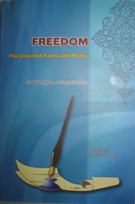
Freedom: The Unstated Facts and Points

Posted: April 28, 2005


Author: Ayatullah Muhammad Taqi Misbah Yazdi
Translator: Mansoor Limba
Publisher: Ahl al-Bayt ('a) World Assembly (ABWA)
Year of Publication: 2006
No. of pages: 114 pages


Contents


Preliminary Pages

Title

Copyright

Contents


Transliteration Symbols
 
Foreword


Preface    
 
Chapter 1: The Various Meanings of Freedom
The Importance of Understanding the Various Meanings of Freedom   
Freedom as existential freedom
Freedom as “freewill”
Freedom as “the lack of attachment”    
Freedom vis-à-vis “slavery”
Freedom in the legal and political parlance: mastery over one’s destiny
 
Chapter 2: Freedom from the Viewpoint of Islam
The Need for the Restraining Law
The Difference between Moral and Legal Laws
The Divine and Atheistic Cultures and the Difference of Their Perspectives on Law
The Three Pillars of the Western Culture
The Fundamental Clash between the Western Culture and Islamic Culture
The Difference between the Islamic and Western Perspectives on the Scope of Freedom    
The Preeminence of the Spiritual and Religious Interests over the Material Interests
The Natural Law School
The Limit of Human Rights in the West
The Emergence of Contradictions on the Limit of Freedom
The Realm of Freedom in the Human Rights Declaration
The Problems of Categorizing Freedom in the West
 
Chapter 3: The Freedom of Belief and Expression
Freedom of Belief as an Affair beyond the Realm of Law
The Freedom of Expression in the West: From Slogan to Reality
The Islamic View on the Freedom of Expression and the Press
First Exposition
Second Exposition
Non-spoken and Media Expression
The Responsibility of Expression
The Freedom to Ask
 
Chapter 4: Clarification of Doubts
Doubt 1: Mandatory laws are against the demand of humanity.    
Reply
Doubt 2: The government’s imposition of limitations is against the demand of freedom.
Reply
Doubt 3: The need for obeying God and the Prophet is against the demand of the Qur’anic verses.
Reply
The Reason behind the Difference between the Two Approaches in the Qur’an    
Doubt 4: The imposition of limitations in actions is against the demand of the natural law.
Reply
Doubt 5: Religion cannot impose limit on freedom.
Reply
Doubt 6: Servitude is against the demand of the natural disposition [fitrah] of man.    
Reply
“Real Ownership” [mālikiyyat-e i‘tibārī] and “Delegated Ownership” [mālikiyyat-e i‘tibārī]
The Requisite of Divine Godhood as Cosmic and Religious Lordship    
Doubt 7: The era of duty-centeredness has ended and the modern man is in pursuit of his rights.
Reply
The Background of Those Who Rebelled against God
Adherence to God and Freedom  
Doubt 8: The demand of the Divine Vicegerency [khilāfatullāh] means absolute freedom of man.
Reply
Doubt 9: Creating ambiguity in defining the legitimate freedom.
Reply
Doubt 10: Observance of the religious precepts is against the demand of the sovereignty of man over his own destiny.
Reply  
 
Subject Index


Index of Qur’anic Verses


Index of Hadīth Quotations


For any comment, email: [email protected].
Copyright © SM Educational & Research Institute (SMERI), 2005-2007. All rights reserved.
Home
SMeRI in Brief
library
education Bureau
research Bureau
external Bureau

Freedom: The Unstated Facts and Points

Of as March 1, 2007, there are still 8 copies of "Freedom: The Unstated Facts and Points" available free on request throughout the Philippines.

On how to request, click here.

For a free copy of the book, you may also send your request to:


Hujjat al-Islam Sayyid Mohammad Hossein Ra'iszadeh,

Deputy Secretary General on Cultural Affairs,

Ahl al-Bayt ('a) World Assembly (ABWA)

P.O. Box 37185/837

Qum

Islamic Republic of Iran

Email: [email protected]

Fax: 0098-251-2913100


Hosted by www.Geocities.ws

1
