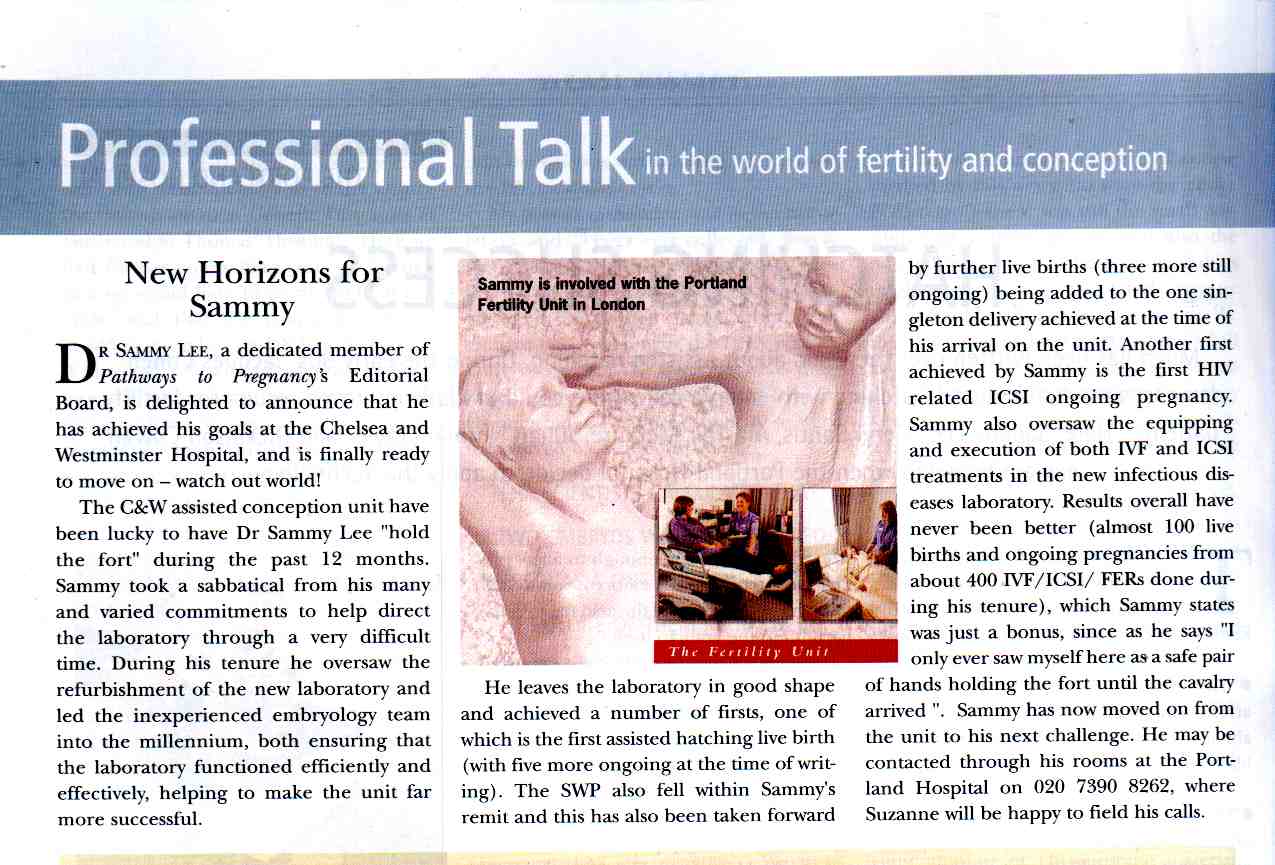
Sammy Lee, a scientist who has been in charge of IVF laboratories since 1985, has seen an explosion in the number of serious cases of male infertility being treated in the clinics during the past fifteen years. In 1985, only 3 percent of all cases would have needed ICSI (sperm injection). Today, 33% need ICSI. In Dr Lee's own clinic at the Portland Hospital, 66% of all cases are ICSI!In 1997 Dr Lee pioneered the first free public telephone counselling service in the UK/World for the infertile. This was funded by the Department of Health. There was a focus on men, since few men take up counselling. In 1997, only 5 percent of all callers were men. By 2000, over 20 percent of callers were male. DoH funding has stopped, but the service continues to be in demand and seven new counsellors have been added to the exisitng team.
One in six couples affected by difficulties with fertility. Fifty-five percent of these males (in twenty percent of these cases both male and female are affected) are subfertile!
About 25 000 couples are treated by IVF per annum. In 1985 only about 3 500 couples were treated, a sevenfold increase! In 1999 alone over 7000 couples were treated by ICSI (sperm microinjection).
Men equate fertility with virility. So a diagnosis of infertility is a deadly blow to most men. Coping with the feelings of being less of a man is a huge challenge; one that many men are only able to cope with by going into complete denial, which can lead to all the problems associated with keeping intense emotions bottled up.
The average female will have half the chance of success once she reaches 35 compared with when she was 25. Men are not immune either, but the age at which men experience a similar drop occurs at around 40.
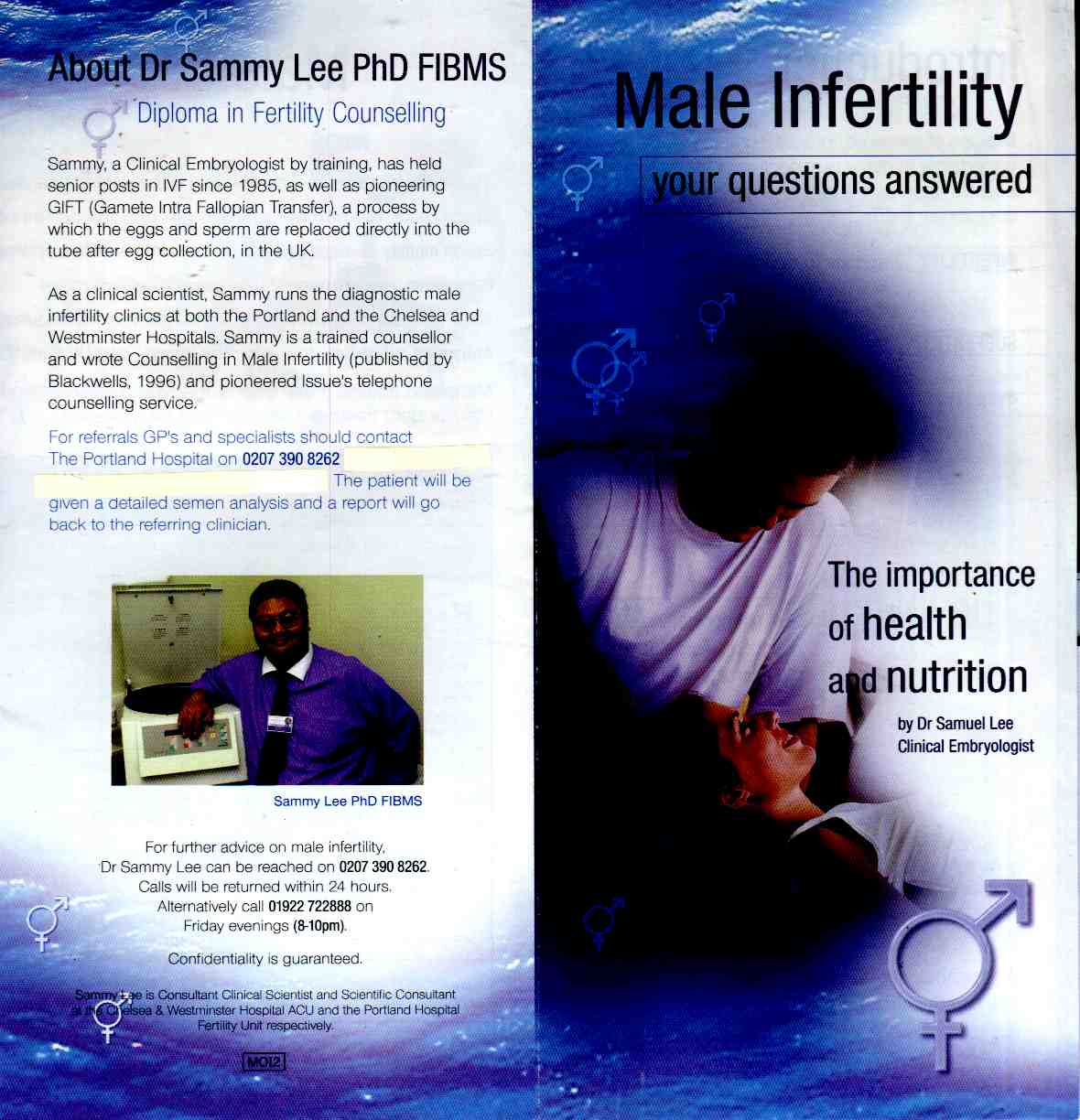
Sammy Lee PhD FIBMS SRCS, Scientific Consultant and male fertility counsellor at the Portland Hospital, has also pioneered the first public telephone male fertility counselling service in the world. Dr Lee is also the author of a book on counselling in male infertility (Blackwells, 1996) and an acknowledged expert on male infertility.The new leaflet was designed to explain to men about the semen analysis. It defines the types of male infertility as well as outlining what treatment options exist for dealing with it. Together with Seven Seas sponsorship, the leaflet is designed to fill the gap in information within the public domain.
The UK is in the vanguard of advances in treatment of infertility, but the reproduction revolution has left many men and women alike, who are unable to have children, feeling not only bereft, but also bewildered by the options that science appears to offer. Dr Lee’s new service will attempt to address these issues.
The launch of the leaflet and the new male fertility service at the Portland Hospital is geared towards helping men with male infertility. Many men ring Dr Lee on his confidential counselling service (at Issue-the national fertility association) in distress. They do not understand their semen analysis results and are at their wits end as to what to do next. Infertility specialists tend to be gynaecologists, who are not trained to work with men. Consequently male fertility patients tend to be isolated. Dr Lee’s new service is aimed at helping both specialists, GPs and their patients get a good semen analysis service, as well as getting a detailed interpretation of the results and a clear outline as to what the treatment options might be.
New data shows one in three men >40 previously having fathered children, now find they have fertility problems and need ICSI. Similarly, this new data also shows men with DI children are now coming back for ICSI in order to have their own genetic children. The demand for ICSI is growing rapidly. Informed consent in this field is important. Dr Lee’s new service also addresses the issue of risk and implications with respect to consenting to ICSI treatment.
Facts:
One in six couples affected by difficulties with fertility.
Infertility occurs in
Thirty-five percent of the males
Thirty-five percent of the females
Twenty percent both causes involved
About 10 percent is unexplainedAbout 25 000 couples are treated by IVF per annum.
In 1985 only about 3 500 couples were treated, a sevenfold increase!About half of all couples undergoing treatment will fail.
Most will attempt a maximum of 3-4 cycles before success or giving up. Freezing helps to increase the number of options available.The average female will have half the chance of success once she reaches 35 compared with when she was 25.
At 37 the chances of having a Down's baby increase significantly.
Part of the problem lies in increasing poor egg quality with age.Once the biological imperative kicks in, couples must get tested quickly-
Semen analysis for male.
Blood tests and tubal patency tests for female.
Ultrasound, hysteroscopy and laparoscopy.
(Time of essence-start treatment reasonably quickly)Research in human reproduction is essential and becoming increasingly urgent!