What is ICSI?
ICSI is the acronym for Intracytoplasmic sperm
injection, which is the technique that allows a single sperm to be microinjected
directly into an egg. This method allows men with very few sperm in their
ejaculate to have a chance of reproducing. Prior to ICSI, such men had
only the options of adoption or of the use of donor semen! Now, so long
as we are able to find sperm in the ejaculate or from the testes, we are
able to offer men treatment. We only need one sperm for each egg! It is
often argued that ICSI allows us to contravene the laws of nature, since
the process of natural selection is bypassed by the method. This is a valid
viewpoint, but is tempered by the fact that in the modern age, much of
medicine might be accused of the same. This is a matter for philosophers.
Since I am only an armchair philosopher, I shall leave it to the experts.
When I am in a quandary about such issues, I rely on my ethics committee
to keep me on the straight and narrow.
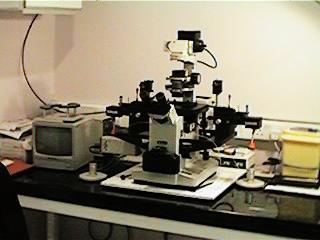
With ICSI we need specialised equipment. The equipment allows
us to make highly precise movements when we are manipulating the eggs and
sperm. It helps to have steady hands. An ICSI cycle is exactly like an
IVF one. The only difference is that after egg collection, instead of just
sitting in the incubator waiting for insemination (usually 50 000 sperm
per egg is used in IVF), the eggs are treated with an enzyme that removes
their jelly covering. This allows the surface of the egg to be subjected
to careful scrutiny. This is important, as the injection of immature eggs
will not be useful for anyone. ICSI may only be done on mature eggs (Metaphase
II stage, for those who might want to know). After all the mature eggs
have been identified, ICSI may begin. Sperm for ICSI are prepared using
a centrifuge and a special separation medium. Bear in mind that if 10 eggs
have been collected, on average, there will be 7 for injection. Each egg
is the size of a full stop and each sperm less than one tenth the size
of the egg! To be able to carry out ICSI properly necessitates working
under a microscope with between x200-400 magnification. The sperm are injected
via a glass pipette which is finer than a human hair. Each ICSI takes between
2 to 15 minutes to complete. Once every egg has been injected, they are
returned to the incubator. From hereon in, the process is a la IVF. Of
the 7 injected we might expect 4 to fertilize, 3 of which might divide.
All 3 embryos would be replaced two or three days after egg collection.
With ejaculated sperm expect a 10-15% success rate. With sperm aspirated
from the testes, 20-25% success rates are possible.
Try visiting the ferti.net site