Home Page
Apple
Orange Durian Soursop
Zoo
 What
fruit is highly portable with a leathery skin and sometimes called, "nature's
most labor-intensive fruit?"
What
fruit is highly portable with a leathery skin and sometimes called, "nature's
most labor-intensive fruit?"
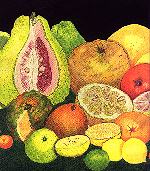
Pugnacious Pomegranate (Punica granatum)
If you don't like winter, blame Persephone. It was pomegranate seeds she ate
that gave Pluto power over her, preventing her return to Earth, thus causing
winter. The fruit's origin is the Middle East, and the Moors brought pomegranate
to Spain where it became the national emblem. Granada, named from the fruit,
has an avenue of pomegranate trees that were planted by the Moors.
Pomegranates grow on a spiny, six-foot shrub, are round, reddish-gold, and
about two to five inches in diameter. Their distinctive crown is the fruit's
blossom end. Juicy, crunchy kernels inside the pomegranate are held in a cream-colored,
bitter membrane that is not edible.
Pomegranate Tips
To remove the seeds: Cut out the blossom end, remove some of the white pith,
but do not break the red pulp around the seeds. Score the skin into quarters.
Break the pomegranate into halves and then halve again following score lines.
Bend back the rind and pull out the seeds. If you do not like seeds, this
fruit is not for you unless you use a juice extractor or food processor to
extract the juice from the pulp. The juice can be strained to remove any seed
sediment.
Pomegranate makes beautiful pink sorbet, icing, salad dressing, soup, and
puddings. The juice gives a unique fresh flavor to sauces and marinades for
fish, chicken, and beef. Use the seeds to garnish fruit salad, dessert, and
appetizers. Pomegranate juice is the original ingredient in Grenadine although
contemporary manufacturers may utilize a synthetic.
 Pineapple
On Trees...Never! Not On Bushes Either
Pineapple
On Trees...Never! Not On Bushes Either
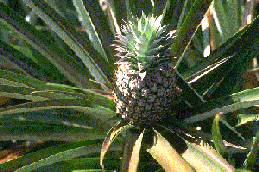
Pineapple is a herbaceous, perennial plant of the bromeliadfamily with large,
pointed leaves. It develops from tiny, lavenderflowers on a short stalk that
grow from the center of the leaves.The flowers fuse with the bracts to become
fleshy and to formthe pineapple. Bet you didn't know that pineapple's fibrous,
chewycore is the original flower stalk! When you see the hexagonalsections
of the pineapple rind, look at each section, a botanicallyindividual fruit,
which merged to form the finished product.
Hawaiian pineapple is ready to eat when harvested and it isrushed to market
at optimum sweetness. Don't store pineapple expectingit to ripen like other
fruit. In the growing process, the starchin the fruit's leaves converts to
sugar and goes directly to thefruit. Once picked, the fruit is cut off from
its "sweetness"supply.
How To Select a #1 Pineapple
Look for fresh, green leaves and be certain they are not wiltedor brown. The
pineapple should smell sweet and be firm with nosoft spots. There is a new
pineapple in your future. Del Monte's latest creation, Golden Pineapple, is
now in many mainland and European markets. Sweeter, juicier, golden, and loaded
with three, yes xxx, times the vitamin C of the older model. This pineapple
grows in Costa Rica and the Philippines. Only a limited number are being grown
on Oahu by Del Monte, and no word about future Hawaiian production at this
time.
Latest production figures from the Del Monte offices in Florida are that 40-50,000
new Golden Pineapples are shipped weekly to both mainland US and Europe. The
Golden Pineapple carries a name tag for easy identification. Happy munching!
Pineapple tips
The most flavorful use for a fresh pineapple is the simplest.Don't mask its
sweet flavor with a rich dressing or bake the freshnessfrom it. Use canned
pineapple for richly dressed salads, marinades,and baked goods. Fresh pineapple
is good uncooked as a toppingfor a cheesecake or a tart and in fresh fruit
salad. Serve itcubed with a dash of brandy or kirsch for dessert. Fresh pineappleis
the perfect ending to a dinner because its enzymes aid digestion.
 MadAbout
Mango!
MadAbout
Mango!
Mango, one of the earliest cultivated fruits, has been grownin India for about
5,000 years. At least 500 mango varieties aregrown there. In Hawaii, mangos
are a common backyard fruit often eatenripe, but they are also enjoyed green
with vinegar, soy sauce, salt, andpepper.
Mango Tips
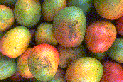
Mangos can be round, oval, or oblong and the fruit color canvary from green
to yellow-orange. When buying mangos, select unblemished,firm fruit. It will
ripen in three to five days at room temperature.If refrigerated, mango keeps
well for about a week.
If you are lucky enough to have a mango tree, you may be overwhelmedwith your
crop. Mango pulp can be successfully frozen for aboutone year as puree or
slices. Peel mangos, remove pulp from theseed, and use a food processor fitted
with a steel blade to pureethe fruit. Pour the puree into ice cube trays and
freeze. Packcubes into freezer bags, or pour puree directly into freezer bagsand
freeze as a block. To freeze mango slices, seal them tightlyin freezer bags
or containers. Do not add sugar or water.
Frozen mango puree slices easily with a sharp knife,almost like cold butter.
No need to thaw. Return remainder ofunused, frozen mango puree immediately
to the freezer. Frozenmango puree can be used in sorbet, salad dressing, and
marinade.
Grow Mango!
Clean the fuzzy mango seed removing as much pulp as possible.Plant it horizontally
in a six-inch pot with a good planting medium.Place the seed on the surface
of the pot with about a quarterof the seed embedded in the soil. Do not overwater
and feed asyou would a regular houseplant. Mangos are hearty plants and inabout
a month you will have a mango plant underway. As the plantmatures, shape your
"tree" by pinching off leaves.