Soursop
Soursop
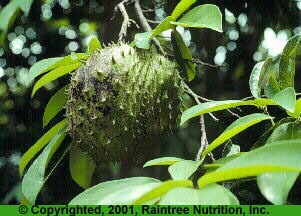
Latin: Annona muricata
Spanish: Guanabana
A member of the custard apple/ atemoya family. the soursop is the largest of this fruit family sold in Australian markets, although the rollinia, which is larger, is also grown but is too fragile to consign to market.
Soursop can weigh up to one kilogram per fruit, the flesh is white compared to the yellow flesh of the custard apple, and the skin is spiky rather than knobbly. The taste, as the name implies, is not sweet but astringent.
Availability: Soursop is available the year round, and the total production in Australia would be around 30 tonnes.
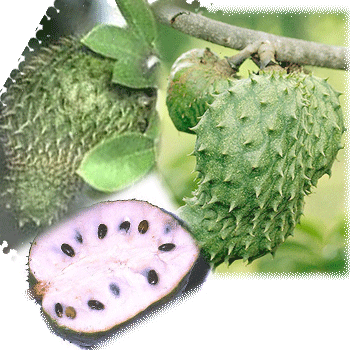
A well-known fruit throughout much
of the world, the soursop's delicious white pulp, with tones of fruit candy
and smooth cream is commonplace in tropical markets, but is rarely found
fresh anywhere else. Inside its thin, leathery, green flesh is a large mass
of creamy pulp, usually intermixed with 50-100 black seeds.
The Soursop is usually processed
into ice creams, sherbets and drinks, but fiber-free varieties are often
eaten raw. The large, elongated, somewhat ovaloid fruit, can be up to 12"
long and 6" wide and usually weighs several pounds. The fruit is covered
in small knobby spines that easily break off when the fruit is ripe. The
thin, inedible, leathery green skin cuts easily to yield the large mass
of cream colored, fragrant, juicy, and somewhat fibrous, edible flesh. A
typical soursop contains anywhere from 30-200 black-brown seeds, each about
1/2" long and 1/4" wide and enclosed in a separate "pocket"
of flesh. There are known seedless varieties, but they are rare, and tend
to have fibrous flesh. Soursop's are processed into excellent ice creams,
sherbets and beverages throughout much of Central and South America. Sweet
varieties of the fruit can be eaten raw, and are often used for dessert.
Today, Soursop ice cream, marketed under its Spanish name "Guanabana,"
can be found in some gourmet supermarkets. Preserved soursop in syrup can
also be found in many ethnic markets. The canned pulp can be pureed or blended
in the home, and easily transformed into a delicious desert, although fresh
pulp is more desirable. Immature soursops are often cooked, and eaten as
a vegetable. The leaves and roots of the tree have various medicinal properties.
Soursops are high in vitamins B1, B2 and C.