Orange Page
 Sweet
Orange
Sweet
Orange
Citrus sinenis
Family: Rutaceae
Clementine, Mandarin, Tangerine, Satsuma
Citrus reticulata,
Family: Rutaceae
Description & storage
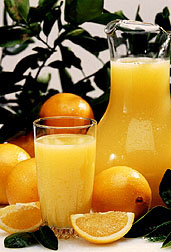
Orange: Round thick skinned juicy edible fruit that is a reddish-yellow
color when ripe.
 Mandarin
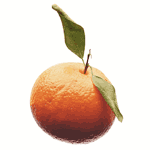
types: type of small orange with loose skin.
Mandarin
types: type of small orange with loose skin.
Store them at 12 degrees Celcius (=57o F) or if you like in the refrigerator. This is nice when you use them for squeezing.
Tree
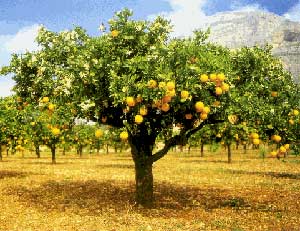
Orange trees are evergreen trees. They grow 8 to 15 m. high.
The mandarin tree grows up to 7,5 m. high.
The kumquat plant is a shrub that grows up to 4m. high.
Sweety: see grapefruits.
Short history
The orange is cultivated over thousands of years now. It is supposed to
originate from South- and indo-China.
The clergyman Pierre Clement crossed
a mandarin and an orange and this luckily crossing
was a seedless mandarin with a looser skin thus easier to peel: the clementine.
(beginning of the 20th century).
The satsuma is a special crossing from Japan.
Use
Oranges are eaten by hand and squeezed a lot.
Mandarins are eaten by hand and can be used to squeeze as well. A great sweetner for grapefruit juice.
Kumquats are eaten raw withe the edible skin,
Types and family
Clementines: the clementine is a seedless
mandarin.
Kumquats: the kumquat is like a citrus fruit and has an edible skin. It
is the most well known of the sort fortunella which is closely related to
Citrus.
Mandarins: type of small orange with loose skin. The mandarin got its name
because it was exploited by high-ranking government officials in China (mandarins).
Minneolas: are a crossing between a tangerine and a grapefruit and can be
recognized by
"the little nose". Can be peeled manually. Is a type of Tangelo,
a minneola is a specifically marketed tangelo.
Oranges: There are different types of oranges: navel oranges, Valencia oranges
and blood oranges are the most cultivated races.
Tangelos: a tangelo is a crossing between a tangerine, a grapefruit and
an orange. A specific kind of tangelo is the Ugli which is described further
on this page.
Satsuma:is a very special seedling from Japan. Its skin is a bit tighter
than the clementine and it doesn't have seeds as well.
Tangerines: a tangerine is an orange-red mandarin with a particular citrus
taste. Can be peeled manually.
Uglis: a specific kind of tangelo, easier to peel. A crossing between a
tangerine, a grapefruit and an orange. Looks really ugli and sometimes has
brown spots. Can be peeled manually.
Other peculiar characteristics
The calcium in fortified orange juice
is better absorbed than the calcium in milk. A glass of milk (8 ounces)
has 291 mg of calcium; of which 93 mg is absorbed (31%). Fortified orange
juice (8 ounces) has 350 mg of calcium; of which 130 mg. is absorbed (37%).
One orange contains about 50 mg. vitamin C; this is about 2/3 of our daily
need;
Oranges are an acid and therefore a detoxifying fruit;
Bitteroranges can't be eaten raw and are used to make marmalades;
Citrus fruit is never colored artificially.
The orange colors orange under the influence of cold temperatures. In the
tropics the fruit keeps a green to green with yellow stains color.
Citrus sinenis
Family: Rutaceae
Clementine, Mandarin, Tangerine, Satsuma
Citrus reticulata,
Family: Rutaceae
Description & storage
Orange: Round thick skinned juicy edible fruit that is a reddish-yellow
color when ripe.
Mandarin types: type of small orange with loose skin.
Store them at 12 degrees Celcius (=57o F) or if you like in the refrigerator. This is nice when you use them for squeezing.
Tree
Orange trees are evergreen trees. They grow 8 to 15 m. high.
The mandarin tree grows up to 7,5 m. high.
The kumquat plant is a shrub that grows up to 4m. high.
Sweety: see grapefruits.
Short history
The orange is cultivated over thousands of years now. It is supposed to
originate from South- and indo-China.
The clergyman Pierre Clement crossed
a mandarin and an orange and this luckily crossing
was a seedless mandarin with a looser skin thus easier to peel: the clementine.
(beginning of the 20th century).
The satsuma is a special crossing from Japan.
Use
Oranges are eaten by hand and squeezed a lot.
Mandarins are eaten by hand and can be used to squeeze as well. A great sweetner for grapefruit juice.
Kumquats are eaten raw withe the edible skin,
Types and family
Clementines: the clementine is a seedless
mandarin.
Kumquats: the kumquat is like a citrus fruit and has an edible skin. It
is the most well known of the sort fortunella which is closely related to
Citrus.
Mandarins: type of small orange with loose skin. The mandarin got its name
because it was exploited by high-ranking government officials in China (mandarins).
Minneolas: are a crossing between a tangerine and a grapefruit and can be
recognized by
"the little nose". Can be peeled manually. Is a type of Tangelo,
a minneola is a specifically marketed tangelo.
Oranges: There are different types of oranges: navel oranges, Valencia oranges
and blood oranges are the most cultivated races.
Tangelos: a tangelo is a crossing between a tangerine, a grapefruit and
an orange. A specific kind of tangelo is the Ugli which is described further
on this page.
Satsuma:is a very special seedling from Japan. Its skin is a bit tighter
than the clementine and it doesn't have seeds as well.
Tangerines: a tangerine is an orange-red mandarin with a particular citrus
taste. Can be peeled manually.
Uglis: a specific kind of tangelo, easier to peel. A crossing between a
tangerine, a grapefruit and an orange. Looks really ugli and sometimes has
brown spots. Can be peeled manually.
Other peculiar characteristics
The calcium in fortified orange juice
is better absorbed than the calcium in milk. A glass of milk (8 ounces)
has 291 mg of calcium; of which 93 mg is absorbed (31%). Fortified orange
juice (8 ounces) has 350 mg of calcium; of which 130 mg. is absorbed (37%).
One orange contains about 50 mg. vitamin C; this is about 2/3 of our daily
need;
Oranges are an acid and therefore a detoxifying fruit;
Bitteroranges can't be eaten raw and are used to make marmalades;
Citrus fruit is never colored artificially.
The orange colors orange under the influence of cold temperatures. In the
tropics the fruit keeps a green to green with yellow stains color.
Citrus sinenis
Family: Rutaceae
Clementine, Mandarin, Tangerine, Satsuma
Citrus reticulata,
Family: Rutaceae
Description & storage
Orange: Round thick skinned juicy edible fruit that is a reddish-yellow
color when ripe.
Mandarin types: type of small orange with loose skin.
Store them at 12 degrees Celcius (=57o F) or if you like in the refrigerator. This is nice when you use them for squeezing.
Tree
Orange trees are evergreen trees. They grow 8 to 15 m. high.
The mandarin tree grows up to 7,5 m. high.
The kumquat plant is a shrub that grows up to 4m. high.
Sweety: see grapefruits.
Short history
The orange is cultivated over thousands of years now. It is supposed to
originate from South- and indo-China.
The clergyman Pierre Clement crossed
a mandarin and an orange and this luckily crossing
was a seedless mandarin with a looser skin thus easier to peel: the clementine.
(beginning of the 20th century).
The satsuma is a special crossing from Japan.
Use
Oranges are eaten by hand and squeezed a lot.
Mandarins are eaten by hand and can be used to squeeze as well. A great sweetner for grapefruit juice.
Kumquats are eaten raw withe the edible skin,
Types and family
Clementines: the clementine is a seedless
mandarin.
Kumquats: the kumquat is like a citrus fruit and has an edible skin. It
is the most well known of the sort fortunella which is closely related to
Citrus.
Mandarins: type of small orange with loose skin. The mandarin got its name
because it was exploited by high-ranking government officials in China (mandarins).
Minneolas: are a crossing between a tangerine and a grapefruit and can be
recognized by
"the little nose". Can be peeled manually. Is a type of Tangelo,
a minneola is a specifically marketed tangelo.
Oranges: There are different types of oranges: navel oranges, Valencia oranges
and blood oranges are the most cultivated races.
Tangelos: a tangelo is a crossing between a tangerine, a grapefruit and
an orange. A specific kind of tangelo is the Ugli which is described further
on this page.
Satsuma:is a very special seedling from Japan. Its skin is a bit tighter
than the clementine and it doesn't have seeds as well.
Tangerines: a tangerine is an orange-red mandarin with a particular citrus
taste. Can be peeled manually.
Uglis: a specific kind of tangelo, easier to peel. A crossing between a
tangerine, a grapefruit and an orange. Looks really ugli and sometimes has
brown spots. Can be peeled manually.
Other peculiar characteristics
The calcium in fortified orange juice
is better absorbed than the calcium in milk. A glass of milk (8 ounces)
has 291 mg of calcium; of which 93 mg is absorbed (31%). Fortified orange
juice (8 ounces) has 350 mg of calcium; of which 130 mg. is absorbed (37%).
One orange contains about 50 mg. vitamin C; this is about 2/3 of our daily
need;
Oranges are an acid and therefore a detoxifying fruit;
Bitteroranges can't be eaten raw and are used to make marmalades;
Citrus fruit is never colored artificially.
The orange colors orange under the influence of cold temperatures. In the
tropics the fruit keeps a green to green with yellow stains color.