|
Learning Center on Caribbean Weather and Climate |
Schools - Suggestions for science classes |
|
4. Learning Key words and Concepts: Ozone depletion, Acid rain, Global warming (11-12 yrs)Introduction
Climate dictates much of the way the world is. All over the planet climate differs and human activities, such as agriculture, have developed according to local climatic conditions. Just as humans are influenced by the climate, they have also influenced our global climate during the industrialized era. The increasing number of people and economic development continue to cause adverse affects for the global environment. This activity will allow students to understand key environmental issues and visualize the impact human actions have on global atmospheric and water problems. The questions at the end of this module will stimulate the students to think about the impact of their daily activities on the environment. Activities that follow are chosen to explain three core concepts related to our atmospheric environment: ozone depletion, acidification, and global warming. Although these terms are frequently used, very often concepts like ozone depletion and global warming are confused. All three environmental problems are linked to processes in the atmosphere that are altered by the behavior of humans. This science project suggestion aims at explaining the different concepts to the students. You may wish to begin, or conclude, this activity by reading the Climate change and Ozone depletion sections of Cawedu.net. Back to top of this pageDepletion of the Ozone LayerThe Ozone Layer is a layer in the upper atmosphere where a form of oxygen with three atoms in a molecule (called ozone) is found. This layer protects us from harmful ultraviolet (UV-B) radiation from the sun. In the seventies investigators observed a “hole” in this layer at the poles. The cause of this hole turned out to be the use of substances which destroy ozone (known as ozone depleting substances), in particular the chlorofluorocarbons (CFCs). As a result of the reduction of this layer the UV-B radiation that reaches the Earth increases. This causes increased skin cancer risks and eye problems. The depletion of the ozone layer is a clear example that the environment does not have national boundaries. CFCs were mainly used in industrialized areas, but its effect concentrated at the polar areas. Table 1 shows the current ozone losses and increase in UV-B as presented in the GEO2000 report (page 27). Table 1 Current ozone losses and UV-B increases (GEO-2000)
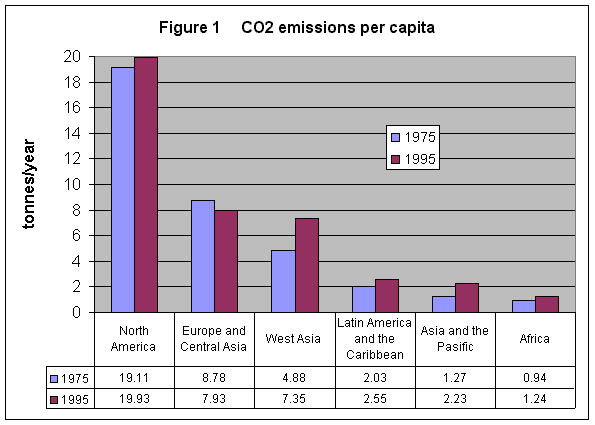
Note: Figure is approximate and assumes other factors, such as cloud cover. Source in GEO-2000: WMO, NOAA, NASA and EC (1998). Back to top of this pageAcidificationSulphur dioxide resulting from sulphur emission is washed out the atmosphere as acid rain. Acid rain causes acidification. This is the process by which soil and water become acidic. The change of acid levels in soils has a large impact on life in lakes and forests, but it also causes crop losses. One of the main causes of sulphur emissions is the burning of sulphur rich fuels, like coal. Although strenuous efforts have begun to abate acid rains in many European and North American countries, emissions in other regions, like Asia, are a major and growing problem. Climatology has a big effect on acid rain. If prevalent winds of a region come from over the ocean, unindustrialized or uninhabited area, the region is probably saved from acid rain. On the other hand, even if the region itself uses the best available technology and does not emit sulphur dioxide, it might still suffer from acid rain due to winds coming from polluting areas. Back to top of this pageGlobal WarmingGlobal warming is the process whereby the average temperature of the atmosphere increases due to the increase of so-called greenhouse gases in the atmosphere. A greenhouse is a widely used metaphor for the warming function of the atmosphere. Even though the effect is the same, the surface of the Earth below the atmosphere and the space inside a greenhouse are warmer, the major mechanisms functioning are different. In a greenhouse the roof and walls effectively prevent convection and advection and the heat is trapped within the greenhouse with the air. In the atmosphere convection and advection redistribute the heat from warmer to colder areas. The atmospheric greenhouse gases do not prevent convection nor advection, they absorb terrestrial (infrared, long-wave) radiation. Due to absorption they have a distinctive temperature which makes them emit themselves long-wave radiation. The more greenhouse gases the more absorption and emission. Part of this emission of long-wave radiation from greenhouse gases is directed to the Earth's surface which heats up further. Read more, and more! One of the greenhouse gases is carbon dioxide (CO2). Mainly due to the burning of fossil fuels, the concentration of CO2 in our atmosphere has increased significantly. However, the contributions of different parts of the world differ considerably. Figure 1 shows CO2 emissions per capita expressed in tonnes per year, for 1975 and 1995 (from the GEO-2000 report).
Note: Source in GEO-2000: CDIAC 1999 Global warming is expected to have an impact on many things: melting of polar ice, an increase of the sea level. Climate patterns will change and this will also have an effect on the growth of plants, the spreading of species and on the Earth’s ecosystems as a whole. Learn more about climate change and the Caribbean in the section Climate change: impacts, adaptation and vulnerability of Cawedu.net. Back to top of this pageProcessThe Hole in the Ozone Layer► Bring an old - really old! - umbrella that can be cut up, or a piece of cloth to the classroom. ► Ask one of your students to volunteer to sit underneath the umbrella on a table at the front of the class. ► Then carefully, with a pair of scissors, get two other students to cut holes in the umbrella. ► Shine a powerful torch or spotlight (or sit outside in the direct sunlight) through the umbrella or piece of cloth so that the children can see the dappled effect on the child sitting underneath it. ► Ask one student to explain what is UV and UV-B radiation, what are the effects of excess exposure to UV-B radiation, what is the ozone layer and how it is connected to the UV-B radiation:
► Invite students to think about what can be done about this problem: Apart from using sun cream, the emission of the gases that damage the ozone layer should be stopped. ► Tell the students that most governments have agreed to stop the production of CFCs that damage the ozone layer. ► Tropics and sub-tropics have not been affected by the depletion of the ozone layer. Ask the students why it is still necessary that also the Caribbean countries need to take measures to curb the ozone depletion: Ozone depleting substances used in Caribbean mix throughout the atmosphere and cause depletion in vulnerable parts of the world. ► Ask if the students know in what products these gases are used? Back to top of this pageAcid RainSet up an experiment with two comparable groups, each of six plants, group A and B: use the same soil for all plants, use plants in similar health and of the same age and so on. ► Prepare two flasks of water: one with tap water and one with tap water plus the juice of a squeezed lemon. Mark the flasks respectively as A and B. Explain to the students that flask B will simulate the acid rain. ► Water each group of plants equally with their assigned flasks: use flask A water for group A plants, and flask B water for group B plants. ► Ask the students to work in six groups and to continue the experiment for two weeks (or until dramatic results in the degeneration in the health of group B plants are shown). Each group is watering one pair of plants (A+B). ► Discuss the differences between the two groups of plants after two weeks. Make an inventory of the differences observed and ask the students to explain the differences. Differences can be observed in freshness of leaves, colour of leaves, plant growth etc. ► Explain to the students that the outcome of their experiment is comparable with what has been observed in forests that were damaged by acid rain. ► Use this as an opportunity for the students to really apply the ‘scientific research method’ to their investigations in describing the experiment in a report. The students should include the following: Introduction, Aim of the experiment, Hypothesis, Materials and Methods used, Results and Conclusion. ► Discuss weather acid rain is a problem of your particular country. Which factors are the most dominant? Does climatology work in favor or against your country? Back to top of this pageThe Greenhouse EffectTo do a simple experiment to explain the working of a greenhouse: ► Get a large glass jar or construct a glass box out of some panes of glass. ► Place a small container of water under the glass and put another just outside of it. ► Leave both in the sunlight and then, at the end of the day, take the temperature of the two containers. Let the students find out which is warmer and why this is the case. ► Experience drawn from the experiment or from people who have visited a green-house can be applied to other examples of insulation such as clothes, sleeping bags, hot water tank jackets etc, to illustrate heat retaining qualities and effects. Explain that carbon dioxide gas does the same thing to heat within the atmosphere (note the different mechanism though!!) and give examples based on the information above. ► The consequences of the heating of the atmosphere can be discussed back in the classroom, using a world map. Predict which areas and which people will be affected most by the melting polar ice or alpine glaciers: sea level rise will affect low lying areas – small islands might disappear, coastal areas are threatened, etc. For more information about the effects of global warming see the section Climate change: impacts, adaptation and vulnerability of Cawedu.net. ► Instruct the students to write up a full report including the following details (see model for report):
Back to top of this pageTo ConcludeAll three of these experiments encourage students to become more familiar with atmospheric changes and to be able to differentiate between these three global problems. As a follow up, you may wish to encourage your students to look further locally at how your region, or country, is affected by these atmospheric changes. Allow them to explore the local context in a homework or library assignment, and if these resources are unavailable, they can use their imagination to write creatively about how their home might be affected by these changes. The students can look for present or predicted examples in their country of the impact of climate change (floods, droughts, warmer seasons, hurricanes), ozone depletion (development of CFC friendly products, increase in health risks, public awareness campaigns), acid rain (forest degradation, water contamination, degradation of national monuments). This will allow the students to bring these global issues down to the local level. Back to top of this pageOutputs:A well designed investigation and report. (This science project suggestion has been adapted from Pachamama Teacher's Guide, UNEP, ISBN: 92-807-2147-X) Back to top of this page |
| Suggestions for science classes | The GLOBE Program |
| SCHOOLS HOME FUNDAMENTALS CLIMATE SOCIETY WEATHER ABOUT NEW |
 yahoo.com with questions or comments
about this web site. Questions concerning material, copyright of which resides
outside of CIMH, should be directed to the institutions in question.
yahoo.com with questions or comments
about this web site. Questions concerning material, copyright of which resides
outside of CIMH, should be directed to the institutions in question.