 |
|
 |
 |
| WALLER JUNIOR HIGH School Background Information |
| TEAM TEACHING The Waller Junior High is based upon a team approach where teams of teachers and students work together to achieve academic and personal goals. Teachers share responsibility for the same students and solve problems together, often before they reach the crisis stage; teacher�s report that classroom discipline problems are dramatically reduced through teaming. This community of learning nurtures bonds between teacher and student that are the building blocks of the education of the young adolescent. Teaming provides an environment conducive to learning by reducing the stress of anonymity and isolation on students. Common planning by teachers of different subjects enables students to sense consistent expectations for them and to strive to meet clearly understood standards of achievement. Teaming creates the kind of learning environment that encourages students to grapple with ideas that may span several disciplines, and to create solutions to problems that reflect understanding, not memorization. Interdisciplinary teams also provide a much-needed support group for teachers, eliminating the isolation teachers can experience in departmentalized settings. Teacher teams are interdisciplinary to ensure coordination across all aspects of the core instructional program. Teachers of elective courses, special education teachers, and support staff are also included on a team. Teams do not exceed 125 students per minimum of 5 teachers for grades 7 & 8. Ninth grade team is designed around one common planning time as students are distributed among 4 core subjects with three electives during a seven period day. A multi-disciplinary team teaching approach allows teachers at times to coordinate the entire instructional program around units that go beyond the standard curriculum guides. This approach requires time set aside for joint planning. Each core team is identified by a team name and work collaboratively in developing cross curriculum integration of subjects through flexible scheduling. The central purpose of the team is to develop a unified approach in helping students to excel academically and socially. The schedule allows for team teaching within a group of five core subjects. Core teachers for seventh grade include math, science, geography, English, career education/reading and one nine weeks of (Spanish/P.E.). Core teachers for eighth grade include math, science, English, US history and one semester of (technology education and Spanish) Core teachers for ninth grade include math, physical science, English and one semester of (Civics and Oklahoma History) |
| ADVISORY PROGRAM An advisory program has been designed to help students with academics, develop a sense of community, the feeling of security and to work on individual needs with interesting activities. Every student is well known by at least one adult. Students will be able to rely on that adult to help learn from their experiences, comprehend physical changes and changing relations with family and peers, act on their behalf to marshal every school and community resource needed for the student to ./' succeed, and help to fashion a promising vision of the future. Small-group advisories, homerooms, or other arrangements enable teachers or other staff to provide guidance and actively monitor the academic and social development of students. Guidance counselors will retain a central role in assisting advisors in developing group activities for the advisory period, consulting with advisors on students' problems, counseling students with problems that go beyond what the advisors are trained to handle, and connecting students to appropriate Community resources when the school cannot adequately meet a youth's need. FACULTY/STAFF INVOLVEMENT Teachers are encouraged to develop solutions and to innovate changes which strengthen staff, student, and parent communication. Teachers also have input on the parent advisory board and various committees such as scheduling, special events, and school climate. The results of teacher involvement have been numerous. Examples are an award winning career education program, improved portfolios, flexible scheduling, and technology education for all students, and the implementation of community education courses. In the classroom, the career portfolio has been implemented by career education teachers at every grade level. Teams of teachers have used the freedom of flexible scheduling to connect learning through interdisciplinary projects. Our teachers are involved in the decisions that affect their students; consequently, they feel ownership in their achievement. |
|
| FAMILY/PARENTAL INVOLVEMENT Parents play a key role in our school. Research shows that the gulf between parent and school widens during the middle school years. Junior highs have often been compared to a "black hole" or a "great abyss." Once the child enters, he/she is not heard of or from again. In an effort to reverse this trend, we offer parents many opportunities for meaningful involvement, and we go to great lengths to keep them involved. Our communication with parents starts well before the first day of school since we provide detailed information about the school rules and procedures. Parents play a central role in the school program by joining in on the decision making process concerning school wide issues and problems. Conferences among families, teacher teams, and students offer parents the opportunity to understand the child's performance and to become more familiar with the school program. |
|
| EDUCATIONAL PLANNING AND TRANSITIONS WJHS leaders and teachers realized that they could not get students to see the importance of taking "the right courses" if parents did not understand new curriculum mandates. As a result, teachers and counselors scheduled an annual "PAC night" for parents. During these events, parents and their children meet with a school counselor and teachers to develop program of study leading to further learning before and after high school. To better assimilate transitions from one grade level to the next, several programs have been implemented at the junior high school level. Sixth graders are first introduced to the junior high school through a student tour of the campus each spring. The sixth graders may also recognize familiar faces as they have an opportunity to view a student-produced play by the drama class concerning life at the junior high school. A similar orientation for the parents of sixth graders is held in the evening. Parents tour the campus, view on stage performance, and also participate in an orientation session where they too have the opportunity to ask questions. At the parent night, policies and procedures of the school are explained in an attempt to familiarize parents with the middle level concept and careers portfolio. Seventh grade students participate in a full year Career Litterateur Enhancement course, a 48 minute class that emphasizes the importance of working hard in junior high school, taking challenging courses, strengthening communication and study skills, and making junior high school an important step toward the future. English teachers help students develop writing skills. Social studies teachers offer tips on taking notes, studying, listening, and managing time. Students also participate in The Real Game, an exercise on calculating the cost of raising a family and the level of income needed in a variety of career paths. A guidance counselor helps students develop personal skills such as conflict management. Students receive a grade in Career Litterateur Enhancement as they would in any other class. By the time a student completes eighth grade at our school, he/she will take to the next level of schooling a portfolio, which contains examples of the student's career interest and academic accomplishments. The counselor integrates the EXPLORE results into the eighth grade technology education curriculum, utilizing such things as the World of Work Map. At the second PAC held in the spring of the eighth grade year parents receive Career Paths, a booklet that describes the three pathways: college preparatory, tech prep and dual. The publication also describes the four clusters, the careers reflected in each cluster, related elective courses, and the academic core that students must complete. Similar "PAC" meeting have been created to help students in ninth grade review their plans for the coming year. Junior high and high school counselors and teacher present mini-lessons at these meetings to help parents understand what is required of their children at each grade level and beyond. More than 85 percent of parents attend these planning conferences. As the ninth graders prepare to enter high school, their transition is made easier by a series of events that have been ongoing all year. Through our ninth grade social science program, the ninth graders are introduced to vocational plans and the world of work through an orientation at the Autry Institute of Technology and Vocational Education. Here they are given the SAGE and Career Interest Inventory. They are introduced to different vocations by a vocational counselor and then explore the different career opportunities available through a tour of the Vo-Tech. All of these portfolio assessments are pulled together at the end of the ninth grade year for a high school planning and parent orientation night. The students and their parents meet by team and go over career assessments with vocational, high school, and junior high school counselors. The emphasis is on utilizing this information for future goal setting and life planning. The high school counselor then goes over the three-year plan for high school and explains academic requirements for graduation. |
|
| ADDRESSING THE NEEDS OF DIVERSE STUDENT POPULATION The team concept allows for more individualized attention from the teachers. Teachers are able to move students within the team to ensure the best placement for each individual. Our school also provides students with a wide variety of elective classes in order to ensure all students have the opportunity for success. Special needs students are supported through such programs as enrichment classes, MR classes, LD labs, SED classes, IEP's, speech therapy, music, and P.E.. IEP and special needs students are hand enrolled in order to ensure fair and equal distribution among the teams. Teaming at all grade levels allows for following academic progress, detecting needs, and providing inclusion and modifications for students. Students in advanced math and enrichment are selected by ITBS scores as well as advanced placement screening and testing. Our special education students can take advantage of all the programs mentioned earlier, and are also served with inclusion, IEP's, LD labs, MR classes, SED, and speech therapy. Additionally students who have difficulty meeting state and local standards in their courses have the option of going to the afternoon computer learning center at the school to receive extra help. Although teachers provide extra help before and after school, students who score below average on standardized tests receive computer-assisted help in reading, writing and mathematics. |
|
| PROFILE OF ASSESSMENT STRATEGIES Achievement is the primary mission of the school. It involves a joint effort between the school and parent, requiring ongoing efforts by, and communication between staff members and parents. Standardized achievement test results are utilized as one means of assessing achievement. They are used as one helpful aid in planning an effective program of instruction for each student based on the student's skill development. They are also used for assessing school wide achievement. Assessing achievement utilizes five achievement test batteries: ITBS, PASS, Learning Styles Inventory, EXPLORE, and SAGE. The data most often utilized for interpretation of individual and group performance are normal curve equivalence, percentile ranking, stanine, and grade equivalence. Students are placed on a team heterogeneously with respect to total battery on the ITBS given in March. This is done to provide teams with an equivalent distribution of students who perform at higher, average, and lower levels. One of the formal procedures of assessing and reporting seventh grade student achievement at our school is administering the Iowa Test of Basic Skills. Our school has scored above the national percentile for the past three years in all core subject areas. The ITBS was administered to all seventh and grade students in our three district junior highs and our school scored higher than other two district junior highs in the district. (See Table 1) The individual educational plan of special education students addresses the non-option of testing in 1999 and all special education students were tested. A second method for formal assessment of student achievement is the eighth grade EXPLORE exam. EXPLORE is a ACT based assessment designed to link a student's academic abilities to his/her interests thereby helping to determine student strength areas for their high school program. The EXPLORE assessment contains four multiple-choice tests - English, mathematics, reading, and science reasoning. Our school was one of the four schools in our state to be selected to pilot for the American College Testing program. The ACT was administered in January 1998 and 1999 to (95%) of the eighth grade population. The highest possible composite score is a 25 with 13 being the norm. The local composite mean in 1998 and 1999 was 15.6 compared to the national mean of 14.1. Waller Junior High students scored above the national mean in all subject areas. (See Table 2) WJHS education programs has brought consistent improvement in students� reading, mathematics and science performance. Students scored significantly higher on the State Criterion Reference Test of reading, mathematics and science in 1998 and 1999 than the average score in Oklahoma. (See Table 3) The Oklahoma Writing Assessment was given in February 1999 to (100)% (210) of the eighth grade students. The testing level was Intermediate 3 and the testing norms were from the spring of 1999. There has been a notable increase in writing skills as evidenced by a rise in NCE scores of the (210) 200 students or 95% of the population scored at or above the satisfactory level. Larger percentages of at WJHS students met or exceeded the state goals in reading, mathematics and science in 1998 and 1999. In reading, the percentage of students who met the performance goal was 89% in 1998 and 85 percent in 1999. The percentage of WHS students who met the state CRT mathematics goal in 1998 was 84% in 1998 and 85% in 1999. WJHS students also made gains in science. The percentage of students who met the state science goal was 89% in both 1998 and 1999. (See Table 3) |
|
|
| Back To Waller Home Page |
|
 |
| Technology Ethics |
|
| School History |
| History of Waller Junior High School |
|
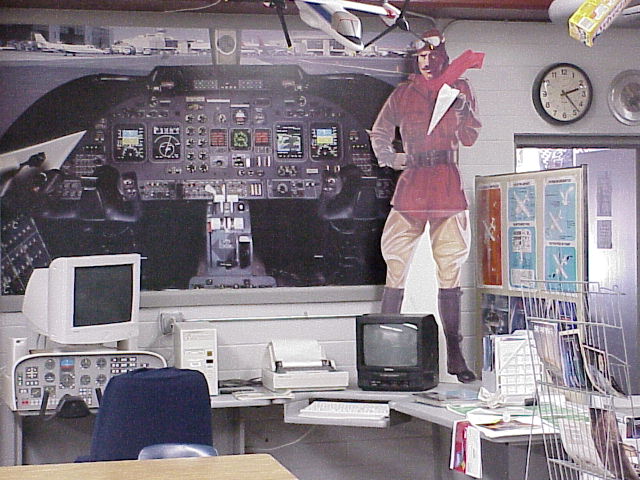
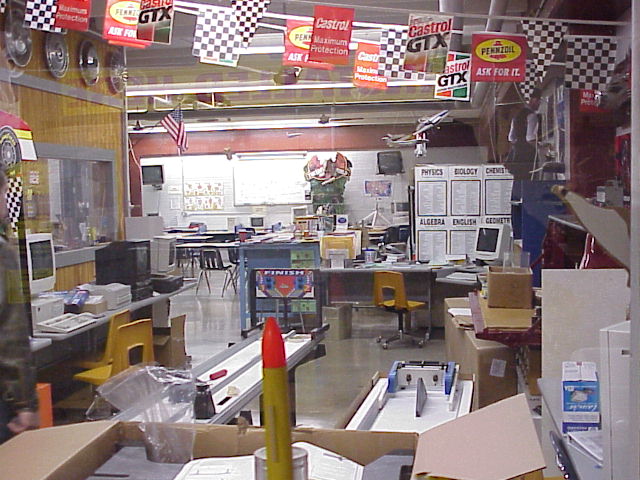
| The T.O.P.S. project serves as a foundation resource for all of our students. Parent Orientations, High School Prep Nights, Parent Advisory Groups, and "Open Houses" all provide opportunities to define and promote career education. During these meetings, parents are introduced to materials that enhance their abilities to assist their children with career and educational planning. The monthly parent newsletter, school newspaper, and school promotional materials serve as media sources to publicize our, educational programs. The school's counselor and Technology Education staff have developed "user-friendly" career based materials that are available to families in the schools media center. These materials are designed to assist individual students and their parents as they prepare for their future. |
 |
 |
|
| Safe School Plan |
|
| City of Enid |
|
| Technology Plan |
|
| Community Ed |
|
| Knowledge Links |
|
| Student Art |
|
| TOPS Project |