Galaxies are systems comprised of large numbers of stars (including star clusters) and as well as variable amounts of interstellar matter such as gas and dust (which includes nebulae). They have a variety of shapes, including spiral, elliptical, lenticular and irregular. They range in content from several million to around a trillion stars, in mass from several million to several trillion times that of the sun, and in dimensions from a few thousand to several hundred thousand light years. Galaxies may be found alone or more commonly arranged in clusters, and clusters in turn may be alone or often arranged in superclusters.
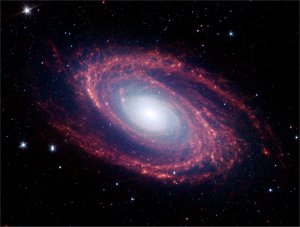
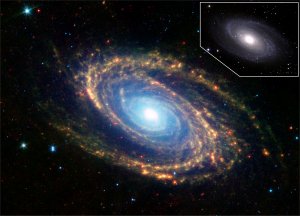
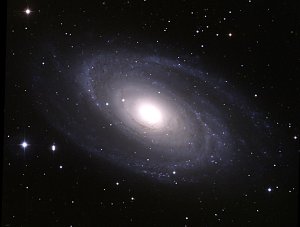
Galaxy M81 (NGC 3031). Top two panels are infrared images taken with Spitzer space telescope; both are composites of several wavelengths. Insert on middle panel as well as bottom panel are ground-based images. Credit: NASA, JPL-Caltech, S. Willner (Harvard-Smithsonian Center for Astrophysics), K. Gordon (University of Arizona), N.A. Sharp (NOAO, AURA, NSF)
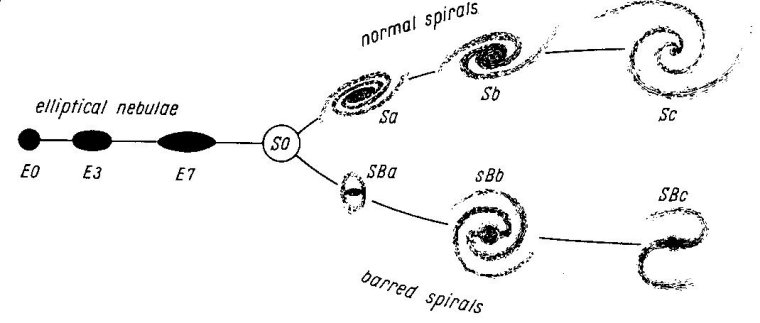
The most widely used shape classification is based on that initially proposed by Hubble, with a number of subsequent modifications (see diagram below). Elliptical galaxies are subclassified based on degree of elongation, ranging from E0 (spherical) to E7 (quite elongated). Spiral galaxies are subdivided into two categories, normal (S) and barred (SB) families, although more recently an intermediate category (SAB) has been added. Within each of these families, galaxies are further subdivided into categories a to c or a to d (d being those which are particularly ragged), in which the a subtype has a large central bulge with tightly wound arms and the c (and d) subtype has a small central bulge with loosely bound and very textured arms. Lenticular galaxies (S0) are lens shaped, and according to the modified Hubble tuning fork diagram are intermediate between the elliptical and two types of spiral galaxies. Irregular galaxies have shapes which do not fall into any of the above categories. Modifications of the original Hubble classification has emphasized the continuity between normal spiral and irregular galaxies. Other additional descriptors exist, for example s is suffixed to the stage and family classification if the spiral arms continuously circle into the nucleus whereas r is suffixed if the spiral structure ends in a ring around the nucleus.
The Hubble classification system has remained popular because it is simple, accomodates the vast majority of bright galaxies, and correlates well with astrophysical properties such as the bulge/disk ratio, gas content, star-forming properties, spectrum, and chemical composition of interstellar mass. Elliptical galaxies are generally small and faint (although some very large ones do exist), have little interstellar dust and gas, and have little to no new star formation. Spiral galaxies are generally luminous, have some or lots of gas and dust in between the stars, and have new star formation in the arms with older stars in the more central regions. The interstellar clouds are the site of new star formation. Compared with older stars, new stars are hotter, accounting for the arms of spiral galaxies generally having a more blue color than the central regions. Most galaxies have considerable amounts of dark matter. A subgroup of galaxies called starburst galaxies have a very high rate of new star formation, which may be galaxy-wide or localized to a small region around the nucleus. Many spiral galaxies are believed to have supermassive objects (most likely black holes) at their centers, of which a subgroup are Seyfert galaxies with their bright centers and considerable amounts of emission with unique spectra. Most Seyfert galaxies are spiral, whereas most radio galaxies are elliptical; however, exceptions do exist.
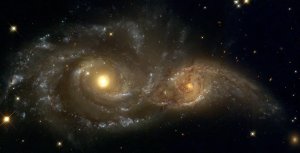
Spiral galaxies NGC 2207 and IC 2163 in a near-collision. Credit: NASA, ESA and the Hubble Heritage Team (STScI)
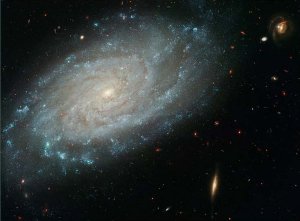
A dusty spiral galazy (NGC 3370). Credit: NASA, Hubble Heritage Team, A. Riess (STScI)
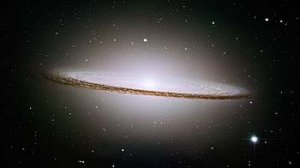
Sombrero galaxy (M104, NGC 4594). Credit: NASA, Hubble Heritage Team (STScI/AURA)
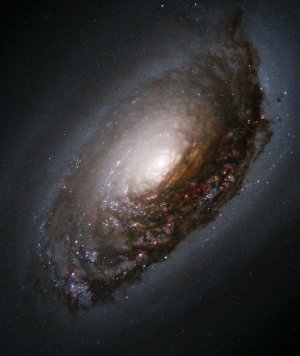
Black eye or evil eye galaxy (M64, NCG 4826). Credit: NASA, Hubble Heritage Team (AURA/
STScI)
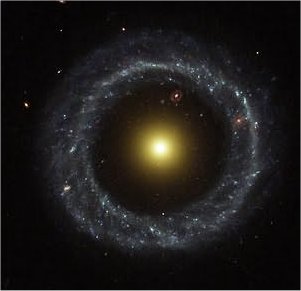
Hoag's Object, with a blue ring dominated by clusters of young, massive stars, which surrounds a yellow nucleus of mainly older stars. Credit: NASA, Hubble Heritage Team (STScI/AURA)
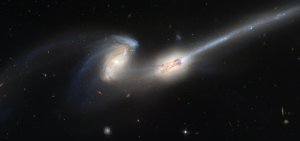
The Mice, two merging galaxies (NGC 4676). Credit: NASA, H. Ford, G Illingworth, M. Clampin, G. Hartig, ACS Science Team, ESA
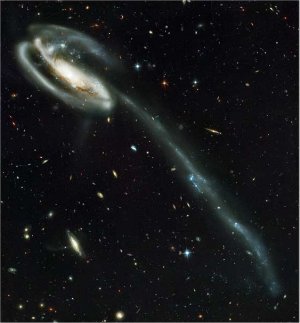
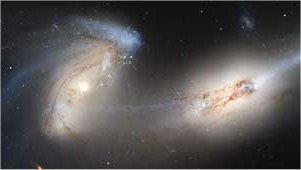
The Tadpole (UGC 10214), a spiral galaxy interacting with a compact blue galaxy. Credit: NASA, H. Ford, G Illingworth, M. Clampin, G.
Hartig, ACS Science Team
Modified "Hubble tuning fork" classification of galaxies. Not included in this diagram are irregular galaxies.