Galaxies demonstrate tremendous diversity, differering in such features as size (eg. dimensions, number of stars, mass), shape (eg, eliptical, spiral, barred spiral, irregular), and character of emissions.
Active galactic nuclei (AGN) may be defined loosely as the central regions of galaxies which show substantial energy release beyond what can be attributed to normal processes from stars, interstellar matter, and their interactions. This includes Seyfert galaxies, radio galaxies, quasars, quasistellar objects, and blazers.
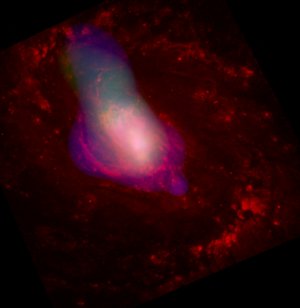
This composite X-ray (blue and green) and optical (red) image of the active galaxy, NGC 1068 (M77), shows gas blowing away in a high-speed wind from the vicinity of a central supermassive black hole. Credit - X-ray: NASA/CXC/MIT/UCSB/P.Ogle et al.; Optical: NASA/STScI/A.Capetti et al.
Probably all types of AGNs are caused by the same physical reason, a central supermassive object (most likely a black hole) which accumulates matter from its surrounding neighborhood. The variety of observed phenomena is believed to be simply a consequence of different viewing angles and different rates of matter supply falling into the objects.
Seyfert galaxies are spiral or irregular galaxies containing an extremely bright nucleus that can sometimes outshine the surrounding galaxy. The light from the central nucleus varies in less than a year, which implies that the emitting region must be less than one light year across. They are named for the astronomer Carl Seyfert, who studied them extensively in the 1940s. Approximately 2% of all spiral galaxies are Seyfert galaxies.
The spectra of Seyfert galaxies are characterized by very bright emission lines of hydrogen, helium, nitrogen, and oxygen. These emission lines exhibit strong Doppler broadening, which implies velocities from 500 to 4000 km/s, and are believed to originate in an accretion disk surrounding the central black hole. Seyfert galaxies also show strong emission in the radio, infrared, ultraviolet, and X-rays parts of the spectrum.
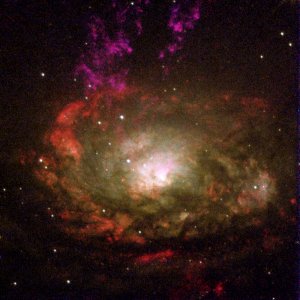
Circinus galaxy, a Seyfert galaxy, in a picture taken by the Hubble telescope.
Credit: NASA, A. Wilson et al.