| Something
To Think About |
|
Christopher
Reeve:
"I want to knock down the barriers to spinal cord injury research that
our government erected last year. I want to tell more Americans that
they can change their lives if they never give up hope. I realize these are
some lofty goals. But if this year has taught us anything, it’s that nothing
is impossible."
|
| Support
This Site |
 |
| Publicity |
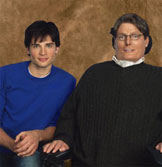
Christopher Reeve made a
return to the Superman legend recently on the WB's hit TV show "Smallville".
He played Dr. Schwann, a brilliant scientist who gives the young Superman
keys to his future. Following the episode, Reeve and Welling sent out
a message to audiences to support CRPF. |
|
|
|
What is Spinal Cord Injury?
Spinal Cord Injury (SCI) is damage to the spinal cord that
results in a loss of function such as mobility or feeling. Frequent
causes of damage are trauma (car accident, gunshot, falls, etc.) or
disease (polio, spina bifida, Friedreich's Ataxia, etc.). The spinal
cord does not have to be severed in order for a loss of functioning
to occur. In fact, in most people with SCI, the spinal cord is
intact, but the damage to it results in loss of functioning. SCI is
very different from back injuries such as ruptured disks, spinal
stenosis or pinched nerves.
A person can "break their back or neck" yet not sustain a
spinal cord injury if only the bones around the spinal cord (the
vertebrae) are damaged, but the 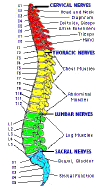 spinal
cord is not affected. In these situations, the individual may not
experience paralysis after the bones are stabilized. spinal
cord is not affected. In these situations, the individual may not
experience paralysis after the bones are stabilized.
What is the spinal cord and the vertebra?
The spinal cord is about 18 inches long and extends from
the base of the brain, down the middle of the back, to about the
waist. The nerves that lie within the spinal cord are upper motor
neurons (UMNs) and their function is to carry the messages back and
forth from the brain to the spinal nerves along the spinal tract.
The spinal nerves that branch out from the spinal cord to the other
parts of the body are called lower motor neurons (LMNs). These
spinal nerves exit and enter at each vertebral level and communicate
with specific areas of the body. The sensory portions of the LMN
carry messages about sensation from the skin and other body parts
and organs to the brain. The motor portions of the LMN send messages
from the brain to the various body parts to initiate actions such as
muscle movement.
The spinal cord is the major bundle of nerves that carry nerve
impulses to and from the brain to the rest of the body. The brain
and the spinal cord constitute the Central Nervous System. Motor and
sensory nerves outside the central nervous system constitute the
Peripheral Nervous System, and another diffuse system of nerves that
control involuntary functions such as blood pressure and temperature
regulation are the Sympathetic and Parasympathetic Nervous Systems.
The spinal cord is surrounded by rings of bone called vertebra.
These bones constitute the spinal column (back bones). In general,
the higher in the spinal column the injury occurs, the more
dysfunction a person will experience. The vertebra are named
according to their location. The eight vertebra in the neck are
called the Cervical Vertebra. The top vertebra is called C-1, the
next is C-2, etc. Cervical SCI's usually cause loss of function in
the arms and legs, resulting in quadriplegia. The twelve vertebra in
the chest are called the Thoracic Vertebra. The first thoracic
vertebra, T-1, is the vertebra where the top rib attaches.
Injuries in the thoracic region usually affect the chest and the
legs and result in paraplegia. The vertebra in the lower back
between the thoracic vertebra, where the ribs attach, and the pelvis
(hip bone), are the Lumbar Vertebra. The sacral vertebra run from
the Pelvis to the end of the spinal column. Injuries to the five
Lumbar vertebra (L-1 thru L-5) and similarly to the five Sacral
Vertebra (S-1 thru S-5) generally result in some loss of functioning
in the hips and legs.
What are the effects of SCI?
The effects of SCI depend on the type of injury and the level of
the injury. SCI can be divided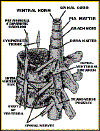 into two types of injury - complete and incomplete. A complete
injury means that there is no function below the level of the
injury; no sensation and no voluntary movement. Both sides of the
body are equally affected. An incomplete injury means that there is
some functioning below the primary level of the injury. A person
with an incomplete injury may be able to move one limb more than
another, may be able to feel parts of the body that cannot be moved,
or may have more functioning on one side of the body than the other.
With the advances in acute treatment of SCI, incomplete injuries are
becoming more common.
into two types of injury - complete and incomplete. A complete
injury means that there is no function below the level of the
injury; no sensation and no voluntary movement. Both sides of the
body are equally affected. An incomplete injury means that there is
some functioning below the primary level of the injury. A person
with an incomplete injury may be able to move one limb more than
another, may be able to feel parts of the body that cannot be moved,
or may have more functioning on one side of the body than the other.
With the advances in acute treatment of SCI, incomplete injuries are
becoming more common.
The level of injury is very helpful in predicting what parts of the
body might be affected by paralysis and loss of function. Remember
that in incomplete injuries there will be some variation in these
prognoses.
Cervical (neck) injuries usually result in quadriplegia. Injuries
above the C-4 level may require a ventilator for the person to
breathe. C-5 injuries often result in shoulder and biceps control,
but no control at the wrist or hand. C-6 injuries generally yield
wrist control, but no hand function. Individuals with C-7 and T-1
injuries can straighten their arms but still may have dexterity
problems with the hand and fingers. Injuries at the thoracic level
and below result in paraplegia, with the hands not affected. At T-1
to T-8 there is most often control of the hands, but poor trunk
control as the result of lack of abdominal muscle control. Lower
T-injuries (T-9 to T-12) allow good truck control and good abdominal
muscle control. Sitting balance is very good. Lumbar and Sacral
injuries yield decreasing control of the hip flexors and legs.
Besides a loss of sensation or motor functioning, individuals with
SCI also experience other changes. For example, they may experience
dysfunction of the bowel and bladder,. Sexual functioning is
frequently with SCI may have their fertility affected, while women's
fertility is generally not affected. Very high injuries (C-1, C-2)
can result in a loss of many involuntary functions including the
ability to breathe, necessitating breathing aids such as mechanical
ventilators or diaphragmatic pacemakers. Other effects of SCI may
include low blood pressure, inability to regulate blood pressure
effectively, reduced control of body temperature, inability to sweat
below the level of injury, and chronic pain
How many people have SCI? Who are they?
Approximately 450,000 people live with SCI in the US. There are
about 10,000 new SCI's every year; the majority of them (82%)
involve males between the ages of 16-30. These injuries result from
motor vehicle accidents (36%), violence (28.9%), or falls
(21.2%).Quadriplegia is slightly more common than paraplegia.
Source = Spinal
Cord Injury [dot] net |
|
|
|