Christopher
Reeve:
"I want to knock down the barriers to spinal cord injury research that
our government erected last year. I want to tell more Americans that
they can change their lives if they never give up hope. I realize these are
some lofty goals. But if this year has taught us anything, it’s that nothing
is impossible."
Support
This Site
Publicity
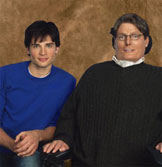
Christopher Reeve made a
return to the Superman legend recently on the WB's hit TV show "Smallville".
He played Dr. Schwann, a brilliant scientist who gives the young Superman
keys to his future. Following the episode, Reeve and Welling sent out
a message to audiences to support CRPF.
Rehab
Choosing a rehab
center is very important. Not all rehab centers have a SCI
program. Do as much research as you can, and ask questions.
A good rehab center does not always
need to adhere to these guidelines. Feel free to print this page out
(click
here for a printer friendly page thanks to Spinal
Cord Injury [dot] net).
the following is an amazing list of information to consider
while searching for a rehab center that'll suit your needs with sci.
It has been provided by the wonderful people at Spinal
Cord Injury [dot] net. For more extended information,
head over to their site.
Some general questions to help you find a rehab that best fits your
specific needs:
Are the beds for
people with SCI in the same area of the facility? Are there
people in the SCI program of the same age and sex as the
person considering admission?
Do the people in
the SCI program have similar levels and kinds of spinal cord
injury e.g., quadriplegia, paraplegia, incomplete and
complete?
What is the
average number of people admitted annually to the SCI program?
(program staff should treat people with SCI on a regular basis
to acquire and maintain expertise.)
Is the SCI
program part of a SCI rehabilitation system operated by the
state?
Are there
treatment specialists in the SCI program who speak the primary
language of the individual seeking treatment?
Will the
treatment team develop a rehabilitation plan with both short
and long term goals?
Will an
experienced case manager be assigned to help family members
obtain medical payments and other benefits from public and
private insurance? Will a team member be assigned to
coordinate treatment and act as a contact for staff and family
members?
Staffing/Rehabilitation
Program Elements
Is the physician
in charge a Physiatrist? If not, what credentials does he/she
have? How long has the physician in charge been directing
programs specializing in SCI? Is there physician coverage
seven days a week? Twenty-four hours a day?
Do the regular
nursing staff and other specialists responsible for providing
treatment in the SCI program have specific training in
treating SCI? Is the nursing staff employed by the hospital or
employed through an outside agency?
Does the program
ensure the availability of rehabilitation nursing and
respiratory care on a twenty-four hour basis?
Are there
consultants available at the facility or nearby medical
centers? These should include neurosurgery, neurology,
urology, orthopedics, plastic surgery, neuropsychology,
internal medicine, gynecology, speech pathology, pulmonary
medicine, general surgery and psychiatry.
How often and
for how long each day will participants get treatment by
specialists such as occupational and physical therapists?
Treatment should be no less then three hours per day.
Are other
specialties such as driver education, rehabilitation
engineering, chaplaincy, and therapeutic recreation available
if needed?
Are activities
planned for SCI program participants on weekends and evenings?
How much time is
spent teaching SCI program participants and their families
about sexuality, bowel and bladder care, skin care and other
essential self-care activities?
Does the SCI
program offer training in the management and hiring of
personal care assistants? If so, how much time is spent by
staff on this topic?
SPECIAL
PROGRAMS
Pediatric
Programs
Because
incidence rates of SCI among children are relatively
low, rehabilitation hospitals and programs usually do
not maintain a separate program or unit exclusively for
children with SCI. As an alternative, caregivers may
consider facilities/programs which placechildren with
SCI in rehabilitation units with other children with
chronic disabilities. Hopefully, this will provide
families and children with opportunities to share common
experiences and information with each other, and may
lead to the development of support networks in the
community.
It
is possible that children may be placed in units with
other children who are too ill for rehabilitation.
Children generally derive greater benefit if they
undergo rehabilitation with other children who are
actively involved in the rehabilitation process.
Are
the beds for children with spinal cord injuries in one
area or in the same location as children with similar
disabilities?
Are
children of the same sex and similar age currently in
the program/facility?
Is
the physician in charge an individual with experience in
rehabilitation? Does this physician have experience with
children? If not, what are his/her qualifications? Do
the other staff members specialize in pediatrics?
How
many children with SCI does the program/facility admit
on an annual basis?
Does
the program/facility offer educational programs for
children and young adults undergoing treatment? If not,
does the facility coordinate tutoring programs with
local schools? If so, who is responsible for payment?
Are
there child life or therapeutic recreation specialists
on staff? (Child life specialists develop programs for
children and families which strive to maintain normal
living patterns and minimize the clinical environment.
Therapeutic recreation specialists focus on teaching
persons with disabilities new leisure and sports skills
to maximize their independence).
Are
young siblings and friends allowed to visit the unit?
Does
the program/facility offer adaptive technology to help
children communicate and learn?
Is
counseling available for siblings and families members?
Is
the equipment used by therapists, appropriate for
children?
Does
the facility/program provide patient education materials
for children and family members?
Ventilator
Programs
Is
the physician who directs the program a board certified
Pulmonologist or a Physiatrist? Does he/she have
experience with SCI? Are ventilator users treated on the
same unit?
How
long has the facility been providing treatment for
ventilator users?
If
the treatment team determines that an individual cannot
breathe independently, what kind of services are offered
to assist them in living as independently as possible?
Are
people in the unit similar in age to the person
considering admission?
Will
they have the opportunity to meet ventilator users who
have returned to the community and maximized their
independence?
Special
Considerations
Psychosocial/Counseling
Services
What
types and how many hours of psychosocial services are
available? These should include peer support, individual
and group psychotherapy, couples, vocational and
substance abuse counseling? Does the facility offer
sexuality and fertility counseling?
Facility
Policies/Family Members
Do
facility policies encourage family members including
siblings regardless of age, to participate in
rehabilitation programs? Are there living arrangements
for family members participating in training? What other
services, parking, meals and etc. are provided? Are
counseling and other social services available to family
members?
Discharge
Planning
Are
SCI program participants given educational self-care
manuals when they are discharged?
Will
staff members develop a formal discharge plan with
program participants and their families?
Does
the facility and discharge planner work with local
Independent Living Centers? Do they incorporate
referrals to these centers into their discharge
planning? Is there an independent living unit available
for program participants and families to practice
self-care skills? Can family members stay there also?
If
the facility does not have an independent living unit do
they encourage overnight therapeutic leave prior to
discharge?
Will
someone be assigned as a liaison to provide follow-up
services? Will a staff member visit or make arrangements
for someone locally to evaluate the home for
modifications?
Will
the follow-up plan include:
Referral
to an appropriate physician and other medical
specialists in the community?
Regular
follow-up visits with this physician or a spinal cord
injury unit physician?
Regular
urological evaluations?
Scheduled
equipment evaluations?
If
appropriate, a thorough vocational evaluation and
referrals to a vocational rehabilitation program?