The original song was presented in a Traladaran chant format, consisting of eight lines of equal cadence, with the fourth and eighth lines rhyming. What follows is a partial translation:
"In ancient times, this land was the forest home of the Traldar, men and women favored by the Immortals and allowed to live amid such beauty.
"The Immortals let the Traldar live happy, simple lives. The Traldar fished and hunted; the men spent most of their time sporting with one another and offering praise to the Immortals.
"But the Immortals knew that the happiness of the Traldar was to end. From the land where the sun is born [the east] a race of evil beast-men prepared to march through the easterly lands in search of booty, prisoners, and more hospitable homelands.
"These beast-men had their own Immortal sponsors equal in might to the early patrons of the Traldar, so only a great battle between man and beast-man would determine the fate of the two races.
"The Immortals descended to Lavv, a Traldar village, to find clever youths and give them secrets they could use to defeat the beast-men.
"They visted Halav Red-Hair, a maker of stone knives, and taught him to forge weapons and armor of bronze. They also taught him the arts of the sword and the strategy of warfare.
"They visited Petra, a maker of pottery, and taught her the art of the bow, the craft of medicine, the use of the potter's wheel, the spinning of flax, and the use of the loom.
"They visited Zirchev, a huntsman, and taught him how to tame and ride and fight from horses, how to train dogs to fight for their masters, how to walk silent as the cat, swim as the fish, see as the hawk.
"Halav, Petra, and Zirchev went to the people of Lavv and told them what the beast-men intended. The king of Lavv laughed and tried to drive the trio away. Halav, using the bronze sword given to him by the Immortals, slew the king and assumed his crown.
"In the years that followed, King Halav, Queen Petra and the Huntsman Zirchev taught their secrets to the people of Lavv and brought all the other villages in Traldar lands under their sway. Villages grew into mighty cities, and Halav was renowned for his fairness and wisdom.
"Eventually, the beast-men attacked in endless waves from the east. The Traldar in their glittering bronze armor stood against them. The irresistible force of the beast-men crashed into the unmovable wall of the Traldar, and the war went on, seemingly, forever. Both sides lost great numbers of warriors; each Traldar fighter slew dozens of bestial enemies before being slain.
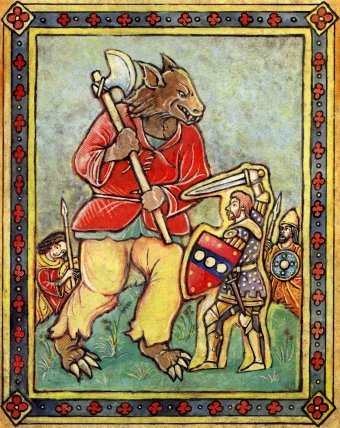
"Finally, King Halav managed to find the King of the Beast-Men alone on a hilltop. The beast-king was twice the height of a man, with the head of a wolf and a hairy body that was foul beyond compare. It brought its great axe against the sword given Halav by the Immortals.
"This was the final battle of man and beast-man. It raged on from dawn until noon, both kings growing so tired that each could barely wield his weapon. Each was resolute and unconquerable, and sure the other would fall.
"Both proved right: King Halav and the King of the Beast-Men perished upon one another's weapons. Their armies looked upon one another, the beast-men now fearful because their king had perished, and the Traldar resolutely raising their weapons and barring the beast-men from advancing.
"The beast-men departed Traldar lands. Queen Petra and Zirchev took up Halav's body and returned home. Great was the lamentation in Lavv when they arrived, but, during the ritual burning of Halav's body that night, the Immortals visited, spiriting Halav, Petra, and Zirchev away."