SATW
SOUTH ASIA TERROR WATCH


DON'T LET TERRORISM WIN ! FIGHT TODAY TO BE SECURE TOMORROW
Home
Pakistan : Heart of World Terrorism
Traitors of India living in USA
To Survive a Non- Muslim should know what is Islam?
Islamic affairs in Bharat
BECOME OUR SOURCE : Contact
Think Globally , Plan Locally !
Next Time it may be your Family Member ! FIGHT TERROR , NOW !
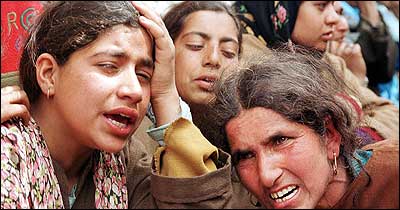
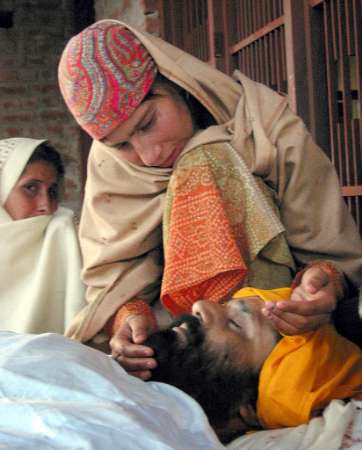
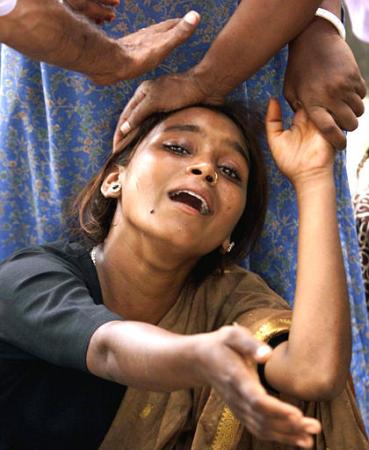
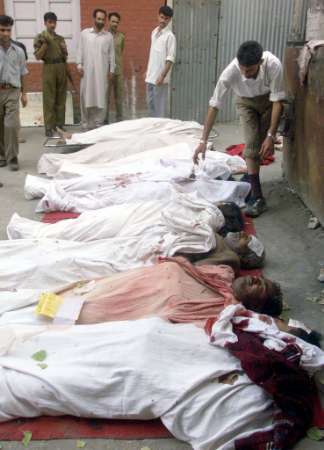
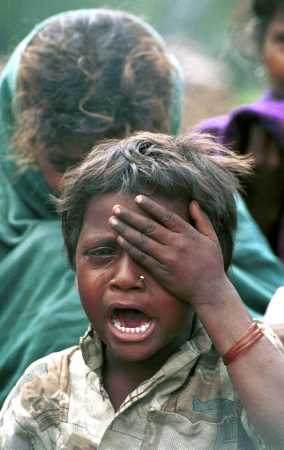
Poornima Lost her Parents ! Now she is Orphan
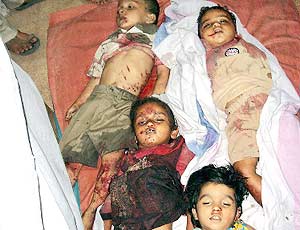
Babies Machine Gunned by Islamic Jihadis... .. Imagine for a second ,if one is your baby !
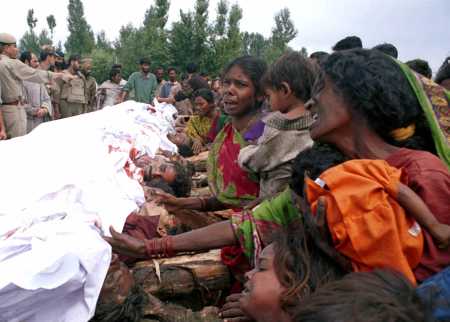
Laborers lost their Husbands
FIGHT TERRORISM NOW !
DON'T LET ISLAMIC JIHADIS WIN !
Communists and RSS -- RED's Vs Safforn's Read more
Learning from History
Francois Gautier
The massacre of six million
Jews by Hitler and the persecution they suffered all over the world in
the last 15 centuries has been meticulously recorded after 1945 and has
been enshrined not only in history books, but also in Holocaust museums,
the most famous of these being the one in Washington DC. It has not been
done with a spirit of vengeance: Look at Israel and Germany today, they
are in the best of terms; yet, facts are facts and contemporary Germany
has come to terms with its terrible actions during Second World War.
Hindus too have suffered a terrible Holocaust, probably without parallel
in human history. Take the Hindu Kush, for instance; probably, one of
the biggest genocides in the history of Hindus. There has practically
been no serious research on the subject or mention in history books. The
Hindu Kush is a mountain system nearly 1,000 miles long and 200 miles
wide, running north-east to south-west and dividing the Amu Darya valley
and the Indus valley. The Hindu Kush has over two dozen summits of more
than 23,000 feet and historically its passes, particularly the Khyber,
have been of great military significance, for they provide access to the
northern plains of India. Most foreign invaders have used the Khyber
Pass: Alexander the Great in 327 BC, Mahmud of Ghazni, in 1001 AD; Timur
Lane in 1398 AD; and, Nadir Shah in 1739 AD.
This is why the Forum Against Continuing Terrorism (FACT), which
sponsored the recent exhibition in Delhi on the plight of the Kashmiri
Pandits - an exhibition which opened also in Bangalore on September 1,
and will be in Poland on September 10, and then in Berlin on the 15th -
would like to start a project aiming at having a Holocaust Museum in New
Delhi. It will record not only the genocide of Hindus at the hands of
Muslim invaders, but also the terrible persecution by the Portugese
(hardly mentioned, too, in Indian History books), or of the British
(nobody knows that 25 millions Indians died in famine between 1815 and
1920, a genocide in the true sense of the term, as the Britsih broke the
agricultural backbone of India for raw materials like Cotton, jute, etc.
FACT needs the support of all Indians for this museum to come into
existence, so that Indian children know their history and what their
forefathers had to endure.
FACT, which stand for Forum Against Continuing Terrorism has three
trustees: Francois Gautier, KG Suresh of PTI and another journalist,
Deepak Bajaj. Its registered office is for the moment at 41 Jorbagh, New
Delhi 110003 and this where the cheques in the
name of FACT can be sent, or else they can be directly credited to the
FACT account: ICICI Bank Limited, New Delhi, Karol Bagh Branch, 2877,
First Floor, Hardhyan Singh Road, Karolbagh, New Delhi 110 005,
a/c N° 629105037071. For those donating abroad, they can
also be donated via an organization which has a charity tax exemption
(ours will take some time to be obtained), such as IDRF USA, or Kashmir
Overseas Organization. FACT is in the process of obtaining tax
exemption.
François Gautier
41 Jorbagh, New Delhi 110003, India / Auromodel, Auroville, 605101, T.N.
India
tel 91 4132622255 / 91 9811118828
website: http://www.francoisgautier.com

François Gautier, born in Paris in 1950, is a French journalist and writer, who was for eight years the political correspondent in India and South Asia for " Le Figaro " and now works for Ouest-France, the largest circulation daily (I million copies) in France and LCI, France's 24 hour TV news channel. François Gautier has written several books: Un autre Regard sur l'Inde" (Editions du Tricorne, Geneva-Paris),which has been reprinted twice since; "Arise O India" (Har Anand) 1999, "A Western journalist on India" (Har-Anand 2001), "India's Self Denial (Editions Auroville Press, 2001) and "Sri Sri Ravi Shankar, a guru of Joy" (India Today Book Club, 2002).He is married to Namrita, an Indian and has lived in India for the past 33 years. Francois, who presently writes the "French Connection" column in the Pioneer and contributes regularly to Rediff.com, shuttles between Delhi and the international city of Auroville near Pondichery.
Kanti Bajpai of JNU
suggests that it is unwise and even gravely dangerous, if not suicidal,
on the part of India to take any direct military or any aggressive
action on Pakistan for its crimes of terrorism. But he does not suggest
any other alternative! Since his interesting arguments demand careful
perusal, I invite comments from our scholars. -- G. ANIL KUMAR
ANALYSIS OF THE ARTICLE AT THE END
BY Dr.Arindam Banerji
An Indian 'War on Terrorism' Against Pakistan?
Dissent, Current Articles - Summer 2003
by Kanti Bajpai
Since the events of September 11, 2001, many in India have argued that
if the United States can justify its wars in Afghanistan and Iraq in the
name of combating terrorism, destroying weapons of mass destruction, and
changing regimes, then India is justified in attacking Pakistan. Indian
external affairs minister Yashwant Sinha is reported to have said,
"India has a much better case to go for preemptive action"
against Pakistan than the United States had in Iraq. The massacre of
more than twenty Hindu men, women, and children in Nadimarg, Kashmir, in
late March 2003, renewed calls for sterner action against Pakistan. And
yet, Indian anger notwithstanding, military action against Pakistan
would be both ineffective and dangerous.
Ever since the Kargil War of 1999, influential Indian strategists have
argued that India should be prepared to fight "limited war under
nuclear conditions," that is, military operations of a limited
conventional nature. This is the only way, they believe, to respond to
Pakistan's strategy of sub-conventional warfare-terrorism, and, as in
1999, incursions across the line of control in Kashmir. Pakistan can
only be dissuaded from continuing its sub-conventional warfare, in this
view, by the threat of military punishment. This new Indian thinking
challenges the Pakistani conviction that its nuclear weapons protect it
from Indian retaliation.
There are probably two reasons for the new Indian thinking on limited
war. The first is the belief that India, with its bigger nuclear forces,
has "escalation dominance" and can up the ante at every level
of violence. To the extent that India has the whip hand, Pakistan's
threat to use nuclear weapons against a punitive Indian strike would be
neutralized. Islamabad would be dissuaded from resorting to nuclear
weapons by the fear of massive retaliation.
The second reason is a calculation that the nuclear powers, especially
the United States, would not allow either country, but Pakistan above
all, to use nuclear weapons. Indian thinking on the subject is not
available in cold print but quite likely rests on the following kinds of
arguments. First, the nuclear powers are determined to preserve the
nuclear taboo and in particular to stop anyone outside the nuclear five
(the United States, United Kingdom, France, Russia, and China) from
using nuclear weapons. Second, a nuclear war between India and Pakistan
could draw in other nuclear-weapon states. Imagine that Pakistan appeals
to China for help after using nuclear weapons against an Indian
conventional attack. Faced with the prospect of Chinese involvement,
India turns to Russia. The United States urges both China and Russia to
stay out of the fight but finds that Beijing and Moscow are unable to
stand on the sidelines. Surely Washington must do everything it can to
avoid such a situation, including stopping Pakistan from starting a
nuclear crisis in the first place. Third, American troops on the ground
in Pakistan since September 11 would be trapped in a nuclear war between
India and Pakistan. Clearly, this would be unacceptable to Washington.
Finally, in regard to Pakistan, the United States and other nuclear
powers do not want a Muslim state using nuclear weapons at a time when
other Muslim countries are in the hunt for weapons of mass destruction.
How persuasive are these Indian suppositions? Does India have escalation
dominance, and will this stop Pakistan from using nuclear weapons
against an Indian conventional strike? First of all, it is unclear that
India can raise the stakes at every level of violence. The most
important consideration here is whether India has superiority at the
nuclear level-this is essential if one is to play the game of escalation
dominance. Given the secrecy of the two nuclear programs, it is hard to
say. Some reports suggest that Pakistan has the nuclear lead in terms of
deliverable weapons (even though India has more fissile material).
Whatever the truth of these reports, Indian nuclear superiority is not
an established fact. Furthermore, even if India has nuclear superiority,
the logic of escalation dominance may be invalid-Pakistan may not be
deterred from raising the level of violence. Everything depends on how
Pakistan perceives Indian military goals once the fighting begins. If it
concludes that Indian objectives go beyond mere punishment, it might
well feel that it has to use nuclear weapons, that it is better to go
down fighting than to surrender or be conquered.
Nor can we count on the nuclear powers' restraining Pakistan. Faced with
the possibility of nuclear war in South Asia, they might choose to wash
their hands of both India and Pakistan and bend their energies to avoid
being dragged into the conflict. Even if this is not the case and they
do exert themselves on Pakistan, they may not have much influence in a
fast-deteriorating military situation. A country, and a government, that
thinks it is on the verge of dismemberment and defeat is not likely to
be swayed by threats from the international community. After all, the
ultimate threat from the nuclear powers would be to do to Pakistan what
India was in the process of doing anyway, namely, punishing it
militarily. One could argue that international pressure at such a
crucial moment would only deepen Pakistan's sense of desperation and
push it further toward the suicidal brink.
Leaving aside the contentious matter of escalation dominance and the
role of the nuclear powers, there is the crucial question of whether or
not any kind of limited war could be effective in reducing the terrorist
threat and Pakistan's support of it. A set of thought experiments will
show that none of India's military options is very good. There are,
roughly, seven options: fomenting terrorism in Pakistan; hot pursuit of
terrorists; special- forces attacks against terrorist camps; air and
artillery strikes against terrorist facilities; conquering and holding a
slice of Pakistani territory; a naval blockade or bombardment of
Pakistani ports; and a serious military push into Pakistani territory.
This list is not exhaustive. The Indian air force, as also the Indian
navy, could, in addition, mount strikes against other Pakistani
targets-dams, cities, and military targets. However, these are even more
dangerous and immoral ventures, and most of my critique of the lesser
options will apply even more acutely to them.
Let's look at each of the options. First, some strategists argue that
India should do to Pakistan what Pakistan has been doing to it for the
past fifteen years: it should encourage internal dissent and violence.
This sounds like an attractive option at a purely military-strategic
level, but the problem with it is twofold. For one thing, going by past
experience, Pakistan is not likely to be stopped from interfering in its
neighbors' affairs by its own internal instabilities. Ethno-religious
violence in Pakistan has been ferocious since at least the 1980s, and no
province and city has been left unscathed. But this did not stop
Islamabad from mounting anti-Indian rebellions in both Punjab and
Kashmir in the 1980s and 1990s. Nor did it stop Pakistan from
prosecuting a civil war in Afghanistan and from ousting the Soviet
forces. Is there any reason to believe that Pakistani leaders today are
more sensitive to internal violence than they were in the past?
Ironically, the recent American intervention in Afghanistan has freed
Pakistani resources for other theaters, including Kashmir, even as
Islamabad deals with domestic disturbances.
Second, and more important, in contemplating the destabilization of
Pakistan, India must consider whether such actions are compatible with
its public and long-standing complaint that Pakistan is a terrorist
state. Indian complaints will carry little moral weight if India itself
supports terrorism. Destabilizing Pakistan is not just a moral issue; it
is also an issue of statecraft. In the global war against terrorism,
India would be part of the problem rather than part of the solution. It
could become the object of international sanctions, whereas it has
profited-and could profit further-if those sanctions were directed
against Pakistan. In short, India would join Pakistan as a terrorist
state. This would be a moral and strategic catastrophe for liberal
democratic India.
What about the various military actions to which India could resort?
These include hot pursuit, special-forces raids, and air and artillery
strikes. All these would be directed primarily at destroying terrorist
facilities in the Pakistani side of Kashmir, thereby reducing the
incidence of terrorism. These options at least have the advantage of
being morally justifiable because they will not target innocent
civilians. Their military effectiveness, however, is questionable. Hot
pursuit strikes would involve Indian troops' crossing the line of
control in chase of terrorists. But these attacks probably would not
achieve a great deal. Indian troops would probably kill some terrorists
and temporarily destroy training and base facilities. The supply of
terrorists is large enough, however, and Pakistan could rebuild and
relocate the affected facilities fast enough, so that India would have
to repeat the attacks, perhaps deeper into Pakistani-held territory,
thus making its forces more vulnerable to counter attacks. Indian units
that cross the line would also run into Pakistani fire, and casualties
might be heavy. India would then be faced with the choice of calling off
the pursuit or escalating the engagement.
Most of these limits apply as well to raids by special forces, which
also have their own difficulties. They depend, critically, on surprise,
stealth, and speed. Indian special forces could attain all three, but we
should be cautious. In the history of warfare, the number of special
operations that have gone wrong may well outnumber the ones that have
succeeded. The capture and destruction of Indian units caught on the
Pakistani side would be a public relations disaster if not a serious
military reverse. Moreover, and this is crucial in terms of
effectiveness, one or two successes will do little to reduce the tempo
of terrorism.
Air and artillery fire against the terrorist camps or even against
Pakistani military units is another plausible option. The Indian air
force and army could launch a series of strikes against terrorist camps
and Pakistani military targets. The success of remote fire of this kind,
either from the air or from ground artillery, depends on intelligence
and accuracy of targeting. If Indian fire is inaccurate, it risks
hitting innocent civilians, which would be both morally corrosive and
diplomatically counterproductive. Satellite imagery, air reconnaissance,
specialized radar, modern locating systems, and precision-guided
munitions are just some of the requisites for a bombardment campaign
against terrorist facilities and Pakistani military targets. It is
unlikely that Indian forces have the requisite capabilities. In any
case, the Pakistanis can camouflage, harden, and move these facilities
and targets, thereby rendering the Indian campaign ineffective.
Finally, India could opt for a much more ambitious set of punitive
actions against Pakistan: conquering and holding a slice of Pakistani
territory, a naval blockade or action, and a serious military push into
Pakistani Punjab and Sindh. Each of these, too, is fraught with risks.
Grabbing and then holding a swath of territory on the Pakistani side of
Kashmir or in Pakistan proper is by no means easy. In Kashmir,
difficulties of terrain would make it a tough operation to mount and
sustain. In Pakistan proper, the prospects are even more daunting, as
the Pakistani forces are much stronger there, with considerable armor to
back them. India too is strong, but the question is whether or not a
potentially expensive operation would serve much purpose. The idea
behind it would be, once again, to punish Pakistan for its support of
terrorism and to offer it a trade-return of territory for the end of
terrorism. What if Islamabad simply shrugs off the loss of territory
even as it battles to get it back and continues the terrorism campaign?
As we noted earlier, Pakistan is not afraid to fight on several fronts
simultaneously. India would then have to decide whether to extend this
kind of salami-slicing to other sectors or to expand the scale of
operations.
One way of expanding the conflict is by a naval blockade or other naval
actions along the Pakistani coast. India signaled the possibility of
naval operations when it sent a flotilla of ships into the Arabian Sea
in the summer of 2002. A naval campaign could involve a blockade of
Karachi harbor, crippling Pakistan's trade, destruction of Pakistani
military and merchant shipping, and destruction of the Gwadar naval
base, which the Pakistanis are currently expanding (with Chinese help).
But a naval blockade raises a number of difficulties. For one thing, it
could cause great suffering among Pakistani civilians. And it would
antagonize many of Pakistan's trading partners, including the major
economic and military powers important to India. A large Indian naval
presence over a long period of time would get in the way of the American
fleet that is positioned in the area as part of the campaign in
Afghanistan. This would lead not only to diplomatic friction with the
United States, but would also risk the two navies' physically blundering
into one another. Finally, a flotilla would be vulnerable to Pakistani
air and naval retaliation, in particular by its submarines and the
deadly Exocet and Harpoon missiles with which its ships are equipped. An
attack against Gwadar is much more attractive, but how would that work
to stop Pakistan's terror campaign?
Instead of a naval campaign, India could do what it does best
militarily-or at least what it is most predisposed to do-which is to go
to war on land, in the plains of Punjab and Sindh. If anything would
truly hurt Pakistan, it is the loss of territory in its heartland. The
Indian army combined with the air force could invade Punjab or Sindh or
both in the kind of "final conflict" that the Indian prime
minister frighteningly referred to in one of his speeches during the
crisis of 2002.
This is a military fantasy at best and a nightmare at worst. An invading
Indian force would have to get past densely mined Pakistani forward
positions. Next, there would be canals and ditches, and, most likely,
more mines. Beyond these passive defenses, the Indian army would run
into Pakistan's active defenses-its armor and regular infantry units.
Contrary to what most Indians and even more foreigners imagine, India
does not have a substantial lead in conventional forces on its western
border. Indian forces are deployed along the northern border with China
and cannot be reduced much further in that sector. Many Indian troops
are deployed for internal security duties, particularly in Kashmir and
the Northeast, and it would be stretching them dangerously to draw their
numbers down significantly. The tide might turn in India's favor if the
air force achieved a rapid and decisive victory in the skies. Few
people, however, would predict that this could be achieved. In short,
the Indian attack would be a very hard slog, and the war might just turn
into a stalemate marked by mutual attrition. And that's the good news.
The bad news is that if India succeeded in making a breakthrough,
Pakistan might unleash its nuclear weapons at Indian troop formations or
Indian cities in order to halt Pakistan's military collapse.
The general point that emerges from these thought experiments is that
much may be ventured, at great risk, for very small gains. The costs of
war would probably be much greater than the costs of the uneasy, flawed,
and violent peace that exists today. Some military ventures will gain
India little in terms of stopping terrorism even if they succeed. Others
could gain it a lot but have little chance of success. Yet others spell
catastrophe.
In short, there are great dangers in applying the doctrines associated
with the U.S. war on terrorism-retaliation and preemption-in South Asia.
While there is no doubt that Pakistan does sponsor terrorism in India,
the simple truth is that Pakistan is not as weak as Afghanistan or Iraq,
and India is not as strong as the United States. Going after Pakistan
militarily will either be ineffective or extremely dangerous. Whatever
the United States can or can't, should or shouldn't, do, India's
response to terrorism has to be different, and it is mere casuistry to
claim that New Delhi should emulate Washington's methods.
Kanti Bajpai is professor of international politics at Jawaharlal Nehru
University, New Delhi.
ANALYSIS
By Dr.Arindam Banerji
Kanti Bajpai's issues can be handled at many levels, but I'll start
at the biggest flaw in his thinking:
1. What is the cost of NOT taking any military or retaliatory
action?
Ajay Sahni's recent article lists out the latest incidents in the war
against India http://www.satp.org/satporgtp/sair/index.htm - it is a
good compendium. The fact of the matter is, that an emboldened Pakistan
has now extended its war to our major cities at a pace never seen
before. Terrorist acts are now common in Mumbai; terrorist encounters
common in UP, Delhi and HP. GOI has already warned us that Hyderabad and
Bangalore are next. Where will this stop? The Indian populace has seen
this in the last 10 years go unanswered - the result is a deep divide in
Indian society and a slowly hardening of opinions against Pakistan. The
fact of the matter is that hundreds of millions of Indians are unsafe in
many areas of their own country, thanks to Pakistan.
We've taught Pakistan and now Bangladesh that if you terrorise India and
kill Indians - its OK. In fact, it might actually be a good business
move. We're now talking of opening up our huge market to Pakistan, in
spite of the fact that our major cities are targetted everyday.
Bangladesh just made huge demands on us for special trade benefits and
we're considering them. Neither country however has even admitted to
support for terrorism, let alone take any real action. Both countries
openly support and finance territorial balkanization of India.
The consequences are larger than what has happened in Indian society and
in our neighbourhood. As globalization widens, and competition for big
international deals get rougher - what will we do? Will india back-off
or will neighbouring countries always have a trick up their sleeve to
force India and Indians to give up their negotiation positions.
The cost of inaction - the cost of not retaliating are ultimately higher
than the risks associated with Indian actions.
2. Flawed reasoning:
The comparison with America as in
"the simple truth is that Pakistan is not as weak as Afghanistan or
Iraq, and India is not as strong as the United States"
is a spurious Pakistani argument that Bajpai happily repeats. The fact
of the matter is that the US has always struck back against its
aggressors. In the revolutionary war, the earliest flag of the American
revolutionaries was a coiled rattle snake ready to strike with the logo
"don't tread on us". This has been and still remains US
philosophy (till the recent pre-emptive doctrine). If Bajpai would check
back on how the US non-navy (they barely had one then) handled the
Barbary pirates and took on a two-front war against Japan+ Germany when
they were the 12th ranked military in the world. So, our inaction is
much more about our national attitude, than anything to do with relative
strength.
The other statement on morality
"India must consider whether such actions are compatible with its
public and long-standing complaint that Pakistan is a terrorist state.
Indian complaints will carry little moral weight if India itself
supports terrorism. Destabilizing Pakistan is not just a moral issue; it
is also an issue of statecraft. In the global war against terrorism,
India would be part of the problem rather than part of the solution. It
could become the object of international sanctions, whereas it has
profited-and could profit further-if those sanctions were directed
against Pakistan. In short, India would join Pakistan as a terrorist
state. This would be a moral and strategic catastrophe for liberal
democratic India".
Again, the author misses the point completely - covert action is
considered a legitimate response and connecting destabilizing to
morality and sanctions is puerile. I think India is too large a country
to start viewing international policy from the childish glasses of
individual morality - most of the world has moved on and maybe the
marxist authors should too. Destabilizing rogue nations with deniability
is just a test of our readiness to win the international public-opinion
game and also our ability to use our growing economic strength to our
advantage. We know that it works on Pakistan as none other than B. Raman
indicates that we've used this successfully to end the Khalistani
terrorism spawned by Pakistan. Oh ! yes - Pakistan had nuclear weaponms
then too and were threatening to use them against us. Once again, covert
operations and destabilizing operations are not terrorism and should not
be viewed as such.
3. Joins the "Do not harm the interests of Pakistan at any cost" crowd
First there was the "lets give up our territory to buy peace"
editorial from TOI, then came Sujata Anandan's now infamous "Mumbai
blasts are all the fault of the damned yindoos from gujarat" report
and finally the shrill attack on India's only consistent friend in the
daily war against Pakistani terror by Mani "India bad, Pakistan
very good" Aiyer. Now, bajpai happily joins this list by proposing
that whatever Pakistan does, India must not retaliate in any form; much
better to have little children killed by Pakistani thugs, our economic
centers attacked and large parts of our country made inaccessible. Other
marxists have begun to see the size of the problem and so should Bajpai
- as KP Nayar says in Telegraph:
"The likes of Laloo who make common cause with Pakistanis have
either not noticed or deliberately chosen to ignore some significant
developments in Calcutta and Thiruvananthapuram. Buddhadeb Bhattacharjee
handled the home portfoilo for four years before becoming West Bengal's
chief minister in November 2000. Bhattacharjee and Kerala's A.K. Antony
are now staunch proponents of steps aimed at defending India against the
threat of low intensity destabilization from abroad.
So much so that the commitment of these two men to the security and
territorial integrity of India sometimes comes into conflict with the
narrow, short-sighted vote bank politics of their respective parties.
Why, even the late Indrajit Gupta was a changed man after serving,
albeit briefly, as Union home minister, during which time he was exposed
to the true nature of India under siege".
(4) Real Solutions
Finally, the obvious flaw in Bajpai's infomercial, he does not suggest any solutions. The solutions lie somewhere in a mix of approaches:
-
Covert actions against key promoters of terror within Pakistan - the army officials and radicals who propose killing Indian children should not feel comfortable/safe making such decisions.
-
Support independence of Sindh and Balochistan, use the Shia-Sunni divide - the weakness of Pakistan's institutions make it much more amenable to such interference.
-
Economic arm-twisting: Much like we're begining to use with the French and Ukraine - we need to start using our economic power to reduce the avenues available to Pakistan for getting hi-tech weapons
-
Energy market access as a weapon: Use the fact that Pakistan cannot be trusted as a land route for oil pipelines with the super-powerful oil companies. Bribe them, if we have to.
-
Increasing the cost for Pakistan - Whatever it takes - through jamming (they have to buy more expensive equipment), cross-border firing (shells cost $500) and other methods, which will change from time-to-time.
-
Violate the IWT - silently if necessary.
-
Increase troubles for Pakistan on its borders - Afghans are happy to fight for money and Shias in Iran are unhappy with Sunni terrorism in Pakistan - use both.
-
In the end our biggest weapon is our economy - freeze any solutions to the problem for a few years - the size of our economy will ensure a solution on our terms. Rarely does anybody mess with countries that have trillion dollar economies. Just remember that.