SATW
SOUTH ASIA TERROR WATCH

DON'T LET TERRORISM WIN ! FIGHT TODAY TO BE SECURE TOMORROW
Home
Pakistan : Heart of World Terrorism
Traitors of India living in USA
To Survive a Non- Muslim should know what is Islam?
Islamic affairs in Bharat
BECOME OUR SOURCE : Contact
Think Globally , Plan Locally !
Next Time it may be your Family Member ! FIGHT TERROR , NOW !
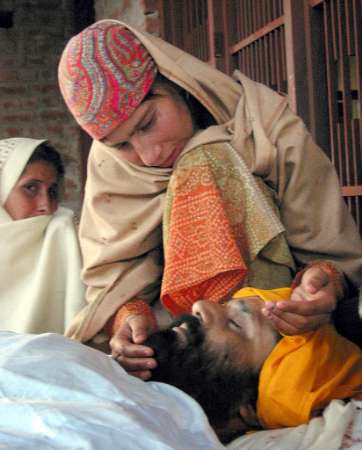
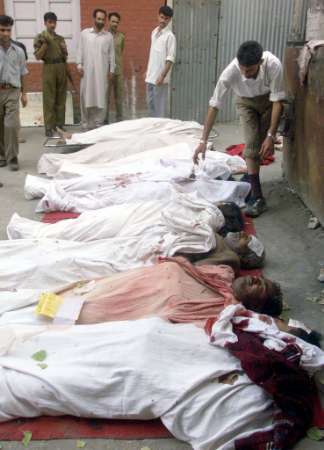
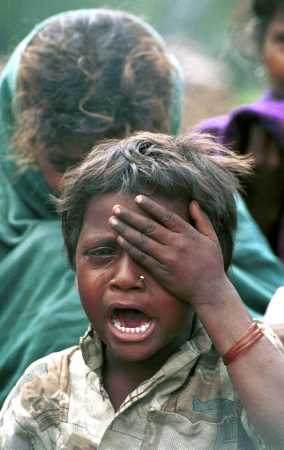
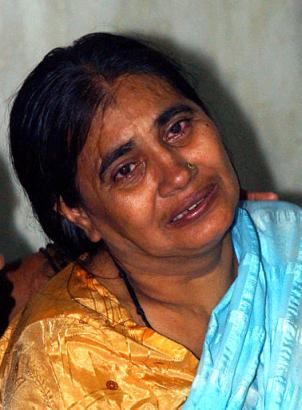
Poornima Lost her Parents ! Now she is Orphan
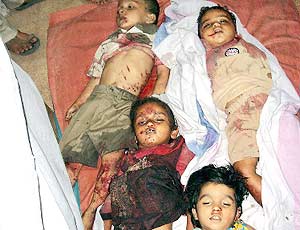
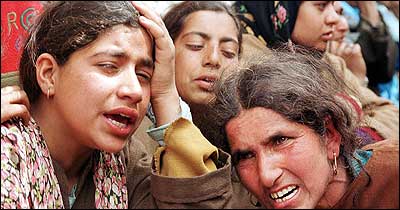
Babies Machine Gunned by Islamic Jihadis... .. Imagine for a second ,if one is your baby !
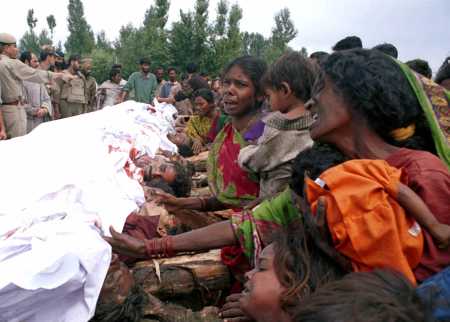
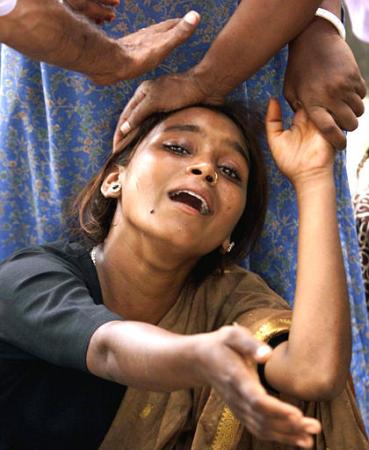
Laborers lost their Husbands
FIGHT TERRORISM NOW !
DON'T LET ISLAMIC JIHADIS WIN !
Author: Balbir K Punj
Publication: The Pioneer
Date: September 26, 2003
The Rashtriya Swayamsevak Sangh (established in 1925) enters its 79th
year this Vijaya Dashami not only as a highly expanded cultural and
nationalistic movement, but as the sole movement to survive without any
ideological split. This is particularly remarkable when compared to the
Congress, socialist and communist movements which have been broken into
several fragments due to competitive personality cults and rival
interpretations of political dogma. What makes the RSS different is the
presence of 'trust' when others lack it. From the very beginning, it
recognised no individual as its guru but the 'Bhagwa-Dhwaj' or the
triangular saffron flag which symbolises the timeless principle of
selflessness and animates India's glorious history, culture and
tradition.
No doubt Hinduism provided a strong spiritual anchorage to India,
originally spread out from Karakoram to Kanya Kumari and Sindh to
Manipur. But Hinduism is the world's most decentralised religion. That
also explains its inability to unite as one body against successive
military and cultural invasions in India. Though India survived despite
seven centuries of Islamic rule unlike the Arabic peninsula, North
Africa or Central Asia, its borders have been shrinking. Not too long
back, cultural India included present day Bangladesh, Pakistan and
Afghanistan. While Hindus valued individual salvation, they neglected
the collective aspect of life, and suffered its consequences. Thus,
India's borders have contracted over the centuries directly in
proportion to reduction in Hindu influence.
In tune with this, Dr KB Hedgewar observed in 1930,"If Hindu culture
perishes in Hindustan itself, and if Hindu society ceases to exist, it
will hardly be appropriate to refer to the mere geographical entity that
remains as Hindustan. More geographical lumps do not make a nation. The
Sangh will cooperate with the Congress in the efforts to secure freedom,
so long as these efforts do not come in the way of preserving our
national culture."
Historically, the RSS was not the first attempt to societally organise
Hindus. Two competing attempts were initiated in ancient India in form
of the Buddhist and Jain orders. The very word Sangh has its genesis in
the Buddhist cloister of monks- "Sangham Sarnaman Gacchyami" (I resort
to the Sangh).
Two millennia later came another upsurge, to which Hindu society would
be indebted eternally: The establishment of the egalitarian Khalsa Panth
by Guru Govind Singh on Baishaki day, 1699, in Anandpursaheb. Hindus,
cutting across caste lines, thronged to the Guru's fold which emerged as
the sword arm of Hinduism. His inspirational mantra was, "Sura so
pahichaniye jo laraiy deen ke het, purja kat mare kabhu na chode khet"
(Recognise him a valiant who fights in defence of his faith/Leaves not
the warfield through bodily hacked to death).
That the RSS and Marxists of various hues are at the extreme ends of the
Indian political spectrum is but natural. Though the name Rashtriya
Swayamsevak Sangh came several months afterwards, Dr Hedgewar
established the RSS in 1925 in Nagpur on Vijay Dashami, which signifies
the triumph of good over evil. In contrast, the Indian chapter of the
Communist Interna-tional (controlled from Moscow) locally named the
'Communist Party of India' (a name preferred over Indian Communist
Party) was born on Christmas (also Mao's birthday) in 1926. The Congress
held its annual sessions during Christmas vacations, a time convenient
to their then white masters!
Why are the communists the most virulent opponents of the RSS? The Sangh
is steeped in the Indian ethos of universal brotherhood, shares India's
concerns and believes in working out Indian solutions for Indian
problems by Indians. But being Indian comes secondary to communists, who
profess to be internationalists first. When the RSS was pleading for
"Akhand Bharat" during British rule, the communists were rallying behind
the Muslim League in its demand for the country's vivisection and
creation of Pakistan. Their views on India's participation in World War
II altered depending on which side Russia flipped, leading to the
sabotaging of the Quit India movement.
The RSS believes in civil society whereas communism's record is the
worst totalitarian tyranny. The RSS stands for democracy and hence it
fought against Emergency. In contrast, the CPI, a part of the
Indira-Government, supported Emergency whereas no politburo member of
the CPI(M) was arrested. Communist belief in democracy is strategic-it
is only a means to capture power, politicalise the entire state
machinery as in West Bengal and sabotage the system from within.
Pro-Communist Jawaharlal Nehru realised at the time of the 1962 Chinese
aggression who the real patriots were. Some communists proclaimed that
Chinese forces were here to 'liberate' India from capitalist domination.
Leftist unions either struck work or hampered supply of provision to war
theatres. But swayamsevaks swung into action, mobilising support to war
efforts. The Bharatiya Mazdoor Sangh, an RSS-inspired national
federation of unions, withdrew agitations and assigned top priority to
stepping up defence production and assisting defence efforts.
Nehru (alas, it was the twilight of his life) realised that, when shady
Muscovites would leave him, only the RSS would stand unflinchingly by
the country. He was so impressed that he invited a Sangh contingent to
participate in the Republic Day parade on January 26, 1963. Also, during
the 1965 Indo-Pakistani war, lasting 22 days, the then Prime Minister
Lal Bahadur Shastri transferred police duties in Delhi like traffic
control to free the police for more pressing tasks. The army came to see
the RSS as its most trusted friend.
The RSS's detractors, particularly the communists (who had shamelessly
worked as British spies during the 1942 Quit India Movement) have tried
to project it as neutral, if not pro-British, during the independence
struggle. This proposition is erroneous, since its founder, Dr Hedgewar,
participated in the freedom struggle first as a revolutionary and then a
disciplined Gandhian. He led the Non- Cooperation Movement in the
Central Province, which earned him a year of rigorous imprisonment
between 1921 and 1922.
However, he positively differed with Mahatma Gandhi over the
Hindu-Muslim question, which also laid the fundamental premise of the
RSS. Dr Hedgewar once explicitly told Gandhiji that, long before the
Khilafat-Swaraj era slogan of Hindu- Muslim unity came into vogue, many
leading Muslims had identified themselves with this nation and worked
shoulder to shoulder with Hindus under leadership of Lokmanya Tilak-MA
Jinnah, Dr Ansari and Hakim Ajmal Khan. He had prophesised that the
Gandhian approach of Hindu-Muslim unity would aggravate the feeling of
separatism amongst Muslims.
The RSS and its affiliates work in multiple fields-education, medical
aid, tribal development, forest conservation, cow protection, calamity
rescue and relief, trade unions, university-level students unions. It
acts as a social bulwark against Marxist violence masquerading as
'secularism', fraudulent religious conversions and combats anti-national
forces. Vidya Bharati, an RSS subsidiary, runs about 11,000 pre-primary
and primary schools and intermediate colleges and 40 degree and
post-graduate colleges involving 74,000 teachers. Vanavasi Kalyan Ashram
runs 107 students hostels, 399 free medical aid centres, 1,197 schools
of various grade, 30 centres of vocational training dispensed through
5,796 centres touching 171 of the country's 276 forest districts.
The RSS rendered prompt and effective service during calamities like the
Latur and Bhuj earthquakes, cyclones in Andhra Pradesh and Orissa, fire
tragedies at HPCL Vishakapattanam and Dabwali. Swayamsevaks were the
first to render rescue and relief operations during the mid-air
collision of a Saudi-Arabian and Kazak aircraft at Charkhi-Dadri
(Haryana), where most of the victims were Muslims.
The sapling planted in Nagpur in 1925 has grown into a giant banyan tree
today, with its branches providing shade in all parts of the country.