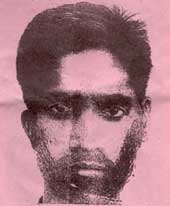
Jaish denies; Gazi dies in encounter
Srinagar, Aug. 30: Chief planner of Jaish-e-Mohammed Gazi Baba, who
masterminded the December 13, 2001, attack on Parliament and nearly triggered an
India-Pakistan war, was killed after a fierce encounter with the Border Security
Force in Srinagar on Saturday morning, a senior BSF official said.
Three other
terrorists, all from the JeM, were also gunned down in the operation in Noorbagh
area of the city.
But the Jaish-e-Mohammed
disputed the claim and insisted that its chief commander in Kashmir is unharmed.
It admitted that its three members — all Pakistanis — were killed in a
fierce firefight with BSF personnel in Srinagar’s congested Dana Mazaar
locality on Saturday.
The Jaish has
identified the three slain militants as area commander Saif-ul Islam, Abu Zaid
and Abu Kasha.
The encounter also
left paramilitary force jawan Balbir Singh dead and eight other people,
including three BSF officers, wounded.
The BSF said Gazi
Baba was killed in the clash and that his corpse was identified by a Srinagar
resident.
It said four other
terrorists of the Pakistan-based outfit were killed in the encounter, which went
on for more than 10 hours.
The police and residents said the BSF raided a house in central Srinagar at about 4.30 am after receiving information that the Jaish militants were hiding there.
As they approached
the house, the militants targeted the Border Security Force men with automatic
rifles and grenades. Border Security Force trooper Balbir Singh, died instantly.
In the ensuing firefight, deputy commandant N N Dubey, assistant commandant
Vinod Chandra and three other troopers were injured.
Around noon, the
Border Security Force blasted the house in a bid to end the encounter.
The owner of the
house, Mohammed Shafi Dar, was also injured in the firing.
The other inmates
of the house, two women and four children, were rescued from the premises.
Jaish spokesperson
Abu Muslim told the local news agency CNS over the phone that there were seven
militants present in the house when the BSF raided it.
He claimed that in
their attack, a BSF officer was killed whereas all but three militants returned
and relocated to another hideout. However, one of the militants, Abu Huraira,
has been injured, the spokesperson said.
He strongly denied
Gazi Baba has been killed. “What the BSF is saying is a bundle of lies. Even
if the entire Indian Army is brought out, it will not be able to capture him,”
he claimed.
The BSF officials who addressed a press conference here in the evening were quite sure that Gazi Baba had been “neutralised.” One of them said, “He is dead.”
|
Unlucky 39 helps BSF blow
Baba’s cover
|
||
| DALIP SINGH | ||
New Delhi, Aug. 30: Perhaps his latest code names 39 and Amir brought bad luck to Gazi Baba and good news to the security forces. When the Border Security Force (BSF) G directorate (intelligence wing) got information that some militants were holed up in Noorbagh, they were not aware that Gazi Baba — the prime conspirator in the December 2001 Parliament attack — was among them. But the code names helped the BSF stumble onto their prize catch when they surrounded the militants at a house in Noorbagh. BSF sources said after cornering the militants the force intercepted wireless messages in the code name of “39”, confirming that Gazi Baba was trapped inside. Gazi Baba, alias Abu Jihadi alias Saqlain, had been giving cops the slip after masterminding some of the most deadly attacks, among them the strikes on Parliament and the Jammu and Kashmir Assembly. But today was not his day. Delhi police special cell officials handling the Parliament attack case say Gazi Baba was a hardcore militant, a strategist and a motivator. His influence on militants in the Valley can be gauged from what Mohammed Afzal, one of three militants facing the death penalty for the December 13, 2001 attack, had to say. “Cadre would compete between themselves to die first when Gazi Baba invited them for jihad,” Afzal said. Another distinctive feature of Gazi Baba’s style of functioning was that he never trusted anyone and would give instructions to hitmen for an operation strictly on a one-on-one basis, Afzal said. Gazi Baba was also said to be always on the move, flitting from one operation to another. He hatched the conspiracy to strike Parliament by himself, at the behest of Pakistan’s Inter-Services Intelligence. Joint commissioner of police (special cell) Neraj Kumar said Gazi Baba was the architect of the attack, with Tariq Ahmed and Afzal next in the hierarchy, executing his instructions. Afzal’s interrogation provides a detailed account of Gazi Baba’s role in the Parliament attack. Sometime in April 2001, Tariq, who is yet to be traced, approached Afzal, who had renounced militancy. Tariq managed to convince Afzal to take up the cause of insurgency once again. Tariq took him to a mobile terrorist camp in south Kashmir’s Pehalgam jungle. It was there that Afzal met Gazi Baba, surrounded by 12 armed bodyguards, for the first time. Afzal said the camp was spread along a 1-km radius, adding that there were three such camps in Pehalgam jungle at the time. Gazi Baba handed Afzal an audio cassette and literature on Jaish-e-Mohammad, headed by Masood Azhar, one of the three militants released after the IC-814 hijacking in 1999. During interrogation, Afzal said even after the first meeting Gazi Baba would not reveal his plans; nor did he immediately recruit him into his tanzeem (outfit). Instead, Gazi Baba asked him to meet up after five weeks, during which time Jaish’s India commander was asked to verify his antecedents. Another group led by Mohammed, who later led the fidayeen squad inside the Parliament complex, was sent to Delhi to set up base towards the end of September 2001. Mohammed was shot dead during the gunfight in the Parliament complex. Gazi Baba’s name cropped up in police files again when Afzal went to Kashmir in October that year to hand over Rs 5 lakh. This was part of the Rs 20 lakh hawala money which was wired from Dubai to Tariq and meant for Gazi Baba, for financing the attack. Tariq and Afzal met in a Batmalu mosque in Srinagar’s Lal Chowk, where details on a possible strike in Delhi and the Rs 5 lakh were exchanged. Afzal says even in October he was not aware of Gazi Baba’s plan to attack Parliament. It was only towards the end of November, when a meeting with Gazi Baba was held in Srinagar, that it was revealed that the Parliament was going to be attacked. Delhi police’s special cell sources said Gazi Baba provided two fidayeen — Rana and Hamza — explosives, AK-47s, grenades and grenade-launchers for the attack. After the attack, the special cell managed to arrest Afzal, Shaukat Hussain, his wife Navjot Sandhu alias Afsan Guru, and a Delhi University lecturer, Syed Abdul Rehman Geelani. But Gazi Baba proved elusive despite several raids in the Valley. Delhi police officials are relieved at the news of Gazi Baba’s killing. But a senior police officer remarked: “Had he been caught alive, we would have come to know who in Pakistan had hatched the conspiracy and the precise role of the ISI.” |
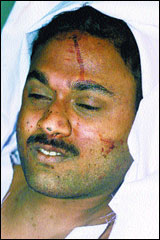
Jammu: Ghazi Baba stands next to Maulana Masood Azhar in the Jaish hierarchy. He is in Kashmir at the behest of Maulana and his Pakistani mentors to pursue the aim of dismembering India. Speaking chaste Urdu, thirty-nine plus Ghazi Baba was the mastermind behind the attack on Parliament. Known as ''brain'' among the organisational cadres of Jaish-e-Mohammed, he is not only well conversant with mountain guerrilla warfare tactics but also an expert in taking hostages. His real name is Shah Nawaz Khan and he hails from Bhawalpur in Pakistan. Operating from his hideouts in Kashmir, he is regarded as the best strategist in the outfit, intelligence sources told the Hindustan Times. Earlier, he used to operate from Bandipore and then shifted to Ganderbal. Repo-rts suggest he is now either in Tral or Pahalgam. Shah Nawaz received his schooling in Bhawalpur. In the 80s he went to Afghan-istan where he fought along with the forces of Gulbuddin Hekmatyar. After the Russians withdrew and the Najibullah regime collapsed, Khan came back to Pakistan. There, he was impressed by Maulana Masood Azhar, the then general secretary of Harkat-ul-Ansar, which was preparing an offensive against India. After Maulana Azhar was arrested near Anantnag in February 1994, Shah Nawaz Khan was entrusted the task of getting him released at any cost. Khan travelled from Pak-occupied Kashmir to the Valley and started organising his group. Sources said he organised the abduction of two Britishers in 1994, but they had to be freed due to international pressure. Khan then gave a front name of Al-Faran to the Harkat in July 1995 and took six foreigners hostage in Pahalgam. One escaped while another was murdered. He was the brain behind the hijacking of the Indian Airlines flight from Kathmandu in 1999 following which Maulana Azhar was released, the sources said. Ghazi was then asked to stay on and work on future strategies to strike at spectacular targets across India— one of them being the attack on Parliament.
New Delhi: Ghazi Baba— the supreme commander of the Jaish-e-Mohammad in India and the mastermind behind the December 13 terrorist attack on Parliament—is a restless person obsessed with the thought of brainwashing the Kashmiri youth to join militancy, according to Mohammad Afzal—the main conspirator in the attack. Ghazi Baba, who hails from Bahawalpur town of Punjab province in Pakistan and is working on the directions of Pak-based Jaish supremo Masood Azhar, is running terrorist training camps in Jammu and Kashmir, Afzal told ‘Aaj Tak’ news channel in an interview. His main motive is to get independence for Kashmir. Till then, he says, he won’t rest with peace, said Afzal who is in the custody of the special cell of Delhi Police. To a question as to how many terrorist training camps were being run in Jammu and Kashmir, Afzal said: I am aware of four such camps in Pahalgam and Kargil areas. Asked whether his mentor had planned other such attacks after the assault on Parliament, Afzal said: Ghazi Baba is a restless person. Once an action is complete, he starts planning the next one. I have spent a night with him. I slept but he never sleeps. He always thinks how to influence more and more boys to do something, he added. Afzal said that after the attack on Parliament, he was scheduled to meet Ghazi Baba at 1330 hours on Sunday (December 16) in Kashmir. However, he was arrested by the Jammu and Kashmir Police, alongwith his accomplice Shaukat Hussain in Srinagar on Saturday.