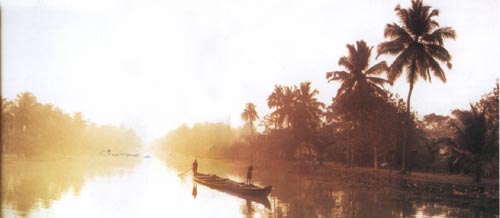
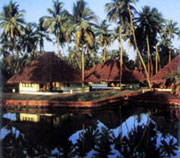
I'd have almost preferred not to go back to India. Over the last 20 years I'd made numerous journey's there. I'd seen most of what I wanted to see; and as much as I loved the daily pleasures of the culture, I felt done with the place. India was entering the 21st century with a billion people, and for me, the enchantment was wearing off. But I had not yet seen Kerala. And, now, on my very first morning here in this State on India's southwestern tip, I'm wondering if I've saved the best for last. For me, however, Kerala's draw is its unmatched reputation for performing arts. I've already been surprised by the high quality of the evening music at our resort. Usually it's a violinist, a singer, and a drummer on a long mridinga, often accompanying Mohiniattam dancer of languorous classical gestures, clad in gold and white. Good art is simply everywhere. The ultimate way to enjoy the backwaters, we find, is to stay a night or two on a converted kettuvallam, a cargo boat traditionally used for transporting, say, 30 tons of rice. The point is not to get anywhere, but to drift languidly through ethereal beauty. It is astonishingly romantic to watch the sunset from one kettuvallam among several, while the three boatmen hang lanterns and a pearly glow fades behind the scrim of palms. Dinner is an abundant 11 platters of keralan cuisine, built around subtly spiced fresh fish. As the coconut islands darken, the shimmering water doubles the infinite tree of stars. Walking at dawn we find ourselves surrounded by hundreds of fishermen's skiffs on immense Vembanad Lake. It's like time travel into a quiet morning of another century. ...the loveliest part of Fort Cochin is Jew Town, a traditional quarter of shuttered houses in ghost-shades of once audacious blues, greens, and ochres, often with a Star of David worked into the grillwork of a window. In earlier centuries a thousand Jews lived here. Most are gone-many old houses are now antique shops for foreign tourists - but the quarter remains the nerve center of Kerala's spice commerce. We tour the famous 16th-century synagogue, which is both simple and lavish, its white plank ceiling and plain walls contrasting with ornate hanging oil lamps and 1,100 blue and white Chinese floor tiles. Services are still held for the few remaining Jews. but none are here today. Wait a minute, advises the Indian guide. And, yes, an elderly, small-boned man of pale complexion stops by. At first he hesitates to talk. When I ask his name he says only, "Nameless", with a faint smile. "The Nameless Jew", I said, "My relatives, too. In the war." At this he thaws. "There are 15 of us left here. And only three are young, like you. What will be the future? I don't know. Whoever is left will decide. But India has never persecuted us. Not in two thousand years. This is the only country in the world where that is so. The Portuguese did, yes. But never the Indians." He opens ornate doors to reveal a silver-clad Torah, containing the five books of Moses, and a gold crown, a gift from local maharajahs back in 1805. "You see?" he says. "We were always welcome here." Again, that Kerala tolerance - the worldly tolerance of traders who've seen the value of their spices rise and fall across generations. |

|
National Geographic Traveler |
October 1999
April 2001
March 2002
London January 2001
February 2002
April 2000